
Introduction
Standard residential furniture fails fast in commercial care environments — and the consequences go well beyond aesthetics. In senior living communities, healthcare facilities, and multi-family properties, incontinence events are a daily operational reality, not an occasional accident.
CDC/NCHS data from long-stay nursing home residents found that 75.8% experienced bladder or bowel incontinence — and that figure covers only skilled nursing populations. Across assisted living, memory care, and behavioral health settings, the exposure frequency is even harder to quantify — but no less demanding on furniture.
That frequency translates directly into budget pressure. Furniture that wasn't built for repeated fluid exposure deteriorates structurally, harbors persistent odor, and triggers replacement cycles that put serious pressure on FF&E budgets. Worse, in regulated environments, compromised upholstery can generate infection control citations.
This guide gives facility operators and procurement specialists a practical framework: which materials hold up, which construction features to require, when to replace rather than clean, and how to build a protocol that protects what you've already purchased.
TL;DR
- Urine exposure is among the most damaging conditions commercial upholstered furniture faces — frequency and severity far exceed typical residential wear
- Primary material options include healthcare-grade performance fabrics (like Crypton), bleach-cleanable vinyl, and polyurethane — each suited to different settings
- Surface fabric alone isn't enough; fluid-resistant seat decks, sealed seams, and protected foam cores are just as important
- Even purpose-built fluid-resistant furniture requires a disciplined, product-specific cleaning protocol
- Reupholstery through a commercial partner like Neuco Furniture & Upholstery extends lifecycles at 50–70% of replacement cost
Why Urine-Proof Furniture Matters for Commercial Properties
The Exposure Gap Between Residential and Commercial
A pet accident at home might happen a few times a year. In a skilled nursing or memory care environment, incontinence events can occur multiple times daily across dozens of residents. Standard upholstered furniture — even quality residential-grade pieces — wasn't designed for that kind of sustained fluid exposure.
The foam absorbs, the frame degrades, and within 18–24 months, operators face replacement decisions that should have been addressed at procurement.
The regulatory dimension adds another layer. CMS Appendix PP (F584) requires facilities to maintain a safe, clean, comfortable, and homelike environment, with specific attention to odor and cleanliness. F880 mandates an active infection prevention and control program. Neither rule names a specific upholstery type, but surveyors have cited facilities under F584 specifically for furniture and bedding with persistent urine-like odor — making upholstery selection a compliance issue, not just a purchasing one.
The Total Cost of Ownership Argument
Compliance risk aside, procurement teams under budget pressure often default to purchase price. That calculation typically reverses within 2–3 years when standard furniture requires early replacement. The better framework is total cost of ownership across the furniture's full service life:
- Higher upfront cost of properly rated urine-resistant furniture, offset by longer service life
- Cleaning labor accumulated over a 5–10-year period
- Lost-use time when furniture is pulled from service for remediation
- Early replacement cost when standard upholstery fails within 2 years
- Warranty scope and what fluid-related failures it actually covers
Reupholstery is often the most cost-effective response when furniture frames are structurally sound but upholstery has failed. Source Bay's partnership with Neuco Furniture & Upholstery delivers reupholstery services at 50–70% of full replacement cost — a significant advantage when a facility is managing dozens of compromised seats at once.
Types of Urine-Resistant Materials and Fabric Solutions
Specifying urine-resistant furniture means navigating a range of material technologies — each with different performance thresholds, aesthetic options, and maintenance demands.
Healthcare-Grade Performance Fabrics
Crypton is the most widely specified performance fabric in healthcare and senior living environments. Its protection combines fiber-level stain resistance with an integrated moisture-barrier backing — not simply a surface coating. According to Crypton's technical specifications, contract woven fabrics achieve a minimum AATCC 127 hydrostatic resistance of 100 cm, a meaningful pressure-based barrier test that surface spray ratings don't replicate. The barrier warranty is documented at five years.
When specifying, request AATCC 127 hydrostatic data rather than spray-repellency ratings alone — they measure different things, and only hydrostatic pressure testing reflects real-world liquid penetration risk.
Teflon and similar topical treatments occupy the lighter end of the spectrum. They reduce surface wetting but don't provide a backing barrier. For incontinence-heavy environments, they're insufficient as the primary defense, though they may have a role in lower-risk hospitality settings.
Vinyl and Polyurethane Upholstery
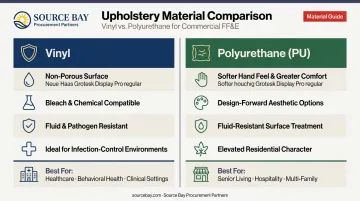
Where fabric solutions reach their limits, non-porous surfaces take over. Both vinyl and polyurethane are fluid-resistant by nature — but they serve different environments:
- Vinyl: Non-porous, bleach-cleanable, and durable under rigorous disinfection protocols. The go-to for healthcare, behavioral health, and transitional housing where chemical compatibility is non-negotiable. The category has moved well past its institutional aesthetic roots.
- Polyurethane (PU): Softer and more design-forward than vinyl. Fluid-resistant and pliable, making it a strong fit for senior living common areas and boutique hospitality settings where comfort and aesthetics are part of the brief.
Products within each category carry distinct approved cleaner lists, dilutions, and contact times — none of which are interchangeable:
- Momentum Silica Blend: 4:1 bleach ratio
- Crypton contract fabric: 10% bleach solution with a 10-minute contact time
Apply each manufacturer's instructions to the specific product in your specification.
Construction Features to Specify When Procuring Urine-Proof Commercial Furniture
Surface fabric is only one part of the system. Liquid that bypasses or penetrates the face material will reach the foam core and frame — that's where persistent odor and structural damage originate.
Fluid-Resistant Seat Decks
The thin fabric layer beneath removable seat cushions is one of the most commonly overlooked failure points in commercial upholstery specifications. When this layer uses standard woven fabric, urine that works past the seat cushion soaks directly into the frame and foam core beneath. Specifying a fluid-resistant seat deck (a moisture-barrier material replacing standard decking fabric) closes this pathway without requiring fully sealed upholstery across the entire piece.
Medline's healthcare furniture catalog documents this feature specifically for removable-cushion seating. It should be a standard ask in any procurement spec for incontinence-heavy environments.
Sealed Seams and Zipper Placement
Standard furniture seams and accessible zippers are direct pathways for fluid ingress. Specifying heat-sealed seam tape applied behind upholstery seams adds a secondary barrier at every stitch line. Global Furniture Group documents this construction detail in their healthcare seating specifications.
Zippers should be positioned away from high-contact surfaces: concealed or inverted zipper placement prevents fluids from tracking into the cushion interior through the closure point.
Foam Core and Frame Considerations
Even with sealed seams and protected seat decks, urine that reaches the foam core won't be addressed by surface cleaning alone. Moisture-barrier foam wraps or impermeable encasements create the final line of defense — preventing the absorption that drives persistent odor even when upholstery surfaces appear clean.
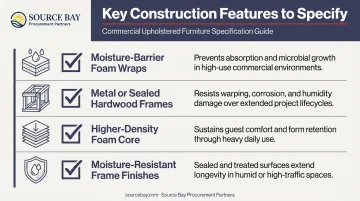
Frame and core specs worth including in any procurement document:
- Moisture-barrier foam wraps or encasements: Request named product specs and test data; practices vary significantly across manufacturers
- Metal frames or sealed hardwood: Repeated exposure causes untreated wood frames to swell, warp, and eventually develop mold
- Higher-density foam: Resists compression better than standard-grade foam under sustained heavy use
- Moisture-resistant frame finishes: Especially important in high-exposure settings where spills won't always be caught immediately
When reviewing a manufacturer's spec sheet, ask for a section drawing that shows the face material, backing treatment, seam construction, cushion-to-deck interface, and which components are field-replaceable.
Warning Signs: When Your Commercial Furniture Needs Attention or Replacement
Signs Fluid Has Reached the Core
These indicators suggest urine has moved past the upholstery surface and into the foam or frame:
- Persistent odor that remains after surface cleaning with an approved cleaner
- Staining that resurfaces after the fabric dries — a sign of subsurface saturation
- Tacky or discolored texture on vinyl or fabric that didn't exist prior to fluid exposure
When these signs appear, standard cleaning protocols won't resolve the problem. Professional deep cleaning or reupholstery is the appropriate next step. If the frame itself has been compromised, replacement is the only viable path forward.
Structural Deterioration Indicators
| Warning Sign | What It Indicates |
|---|---|
| Fabric delamination | Backing barrier has failed |
| Vinyl cracking or splitting | Surface integrity lost; no longer cleanable |
| Foam softening / seat compression | Core no longer provides safe support |
| Frame warping or swelling at joints | Structural moisture damage |
The Association for the Health Care Environment (AHE) identifies tearing, peeling, cracking, and splitting as conditions that directly impede effective cleaning. The CDC recommends recovering worn furniture with easily cleanable covers or replacing it. What drives the decision isn't a set lifespan — it's whether the piece can still be effectively cleaned. Once cleanability is lost, the furniture becomes a liability regardless of its age.
In regulated environments, the stakes are higher. Furniture that harbors bacteria or has compromised structural integrity can generate F584 citations during state inspections and create fall-risk concerns for residents. Document condition assessments at regular intervals and act on failed cleanability as an operational trigger.
Cleaning and Maintenance Protocol for Commercial Urine-Resistant Furniture
Purpose-built urine-resistant furniture slows fluid penetration significantly. It doesn't make furniture immune. What preserves performance over time is a disciplined, protocol-driven maintenance schedule applied consistently across all high-use areas.
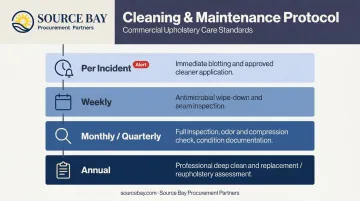
Recommended Cleaning Frequency
| Frequency | Action |
|---|---|
| Per incident (immediate) | Blot excess fluid with a clean cloth. Apply an approved commercial cleaner matched to the specific upholstery type. Do not let fluid dwell. |
| Weekly | Wipe all upholstered surfaces in high-use areas with an approved antimicrobial cleaner. Inspect seams, zippers, and seat decks for signs of penetration. |
| Monthly / Quarterly | Full inspection of all seating in incontinence-heavy areas. Check for odor, foam compression, frame stability, and surface deterioration. Document condition for asset tracking. |
| Annual | Professional deep clean or formal assessment. Evaluate whether any units require reupholstery or replacement. |
For annual refurbishment needs, Source Bay's partnership with Neuco Furniture & Upholstery offers an integrated solution — reupholstering compromised units with healthcare-grade materials rather than triggering full asset replacement, typically at a meaningful cost reduction compared to full unit replacement.
Cleaner Compatibility: A Non-Negotiable Requirement
Using the wrong cleaner — even a bleach solution that exceeds the manufacturer's specified dilution — can degrade surface performance, void warranties, and undermine the fluid-resistance properties of the upholstery.
- Crypton contract fabric: 10% bleach solution, 10-minute contact time, followed by rinsing
- Momentum Silica Blend: 4:1 bleach ratio (as documented on the manufacturer spec sheet)
- Other vinyls and PU fabrics: manufacturer documentation required — dilution ratios and contact times vary; applying bleach without verification risks surface degradation
Build a cleaner-compatibility reference into your procurement documentation at handoff — including product name, active chemistry, dilution ratio, wet contact time, rinse requirements, and any warranty exclusions tied to cleaner use.
Frequently Asked Questions
What is the best material for urine-proof furniture?
For commercial properties, healthcare-grade performance fabrics like Crypton and bleach-cleanable vinyl or polyurethane are the primary options. Vinyl excels where disinfection frequency is highest; performance woven fabrics offer more comfort and aesthetic range for senior living common areas. The right choice depends on incontinence frequency, cleaning protocols, and design requirements.
Will urine smell in a couch go away?
Surface odor can be reduced with cleaning, but urine that reaches the foam core or frame typically requires professional deep cleaning or reupholstery to resolve. In commercial settings, fluid-resistant seat decks are the most effective way to prevent penetration from occurring.
What is the difference between fluid-resistant and waterproof upholstery for commercial use?
Fluid-resistant upholstery (like Crypton) slows penetration but can absorb fluid if left untreated. Fully waterproof materials like vinyl create a non-porous barrier. Both work in commercial settings — the right choice comes down to exposure frequency and cleaning protocols.
Is vinyl or Crypton fabric better for senior living communities?
Crypton and similar performance fabrics generally offer a better balance of comfort, aesthetics, and fluid resistance for independent and assisted living settings. Vinyl excels in memory care and skilled nursing environments where bleach-cleanability and ease of disinfection are the priority over tactile comfort.
How often should urine-resistant commercial furniture be professionally deep cleaned?
Annual professional deep cleaning is a reasonable baseline for most commercial environments. Memory care, skilled nursing, and other high-incontinence areas warrant more frequent professional attention. Consistent daily and weekly maintenance significantly extends the intervals between professional cleaning cycles.
Can urine damage commercial furniture frames over time?
Yes. Repeated exposure that goes uncleaned can penetrate past upholstery and cause wood frame swelling, mold growth, and structural weakening. Fluid-resistant seat decks, sealed finishes, and prompt cleaning are baseline requirements in any commercial procurement specification.