That complexity makes fragmented, vendor-by-vendor procurement a persistent liability. When a dozen vendors are managing different scopes without coordination, timelines slip, specifications conflict, and compliance gaps appear exactly where they're most costly.
According to NIC, senior housing occupancy reached 89.1% in Q4 2025 after 18 consecutive quarters of growth — while fewer than 1,900 new units opened that same quarter. Demand is rising faster than supply, which means every campus renovation, expansion, and new build needs to deliver efficiently, on schedule, and to a standard that justifies the investment.
Turnkey facility solutions are how the best operators are meeting that standard.
Key Takeaways
- Consolidating sourcing, procurement, logistics, and installation under one process eliminates vendor fragmentation and reduces project risk
- Five solution categories matter most: FF&E procurement, life-safety compliance, wellness environments, dining infrastructure, and smart building technology
- Life-safety and environment-of-care failures carry the highest regulatory consequences, including admission restrictions and civil money penalties
- Dining and FF&E quality directly drive resident satisfaction scores — measured, not assumed
- Senior living projects require a partner with sector-specific regulatory knowledge, not just general commercial experience
What Are Turnkey Facility Solutions for Senior Living Campuses?
A turnkey facility solution is a fully managed service where a single partner, or tightly coordinated team, handles sourcing, procurement, logistics, installation, and final handoff of physical assets for a campus. The alternative is the traditional model: separate vendors for furniture, technology, kitchen equipment, and compliance systems, each managed independently by an already-stretched operations team.
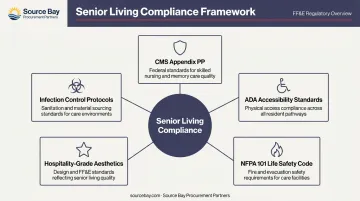
The difference matters more in senior living than almost any other environment. Facilities must meet:
- CMS Appendix PP requirements under 42 CFR 483.80 (infection control) and 483.90 (physical environment)
- ADA accessibility standards for routes, grab bars, fixture heights, and bathing rooms
- NFPA 101 Life Safety Code (2012 edition) for fire suppression, egress, and corridor requirements
- Hospitality-grade aesthetics that residents and families evaluate against market alternatives
- Infection-control protocols requiring cleanable, antimicrobial-compatible surfaces throughout
Managing those requirements across multiple uncoordinated vendors creates both operational strain and real compliance exposure.
For operators planning new builds, expansions, or campus-wide renovations, understanding which solution categories carry the most risk — and where a single coordinated partner changes the outcome — is where planning has to start.
Best Turnkey Facility Solutions for Senior Living Campus Operations
Each category below was evaluated on its operational relevance to senior living, the risk of managing it independently, and the degree to which a coordinated turnkey approach creates measurable value.
Turnkey FF&E Procurement & Interior Design
FF&E — Furniture, Fixtures, and Equipment — is the largest single category of physical asset procurement in most senior living projects. Resident room furnishings, custom textiles, dining chairs, common area lounge seating, case goods, lighting fixtures, and window treatments all fall within this scope. Sourcing these independently from separate vendors introduces schedule risk, specification inconsistencies, and budget overruns that compound across a large campus.
What separates a strong turnkey FF&E approach in senior living is the ability to bridge design intent with operational reality. Every fabric selection, fixture height, and furniture specification must satisfy two simultaneous requirements: the aesthetic vision of the community and the durability, infection-control, and ADA standards of a care environment.
Those requirements aren't always compatible — and resolving them at the sourcing stage, rather than after installation, is where a coordinated procurement partner earns its value.
J.D. Power's 2025 senior living satisfaction study found that independent living satisfaction rose 25 points, with buildings and grounds up 21 points. Assisted living and memory care family satisfaction rose 12 points. Interior quality isn't cosmetic — it's a measurable driver of resident and family satisfaction that directly affects occupancy.
Firms like Source Bay Procurement Partners bring together senior living-specific manufacturer relationships — including Kellex Furniture for senior living seating, Schumacher and Fabricut for custom textiles, Serta for commercial sleep solutions, and Remington Lighting for custom fixtures — to source products that meet both hospitality-grade aesthetics and care environment standards.
| Details | |
|---|---|
| Core Service Scope | Design consultation, custom textile and finish sourcing, manufacturer procurement, freight coordination, sequenced warehousing, on-site installation, final project handoff |
| Key Senior Living Requirements | Antimicrobial and easy-clean fabrics, weight-bearing and fall-resistant furniture, ADA-compliant fixture heights, durable commercial-grade construction |
| Turnkey Value Add | Single point of accountability from design brief to move-in ready space; reduced vendor management burden; on-schedule, on-budget delivery |

Turnkey Life-Safety, Compliance & Accessibility Upgrades
This category carries the highest regulatory risk of any solution area. Life-safety systems — fire suppression, emergency egress lighting, nurse call infrastructure, grab bar installation, and ADA path-of-travel compliance — are subject to CMS survey oversight, state health department licensing, NFPA 101 requirements, and local building codes simultaneously.
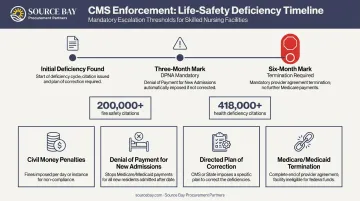
The consequences of deficiencies here are serious. CMS enforcement tools include civil money penalties, denial of payment for new admissions (DPNA), directed plans of correction, and termination from Medicare and Medicaid.
Timelines are unforgiving: DPNA becomes mandatory if substantial compliance isn't achieved within three months, and termination is required if facilities remain non-compliant at six months.
The scale of exposure is visible in CMS data: the CMS Fire Safety Deficiencies dataset currently contains over 200,000 citation rows from the last three years, alongside more than 418,000 health deficiency citation rows in the Health Deficiencies dataset. A 2023 OIG audit of Georgia nursing homes found 155 deficiencies across 19 of 20 facilities reviewed, including 71 life-safety deficiencies alone.
A coordinated compliance upgrade program addresses this by ensuring all systems are specified, procured, installed, and documented together — creating an audit-ready record from day one. The best partners also understand how to execute compliance work in occupied buildings, where minimizing resident disruption is as important as the installation itself.
| Details | |
|---|---|
| Core Service Scope | ADA accessibility assessment, grab bar and handrail installation, fire suppression system upgrades, emergency lighting, egress path compliance, nurse call system integration |
| Key Senior Living Requirements | State and CMS regulatory alignment, infection-control-compliant materials, minimal resident disruption during installation |
| Turnkey Value Add | Consolidated compliance documentation, reduced risk of inspection deficiencies, coordinated scheduling across all trades |
Turnkey Wellness & Therapeutic Environment Setup
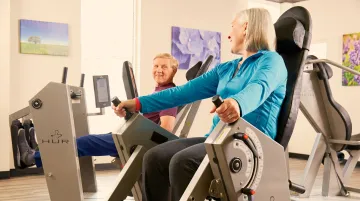
Wellness programming has become a primary differentiator in senior living — and the physical environments that support it require careful, specialized procurement. Fitness centers, spa and salon facilities, rehabilitation spaces, meditation rooms, and accessible outdoor areas each have distinct equipment sourcing requirements, ADA-compliant layout considerations, and safety specifications.
Memory care environments add another layer of complexity. Research into dementia-friendly design identifies visual access, spatial orientation, safety, privacy, and access to outdoor space as core design domains. In nursing homes where 61–90% of residents have ADRD or cognitive impairment, about 20% operate special care units. Those units require sensory-appropriate materials, fall-risk mitigation in layout design, and therapeutic equipment specified for the cognitive and physical range of that population.
The fall-risk dimension alone justifies a coordinated approach: peer-reviewed research in long-term care indicates approximately 50% of older long-term care residents fall annually, with incidence at 1.7 per person-year. Layout decisions and equipment anchoring made during procurement directly affect that risk.
A turnkey wellness environment solution delivers a cohesive design-to-installation process that accounts for these realities. The goal is therapeutic functionality that doesn't feel clinical — spaces residents actually want to use.
| Details | |
|---|---|
| Core Service Scope | Fitness and rehabilitation equipment procurement, spa and salon fixture setup, accessible outdoor furniture, sensory room design for memory care units |
| Key Senior Living Requirements | Age-appropriate equipment specifications, fall-risk mitigation in layout design, sensory-friendly materials for memory care environments |
| Turnkey Value Add | Integrated design and procurement reduces specification gaps; coordinated installation prevents equipment mismatches; finished environments ready for programming on day one |
Turnkey Dining & Commercial Kitchen Infrastructure
Dining consistently ranks among the top factors in resident satisfaction and family decision-making. Outfitting a senior living dining program means coordinating commercial kitchen equipment, dining room FF&E across multiple venues, specialty dishware and adaptive service equipment, and often point-of-sale or dietary management technology — all within a single campus.
J.D. Power's 2025 data shows dining satisfaction drove 11 points of the assisted living gains. The regulatory dimension is equally demanding: CMS Appendix PP includes F812, governing food procurement, storage, preparation, and service sanitation, and the FDA Food Code provides the baseline model for safe food handling in these environments.
Dining infrastructure also carries a clinical dimension that commercial kitchen vendors often overlook. ASHA guidelines for adult dysphagia recommend texture modifications, thickened liquids, and adaptive equipment depending on assessment.
That means tableware, serving equipment, and kitchen specifications all need to account for residents with swallowing difficulties — a requirement that only surfaces when someone at the procurement table understands the care environment.
The turnkey advantage here is alignment: a single partner managing all dining and kitchen infrastructure ensures that front-of-house design and back-of-house equipment specifications are coordinated, that delivery and installation is properly sequenced, and that the completed space meets both health department standards and the hospitality-grade experience families evaluate during tours.
| Details | |
|---|---|
| Core Service Scope | Commercial kitchen equipment sourcing and installation, dining room furniture and fixture procurement, specialty dishware and service equipment, private dining and café space outfitting |
| Key Senior Living Requirements | Health department and food safety compliance, adaptive dining equipment for residents with mobility or swallowing difficulties, multi-venue coordination across campus |
| Turnkey Value Add | Coordinated front-of-house and back-of-house specification; sequenced delivery and installation; commissioning support to ensure all equipment is operational before opening |
Turnkey Smart Building & Technology Integration
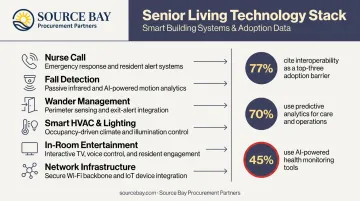
Technology infrastructure in senior living now spans nurse call systems, fall detection sensors, wander management for memory care, smart HVAC and lighting controls, in-room entertainment and communication systems, and robust wired and wireless network infrastructure. These systems must interoperate, and they must be installed with minimal disruption to an occupied building.
Argentum's 2025 technology report found 77% of respondents rank interoperability as a top-three barrier to technology implementation. Yet adoption is accelerating: 70% of respondents report using predictive analytics and 45% use AI-based health monitoring. That adoption only delivers value when the underlying infrastructure is built to support it.
HIPAA adds a compliance layer that not all technology vendors navigate well. When systems create, receive, maintain, or transmit electronic protected health information for covered entities, the HIPAA Security Rule applies — making data governance requirements a specification-stage decision, not a post-installation fix.
Key infrastructure considerations include:
- Network design: Wired and wireless architecture built for device density, not just general use
- Life-safety redundancy: Nurse call and emergency response systems on independent power and failover paths
- Data governance: HIPAA-compliant configuration documented at commissioning, not retrofitted later
- Scalability: Physical infrastructure sized to accommodate technology adoption still in development
Installing robust infrastructure during construction or renovation is significantly less costly than retrofitting later. A turnkey technology integration solution provides end-to-end coordination of system specification, vendor procurement, installation sequencing, and commissioning — ensuring all systems are properly integrated and that the physical infrastructure supports both current and future technology needs.
| Details | |
|---|---|
| Core Service Scope | Network infrastructure design and installation, nurse call and emergency response systems, fall detection and wander management, smart room controls (HVAC, lighting, entertainment), telehealth connectivity |
| Key Senior Living Requirements | HIPAA-compliant data management, life-safety system redundancy, low-disruption installation protocols in occupied buildings, scalability for emerging technologies |
| Turnkey Value Add | Single-source accountability for system interoperability; future-proofed infrastructure; reduced risk of post-opening technology failures |
How to Choose the Right Turnkey Facility Solutions Partner
The most common evaluation mistake is leading with price. A vendor who wins on initial cost but lacks senior living-specific regulatory knowledge will generate change orders, compliance deficiencies, and schedule delays that erode any savings within the first few months.
Evaluate prospective partners on these criteria:
- Senior living-specific experience — demonstrated knowledge of CMS survey requirements, ADA standards in care environments, and the operational realities of occupied senior living buildings
- Manufacturer and vendor network depth — direct relationships with suppliers who produce products built for care environments, not general commercial substitutes
- In-house logistics and warehousing — sequenced delivery capability that coordinates installation around occupied buildings and minimizes resident disruption
- Design-to-handoff accountability — a single point of contact who manages the full lifecycle from design brief through final installation, not a firm that fragments responsibilities across disconnected teams
- Handles both single-building renovations and multi-site campus rollouts with consistent process and documentation
Source Bay Procurement Partners illustrates what this looks like in practice for the FF&E category. Their four-phase model covers Discovery, Sourcing, Logistics, and Installation — built specifically around the intersection of architectural intent and operational reality.
With Senior Designer Barbara Church embedded in the sourcing process and operations leads Paul Tomczak and Greg McKinnon managing freight and sequenced warehousing, design decisions and logistics decisions happen in coordination rather than in sequence. The partnership with Neuco Furniture & Upholstery adds an integrated refurbishment capability that's particularly valuable for operators managing phased renovations in occupied communities.
The strongest partners also deliver clear documentation at handoff — not just a completed project, but an audit-ready record that supports future inspections, phased expansions, and informed asset replacement decisions.
Conclusion
Senior living campus operations demand a level of precision that fragmented procurement fails to deliver. Vendor-by-vendor sourcing creates specification gaps, compliance blind spots, and schedule vulnerabilities that cost operators far more than any initial price advantage.
Each solution category covered here — FF&E, life-safety, wellness environments, dining infrastructure, and technology integration — rewards a coordinated approach. Single-source accountability shortens timelines, closes compliance gaps, and produces environments residents and families notice from day one.
When evaluating partners, look past the portfolio and press on accountability: who owns the project from design brief through final handoff, and what documentation exists at every stage? That single question separates procurement partners from procurement vendors — and the answer shapes a community's compliance standing, resident experience, and asset value for years.
Source Bay Procurement Partners manages that accountability across every phase — from initial design consultation through move-in-ready FF&E installation. To discuss your next senior living campus project, reach out at hello@sourcebay.com or (231) 943-3455.
Frequently Asked Questions
What is the 80/20 rule in senior communities?
The 80/20 rule in senior living refers to a federal requirement under the Housing for Older Persons Act (HOPA): at least 80% of occupied units must be occupied by at least one person age 55 or older for a community to qualify as age-restricted housing under 24 CFR Part 100. This standard shapes how communities are designed, marketed, and legally classified.
What is the average monthly cost of a senior living facility?
Costs vary significantly by care level and geography. The national median for assisted living is $6,200 per month (CareScout, 2025), while memory care averages $8,399 per month according to AARP citing 2023 NIC statistics. Facility quality, amenities, and FF&E standards are among the factors that influence where a community falls within regional pricing tiers.
What does a turnkey FF&E procurement solution include for senior living?
A turnkey FF&E solution covers the full scope from design consultation and product specification through manufacturer procurement, freight management, sequenced warehousing, on-site installation, and final project handoff — with one partner accountable from brief to move-in ready. This eliminates the need for operators to coordinate multiple vendors independently.
How do you balance aesthetics and compliance in senior living interior design?
The most effective approach is sourcing from manufacturers who engineer hospitality-grade products to meet healthcare durability and safety standards, including antimicrobial fabrics, ADA-compliant fixture specifications, and impact-resistant finishes. Design quality and regulatory compliance are achieved together, not treated as competing priorities during value engineering.
What should I look for when selecting a turnkey facility solutions partner for a senior living project?
Prioritize senior living-specific regulatory experience, manufacturer network depth, and in-house logistics and warehousing capabilities. Beyond credentials, confirm the partner maintains a single point of accountability from design brief through final handoff and can provide documentation that supports compliance and asset management after the project closes.