Introduction
Hotel lounges carry a disproportionate share of a property's brand identity. A guest forms their first impression of a hotel within seconds of entering the lobby — and that impression is shaped almost entirely by the lounge furniture, lighting, and textiles surrounding them.
That makes lounge FF&E procurement one of the most consequential purchasing decisions a hotel ownership team will make. It's also one of the most complex. Unlike guestroom procurement — where furniture serves one guest at a time in a private space — lounge pieces face continuous, multi-guest, multi-purpose use across food and beverage service, social gatherings, and informal work sessions, often 16+ hours a day.
The core tension is real: lounge furniture must balance sophisticated aesthetics with commercial durability, brand alignment with budget constraints, and long lead times with tight opening schedules.
According to HVS, brand standard requirements and extended furniture lead times can add significant logistics costs to renovation budgets. That pressure makes early, structured procurement planning one of the most important decisions a project team will make.
This guide covers how experienced procurement teams approach lounge FF&E: from setting budgets and evaluating commercial durability to managing vendor lead times, coordinating phased delivery, and aligning every piece with brand standards before opening day.
Key Takeaways
- Lounge procurement demands public-use durability standards, not residential benchmarks.
- Specify commercial-grade construction and verified fabric ratings (BIFMA, ACT) before finalizing aesthetics.
- Budget against total delivered cost, not unit price alone.
- A single procurement partner reduces timeline risk and eliminates multi-vendor coordination overhead.
What Sets Hotel Lounge Furniture Procurement Apart
Hotel lounges are not single-purpose rooms. A lobby lounge might host a business meeting at 9am, a cocktail service at 7pm, and a late-night social gathering at midnight — all using the same chairs. That operational reality reshapes how procurement must approach these spaces.
Multi-Zone Environments Require Distinct Typologies
A single lounge floor plan typically contains multiple distinct zones: entry seating clusters, conversational groupings, bar and counter-height seating, banquette configurations, and transitional accent areas. Each zone carries different ergonomic requirements, durability demands, and aesthetic roles — yet all must read as a single cohesive design language.
This means procurement must account for multiple furniture typologies simultaneously:
- Upholstered club chairs and sofas for conversational clusters
- Bar stools and counter-height seating for bar areas
- Banquettes for fixed perimeter seating
- Cocktail and accent tables at varying heights
- Ottomans and occasional accent pieces for flexibility
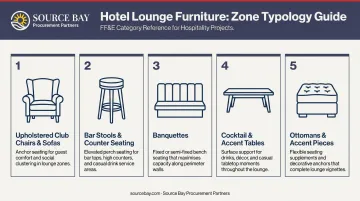
Managing these as separate purchase decisions — rather than a coordinated scope — is one of the most common mistakes hotel procurement teams make.
The Durability Gap Nobody Plans For
Getting the typologies right is only half the challenge — what the furniture is made of matters just as much as where it's placed.
BIFMA reaffirmed ANSI/BIFMA X5.4-2020 (R2025) specifically for public and lounge seating, a distinct standard from residential or private-space furniture. As the Polyurethane Foam Association confirms, commercial furniture in hotels and restaurants faces far more intensive use than residential equivalents, requiring higher-quality, more specialized materials throughout.
Under-specifying lounge seating to residential-grade standards doesn't save money. It accelerates replacement cycles and creates mismatched replacement challenges when original fabrics are discontinued.
Brand Compliance Adds Real Schedule Risk
For branded hotel properties, lounge furniture must clear brand prototype approval cycles before production begins. This adds documentation requirements, sample review rounds, and approval wait times that belong in the procurement schedule from day one. Cornell University's hotel public-space design curriculum frames hotel public spaces as revenue-generating, guest-facing environments, which is precisely why brand operators treat lounge furniture specification with the same rigor as guestroom standards.
Lounge spaces are also the most photographed areas of any hotel property. Finish inconsistencies and textile color inaccuracies that would go unnoticed in a guestroom become immediately visible in a lounge.
How to Select the Right Furniture for Hotel Lounge Spaces
Start With Zone-by-Zone Analysis, Not Product Selection
Procurement should begin with the floor plan, not the catalog. A zone-by-zone analysis — identifying seating clusters, bar areas, circulation zones, and focal points — establishes the functional brief before any product selection begins.
Each zone drives different product specifications:
| Zone | Primary Typology | Key Specification Priority |
|---|---|---|
| Entry/conversational clusters | Club chairs, sofas | Ergonomics, visual weight |
| Bar area | Bar stools, counter seating | Height, footrest durability |
| Perimeter/fixed | Banquettes | Frame rigidity, COM execution |
| Transitional | Accent tables, ottomans | Surface durability, flexibility |
Selecting seating to fill square footage — rather than to support operational flow — produces spaces that look right in renderings but fail in use.
Commercial-Grade Construction: What It Actually Means
Once zones are mapped, construction specification becomes the next filter. "Commercial grade" is not a marketing claim. For lounge seating, it refers to specific, verifiable standards:
- Kiln-dried hardwood or welded steel frames — not particleboard or finger-jointed wood
- Woven upholstery rated to 30,000 Wyzenbeek double rubs (per ACT Voluntary Performance Guidelines for high-traffic/public spaces); coated upholstery in the same environments requires 50,000 double rubs
- Hardware and joinery cycle-tested for continuous public use, not residential load assumptions
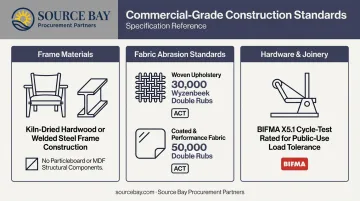
One note on fabric specification: ACT explicitly cautions that abrasion results above 100,000 double rubs have not been shown to reliably indicate longer fabric lifespan, and results on identical textiles can vary by 60% or more.
Chasing ever-higher rub counts beyond verified thresholds is not a reliable procurement strategy. Specifying to ACT-verified thresholds for the actual traffic level is.
COM and COL: Custom Fabric Execution at Commercial Specification
COM (Customer's Own Material) and COL (Customer's Own Leather) allow procurement teams to specify custom upholstery fabrics outside a manufacturer's standard offering — a common requirement in branded lounge environments. Keilhauer's contract pricebook, for example, formally defines both terms and notes that manufacturers may reject unsuitable COM/COL submissions.
Before releasing any COM/COL order, confirm:
- The manufacturer has reviewed and approved the specific fabric for their construction process
- Cut-and-sew samples have been produced and approved at commercial specification
- The fabric meets ACT performance thresholds for the intended traffic level
Source Bay Procurement Partners works with textile partners including Schumacher and Fabricut — both contract suppliers with deep hospitality portfolios — to specify fabrics appropriate for high-traffic lounge environments. COM/COL evaluation can be coordinated through its manufacturer network.
Proven Procurement Strategies for Hotel Lounge FF&E
Consolidated Vendor Management Reduces the Largest Risk
Lounge FF&E projects routinely involve upholstered seating, case goods, custom lighting, textiles, and decorative accessories — often sourced from five or more different manufacturers with misaligned lead times. Managing each of those vendor relationships separately, across a single project, is where timelines collapse.
A consolidated procurement model — where a single firm manages all vendor relationships, purchase orders, freight coordination, and delivery sequencing under one project management structure — directly addresses this risk.
Source Bay Procurement Partners serves as that single point of accountability across the full lounge FF&E scope — managing manufacturer sourcing through their global partner network (Blue Leaf Hospitality for case goods and upholstered furniture, Remington Lighting for custom fixtures, Schumacher and Fabricut for textiles), freight coordination, sequenced warehousing, and final project handoff.
Attic Stock: A Non-Optional Line Item for Upholstered Lounge Pieces
Procuring additional upholstered pieces and COM fabric yardage at the time of initial order is standard practice in hospitality lounge procurement — not an optional add-on. A single damaged chair or discontinued fabric creates a costly mismatched replacement problem years later when the original production run is no longer available.
The right quantity depends on damage risk, lead times, and manufacturer reorder minimums for each specific product. Calculate attic stock per item rather than applying a generic percentage across the full scope.
Supplier Vetting: Four Non-Negotiable Checkpoints
Before placing any lounge FF&E order, vet manufacturers across these four gates:
- BIFMA X5.4 applicability — Does the product meet the public/lounge seating standard?
- ACT textile performance by traffic level — Can the manufacturer provide test results for the specified fabric at the appropriate threshold?
- COM/COL approval capability — Will the manufacturer review and approve the custom fabric before production?
- Sustainability documentation — Does the manufacturer participate in recognized programs such as MindClick, EcoVadis, FSC, or BIFMA e3?
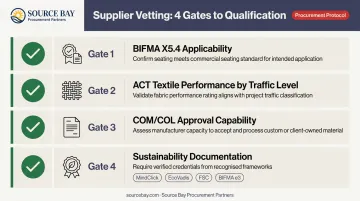
On sustainability: Hilton's 2024 Travel With Purpose report states that 42% of key suppliers in the Americas and EMEA now hold EcoVadis ratings, and Hilton uses MindClick data to assess FF&E. Marriott requires approved North American FF&E vendors to participate in MindClick's Sustainability Assessment Program. For branded properties, supplier sustainability documentation has moved from differentiator to baseline procurement requirement.
Sequenced Delivery Protects the Project Schedule
Lounge furniture should not arrive before the space is ready for installation. Construction sites expose upholstered pieces to dust, moisture, and physical damage that can render a $2,000 club chair unusable before it ever sees use.
Experienced procurement teams use staged warehouse releases — holding finished goods until installation windows are confirmed — to protect furniture condition and keep the project on schedule. Source Bay's logistics phase is built around sequenced warehousing specifically coordinated to match project timelines, ensuring nothing reaches the site before it can be properly received and installed.
Budgeting and Managing Lead Times for Lounge FF&E
Total Delivered Cost Is the Only Reliable Budget Framework
The catalog unit price of a lounge chair is not what the lounge chair costs. Freight, warehousing, installation labor, and attic stock all add to the delivered and installed cost. Procurement teams who budget from catalog pricing alone routinely face overruns when those additional components arrive as invoice line items.
Build budgets from verified cost drivers:
- Product cost (negotiated, not list price)
- Freight (domestic or international, dimensional weight implications for oversized upholstered pieces)
- Warehousing (especially critical when construction delays push delivery windows)
- Installation labor
- Attic stock (fabric yardage and additional upholstered pieces)
- COM/COL approval samples
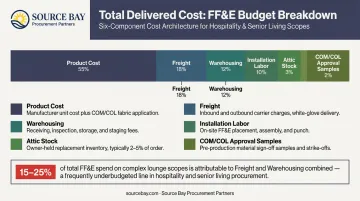
The HVS cost estimating framework notes that long furniture lead times can add significant logistics costs to hotel renovation budgets — freight and warehousing routinely represent 15–25% of total FF&E spend on complex lounge scopes.
Custom vs. Program Pieces: When Each Makes Sense
| Factor | Custom Pieces | Program/Semi-Custom |
|---|---|---|
| Lead time | Longer (confirm with each manufacturer) | Shorter; some contract suppliers offer quick-ship programs |
| Per-unit cost | Higher | More predictable |
| Design fit | Optimal for brand differentiation | May require compromise |
| Replacement sourcing | Complex if discontinued | Easier reorder path |
Choose fully custom when the lounge design requires pieces that don't exist in contract catalogs, when COM/COL application is essential to the design concept, or when a flagship property justifies the premium for spatial fit and brand differentiation.
Choose program or semi-custom when budget and timeline are constrained, when the design concept works within available configurations, or when replacement sourcing simplicity is a priority.
Note: Some contract manufacturers offer quick-ship lounge seating programs for smaller quantities. Encore Seating, for example, offers lounge seating and tables within 15 business days for qualifying orders up to 10 units per model. This can help fill gaps in a phased installation, but it doesn't apply to full-scope lounge procurement where lead times are longer and more variable.
These timeline risks are worth confirming before any purchase order is placed:
Key logistical risks to confirm before ordering:
- Elevator and corridor clearance for oversized sectionals and large banquettes
- Freight consolidation strategy for multi-vendor orders with misaligned ship dates
- Written lead-time commitments in purchase orders with production milestone update intervals
Sustainability, Brand Compliance, and Refurbishment Planning
Sustainable Specification Is Now a Standard Requirement
FSC chain-of-custody certification for wood frames, GREENGUARD certification for low chemical emissions, and BIFMA e3 (now in its sixth edition, e3-2024) are standard procurement requirements at major hotel groups — not optional upgrades. Vetting lounge furniture suppliers on documented sustainability data, rather than marketing language, is the only defensible approach for branded properties.
Proactive Refurbishment Over Reactive Replacement
Lounge furniture tends to show aesthetic aging before guestroom casegoods — guests notice faded upholstery and worn lounge seating faster than they notice guestroom wear. A proactive refurbishment strategy, rather than waiting for full replacement cycles, gives hotel operators a cost-effective path to maintaining design currency.
For properties where replacing structurally sound pieces isn't the right financial call, reupholstering, refinishing, and restoring existing lounge chairs and sofas extends asset lifecycle at a fraction of full replacement cost. Source Bay's partnership with Neuco Furniture & Upholstery is built specifically around this capability.
Where custom upholstery and COM fabrics represent significant original investment, refurbishment preserves that investment while keeping the aesthetic current — no procurement cycle required.
Brand Compliance Documentation: Maintain a Complete FF&E Specification Record
Branded hotel properties must maintain a clear FF&E specification record for all lounge pieces to support brand standard audits and future replacement sourcing. At minimum, this record should include:
- Manufacturer name and model number
- Finish code and colorway designation
- Fabric pattern, colorway, and COM yardage per piece
- Purchase order dates and vendor contact information
Without this record, replacing a single damaged lounge chair years after opening can become a multi-week research project — or result in a visible mismatch that fails the next brand audit.
Frequently Asked Questions
What is procurement in the hotel industry?
Hotel FF&E procurement is the end-to-end process of sourcing, purchasing, coordinating, and delivering all furniture, fixtures, and equipment required to outfit a hotel. It spans initial vendor selection and purchase orders through freight management, warehousing, and final installation — not simply the act of buying furniture.
Where do hotels buy their furniture from?
Hotels source furniture through contract furniture manufacturers, hospitality-focused wholesalers, or professional FF&E procurement firms. Procurement firms like Source Bay manage vendor relationships, negotiate pricing, and coordinate delivery — consolidating what would otherwise be dozens of separate supplier relationships into a single managed scope.
What type of furniture is used in a hotel lounge?
Hotel lounge furniture typically includes upholstered club chairs and sofas, banquette seating, bar stools and counter-height seating, cocktail and accent tables, ottomans, and occasional accent pieces. All pieces should be specified to commercial-grade construction standards, not residential equivalents.
How long does hotel lounge furniture typically last before needing replacement?
Properly specified commercial-grade lounge furniture typically lasts 8–12 years structurally. However, most hotels refresh lounge aesthetics every 5–7 years through reupholstery and refurbishment programs to maintain brand currency and design relevance without incurring the full capital cost of replacement.
What is a typical lead time for hotel lounge furniture procurement?
Lead times vary by product type. Quick-ship programs for standard configurations typically run 4–8 weeks; fully custom upholstered lounge seating commonly requires 14–20 weeks from purchase order to delivery. Confirm lead times in writing and build your procurement schedule backward from the opening date.
Should hotels work with a procurement agent or source lounge furniture directly?
For complex lounge projects spanning multiple product categories and tight timelines, a professional FF&E procurement agent brings established manufacturer relationships, consolidated project management, freight coordination, and quality oversight under one scope. Direct sourcing is possible but shifts all vendor management, logistics, and compliance responsibilities onto the hotel team.