A wrong choice here isn't just inconvenient. Specification mismatches, delayed openings, fire code compliance failures, and furniture that needs replacing within three years of installation are all real consequences of poorly vetted manufacturer relationships. For hospitality developers, senior living operators, and commercial project managers, these aren't hypothetical risks.
This guide covers what custom commercial furniture is, how it differs from standard contract products, the criteria that actually matter when vetting manufacturers, and how an experienced FF&E procurement partner can reduce your exposure across all of it.
Key Takeaways
- Custom commercial furniture is engineered to meet durability, compliance, and aesthetic standards that residential or off-the-shelf products cannot match
- Manufacturer vetting must cover customization depth, certifications, lead times, material specs, and after-sales terms — pricing is only one factor
- Skipping prototype review and underestimating delivery logistics are the two most common and costly procurement mistakes
- The right manufacturer relationship is a long-term strategic partnership built on accountability and repeat performance
- An experienced FF&E procurement partner reduces risk, protects timelines, and connects you to vetted global manufacturers
What Is Custom Furniture for Commercial Spaces?
Custom commercial furniture is designed, specified, and manufactured to meet the precise functional, aesthetic, and compliance requirements of a specific commercial environment — not off-the-shelf residential furniture, and not semi-custom contract products with limited configuration options.
The category spans seating, casegoods, upholstered pieces, lighting fixtures, textiles, and sleep solutions. These products appear across hospitality, senior living, multi-family, healthcare, education, and government facilities.
How It Differs from Residential and Standard Contract Furniture
Commercial-grade furniture must meet stricter durability thresholds that residential products aren't built to satisfy. For upholstery, the Association for Contract Textiles (ACT) voluntary performance guidelines set the benchmark: high-traffic/public woven upholstery should achieve 30,000 Wyzenbeek double rubs or 40,000 Martindale cycles, while high-traffic coated upholstery should reach 50,000 Wyzenbeek double rubs. Residential furniture carries no such requirement.
Those durability requirements intersect with a distinction worth clarifying: contract furniture refers to furniture ordered for commercial use under a specification contract, while custom means it's manufactured to a unique project specification. Most high-end commercial projects require both — custom contract furniture that combines precision manufacturing with commercial durability standards.
Sectors That Commonly Specify Custom Furniture
| Sector | Primary Driver |
|---|---|
| Luxury hotels & boutique properties | Brand-differentiated design, guest experience |
| Senior living communities | Safety compliance, accessibility, comfort |
| Multi-family developments | Unit consistency at scale |
| Healthcare facilities | Infection control, durability |
| Corporate & government spaces | Ergonomic and functional standards |
Key Factors When Choosing a Custom Commercial Furniture Manufacturer
Custom commercial furniture procurement is not one-size-fits-all. What works for a boutique hotel renovation won't suit a 300-unit senior living opening. The following criteria bridge design intent with operational outcome.
Manufacturing Capabilities and Customization Depth
The real question isn't whether a manufacturer does custom work — it's how deep that customization goes. Can they match exact dimensions from design documents? Produce proprietary joinery? Finish-match to an architect's spec? Work with mixed materials on a single piece?
Ask to see evidence of similar custom orders completed at similar scale. Manufacturers who overstate their capabilities are a specific risk.
When their standard production line can't accommodate a true custom spec, the result is specification drift — field modifications and change orders discovered only after delivery, at the client's expense.
Compliance with Commercial Standards and Certifications
Commercial spaces — especially hospitality, healthcare, and senior living — are subject to multiple overlapping regulatory standards. A manufacturer without documented certification for the applicable standards creates genuine liability exposure.
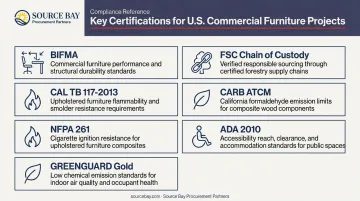
The most relevant certifications for U.S. commercial projects include:
- BIFMA (ANSI/BIFMA X5.4) — structural performance for public and lounge seating; search the BIFMA Compliant product registry to verify
- CAL TB 117-2013 — smolder resistance for upholstered furniture materials; mandatory for furniture sold in California
- NFPA 261 — resistance of upholstered furniture assemblies to ignition by smoldering cigarettes
- GREENGUARD / GREENGUARD Gold — indoor air quality certification; UL GREENGUARD Gold applies stricter VOC limits for sensitive environments and verify through UL SPOT
- FSC Chain of Custody — confirms responsible sourcing of wood-based materials through the supply chain
- CARB Composite Wood ATCM — formaldehyde emissions limits for hardwood plywood, particleboard, and MDF
- ADA 2010 Standards — dining and work surface heights must fall between 28 and 34 inches above finished floor; relevant to accessible public accommodations and transient lodging
When vetting a manufacturer, request the actual third-party test reports, not just a compliance claim. Reports should identify the exact standard and version tested.
Production Lead Times and Delivery Logistics
Furniture delivery in commercial projects is tied to construction punch lists and occupancy timelines. A manufacturer whose production schedule can't align with the project's construction phases creates cascading delays that push opening dates and delay revenue.
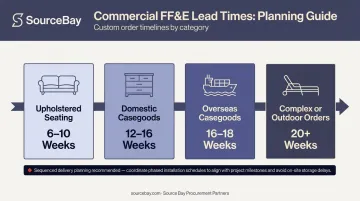
Typical lead times for custom commercial furniture vary significantly by category:
- Upholstered seating: 6–10 weeks
- Domestic casegoods: 12–16 weeks
- Overseas casegoods: 16–18 weeks
- Outdoor furniture or highly complex custom orders: 20+ weeks
Beyond production, large installations require sequenced delivery keyed to floor or zone completion. Furniture delivered all at once to an active construction site gets damaged, blocks installation crews, and creates storage problems — and any partner who can't manage phased warehousing compounds every other scheduling risk on the project.
Material Quality and Durability for High-Traffic Use
Surface aesthetics don't tell you how a piece will hold up after two years of daily commercial use. The technical indicators that matter are:
- Frame construction — solid wood, engineered wood core, or steel gauge appropriate for the use category
- Joinery methods — mortise-and-tenon and corner-blocked frames outperform staple-and-glue construction under daily load cycling
- Upholstery abrasion — ACT benchmarks are the industry reference; 30,000+ Wyzenbeek double rubs for high-traffic woven fabrics
- Finish durability — surfaces must withstand commercial cleaning agents, including bleach-based protocols common in healthcare and senior living environments
- BIFMA load ratings — BIFMA X5.41 Large Occupant Public and Lounge Seating includes test sets based on 400 lb and 600 lb individuals, a meaningful bar for public-space durability
Request manufacturer specification sheets that name the exact BIFMA standard version and test basis. If a manufacturer can't provide that documentation, don't proceed — incomplete documentation is a meaningful red flag at the specification stage.
After-Sales Support, Warranty Terms, and Lifecycle Management
The true cost of commercial furniture extends well beyond the initial purchase. Hotel Management reports that soft goods — carpeting and seating — typically cycle every 3–5 years, while hard goods like casegoods follow a 7–10 year replacement schedule. A manufacturer with strong warranty terms, available replacement parts, and refurbishment support reduces that total ownership cost considerably compared to one who simply offers a lower unit price.
For multi-property operators or those planning future renovations, confirm these capabilities directly with any manufacturer under consideration:
- Specification reorder — can they match the same finish, fabric, and dimensions years later?
- Parts availability — are replacement components stocked or manufactured on demand?
- Refurbishment support — do they offer structural repair or reupholstery, or only full replacement?
- Warranty terms — what's covered, for how long, and under what use conditions?
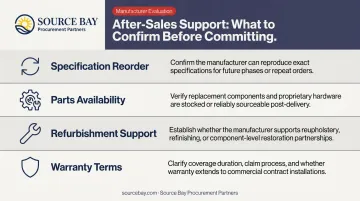
If a manufacturer doesn't support specification continuity, budget for a full replacement rather than a refresh.
Sustainability Practices and Environmental Credentials
Sustainability is now a procurement requirement on many commercial projects — driven by LEED standards, brand-mandated ESG commitments, and government procurement policies that require documented sustainable sourcing.
For LEED v4.1 Low-Emitting Materials credits, at least 75% of furniture by cost must meet emissions evaluation criteria, referencing ANSI/BIFMA M7.1 and ANSI/BIFMA e3 standards. Key certifications to request from manufacturers:
- FSC or FSC Chain of Custody — for wood-based products
- GREENGUARD or GREENGUARD Gold — for VOC emissions compliance
- CARB ATCM compliance — for composite wood components
- Declare labels — for disclosed ingredient and health information
Request documentation directly from the manufacturer, not just a verbal assurance. Verify FSC certificates through FSC Search and GREENGUARD certifications through UL SPOT.
Common Mistakes to Avoid When Selecting a Custom Furniture Manufacturer
Choosing on Unit Price Alone
A lower per-unit cost from a manufacturer with poor quality control, limited warranty coverage, or unreliable delivery frequently results in higher total spend over the asset lifecycle. Early replacements, field corrections, and project delays each carry costs that exceed the original per-unit savings. Evaluate manufacturers against total cost of ownership — production quality, logistics reliability, warranty terms, and lifecycle support — not just the quoted price.
Skipping the Sample and Prototype Review Stage
Reviewing physical samples, prototypes, or factory references before committing to a full production run is standard practice in professional FF&E procurement. Bypassing this step to save time routinely surfaces specification failures only after delivery:
- Wrong finish tones that don't match the design intent
- Fabric that fails to meet performance or durability specs
- Dimensions that conflict with the actual space
The time cost of a prototype review is a fraction of the remediation cost after a full delivery.
Underestimating Logistics Complexity
Furniture delivery to a hotel, senior living campus, or multi-family development is not a standard freight shipment. White-glove delivery, sequenced staging, and supervised installation handoff are operational requirements — and they need to be planned from the start.
Many buyers don't account for logistics complexity until problems are already in motion:
- Pieces damaged from premature site delivery
- Installation crews idling while staged furniture catches up
- Congestion that pushes the punch list into the opening window
How Source Bay Partners Can Help
Source Bay Procurement Partners is an experienced FF&E procurement firm that bridges the gap between architectural design intent and operational delivery for hospitality, senior living, and multi-family projects. President Diane Arnold leads the team alongside operations specialists Paul Tomczak and Greg McKinnon, with Senior Designer Barbara Church overseeing textiles and finishes. Together, they bring combined expertise spanning procurement, design, and large-scale project logistics.
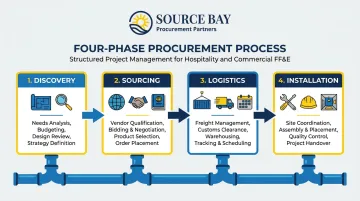
Source Bay manages the full procurement process through a structured four-phase model:
- Discovery — Aligns scope, design intent, and budget before sourcing begins
- Sourcing — Selects manufacturers from a vetted global network matched to project specifications
- Logistics — Manages freight and sequenced warehousing coordinated with construction timelines
- Installation — Provides on-site oversight, quality control documentation, and formal project closeout
Key differentiators include:
- Global network of vetted hospitality-grade manufacturers, including Blue Leaf Hospitality for casegoods and upholstered furniture, and Kellex Furniture for senior living seating
- Strategic partnership with Neuco Furniture and Upholstery for integrated refurbishment services, extending the lifecycle of existing commercial assets without the cost of full replacement
- Custom textiles and value-engineered finishes curated by Senior Designer Barbara Church, working with textile partners including Schumacher and Fabricut
- End-to-end procurement model that keeps complex, large-scale projects on schedule and within budget from specification through installation
Conclusion
The right custom furniture manufacturer isn't the one with the most recognizable name or the lowest quoted price. It's the one whose manufacturing capabilities, compliance credentials, lead time reliability, and after-sales support align with the specific demands of your project.
Furniture is a long-term asset, and manufacturer selection deserves the same scrutiny as any other major capital decision. Total cost of ownership, lifecycle support, and renovation flexibility all matter well beyond the initial install. A manufacturer that looks right on paper but fails on lead times or warranty follow-through creates problems that compound across every subsequent refresh cycle — often at a far higher cost than the original price gap suggested.
Frequently Asked Questions
What is commercial-grade furniture?
Commercial-grade furniture is designed and tested to meet the durability, safety, and usage standards required for high-traffic public spaces. This includes stricter frame construction, higher fabric wear ratings, and compliance with fire and structural standards — requirements that residential furniture is not built to satisfy.
Who builds the highest quality furniture?
Quality in commercial furniture is determined by manufacturing process controls, material specifications, third-party certifications such as BIFMA and GREENGUARD, and verifiable track records in similar commercial projects. Brand name alone tells you little — look for documented performance in comparable project environments.
What is the difference between custom and contract furniture for commercial spaces?
Contract furniture refers to furniture ordered for commercial use under a specification contract. Custom furniture is manufactured to a project-specific design. Most high-end commercial projects require custom contract furniture: precision manufacturing paired with commercial durability standards.
How long does custom commercial furniture typically take to manufacture and deliver?
Lead times range broadly: upholstered seating typically runs 6–10 weeks, domestic casegoods 12–16 weeks, and overseas casegoods 16–18 weeks. Highly complex or outdoor categories can exceed 20 weeks, and sequenced delivery coordination for large installations must be factored into the project schedule from the outset.
What certifications should I look for in a commercial furniture manufacturer?
For U.S. commercial projects, the most relevant certifications are BIFMA (structural performance), GREENGUARD or GREENGUARD Gold (indoor air quality), CAL TB 117-2013 and NFPA 261 (fire and smolder safety), and FSC or CARB certification for sustainable and low-emission wood-based materials.
How do I verify a manufacturer's quality before committing to a large order?
Request physical samples or prototypes, review completed project references in comparable environments, and audit compliance documentation directly. For large orders, factory visits or engaging an experienced FF&E procurement partner to conduct due diligence on your behalf is standard practice.