For commercial projects at scale, this isn't a minor operational detail. According to HVS's 2025 U.S. Hotel Development Cost Survey, FF&E represents up to 10% of total hotel development cost — reaching $94,613 per room for luxury properties. For senior living, CBRE's 2026 survey pegs FF&E at $11,900 per revenue unit. Across hundreds of rooms or units, the numbers compound fast.
What makes commercial procurement fundamentally different is scale and complexity. Hundreds of line items. Multiple vendor relationships. Phased delivery schedules tied to active construction. Unforgiving installation windows. Get it wrong and the consequences aren't just aesthetic — they're financial.
This guide covers what commercial procurement actually includes, how the process works, where it typically fails, and what to look for in a procurement partner.
Key Takeaways
- Commercial FF&E procurement spans the full project lifecycle — not just purchasing
- Procurement mismanagement creates measurable consequences: delayed openings, budget overruns, and design-intent erosion
- Three main approaches exist — in-house, furniture dealer, and third-party specialist — each with distinct trade-offs
- Engaging a specialist during the design phase (before construction) reduces costly reselections and missed delivery windows
- The right partner provides vendor access, logistics infrastructure, and single-point accountability most internal teams can't match
What Is Interior Design Procurement for Commercial Projects?
Commercial interior design procurement is the end-to-end process of specifying, sourcing, ordering, tracking, delivering, and installing all furniture, fixtures, and equipment (FF&E) required to complete a commercial space — within a defined budget and timeline. That scope routinely surprises owners who've only managed smaller-scale projects.
How It Differs from Residential or Retail Purchasing
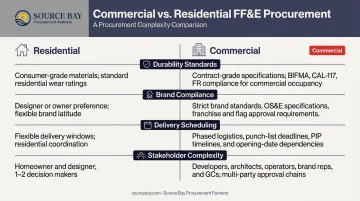
Residential projects involve dozens of items, a single delivery window, and a relatively forgiving installation timeline. Commercial projects are an entirely different discipline:
- Institutional durability standards — hospitality-grade furniture is engineered for daily commercial use; residential-grade product fails prematurely under the same conditions
- Brand compliance requirements — branded hotel portfolios must meet franchisor specifications governing finishes, materials, and product categories
- Phased delivery schedules — FF&E cannot arrive during active construction, and items can't sit in a warehouse indefinitely
- Multiple stakeholders — architects, general contractors, ownership groups, and operators all have concurrent requirements that procurement must navigate
Sourcing vs. Procurement: The Distinction That Matters
These terms get used interchangeably, but they cover different ground:
- Sourcing: Identifying and vetting the right products and vendors for a project
- Procurement: The execution — contracts, purchase orders, payment management, freight coordination, inspections, and final handoff
Strong sourcing alone doesn't guarantee a successful project. Where many engagements break down is in the procurement phase, when logistics and accountability become the critical variables.
What Does Commercial FF&E Procurement Actually Cover?
The scope of a full commercial procurement engagement covers more ground than most clients anticipate at project outset.
Product Specification and Sourcing
A procurement specialist translates the design team's FF&E schedule into actionable purchase orders across every product category the finished space requires. For a hotel project, that means:
- Guestroom casegoods: dressers, nightstands, desks, headboard units
- Upholstered seating for guestrooms, lobbies, and common areas
- Custom textiles, drapery, and wallcoverings
- Lighting — ambient, task, architectural pendant, and custom fixtures
- Sleep systems engineered for commercial hospitality use
- Dining and F&B furniture, tabletop accessories, bar fixtures
For senior living, the scope shifts to include seating that meets fall-risk and fire-code standards, dementia-friendly design specifications, and materials with cleanability for care environments — while maintaining a residential aesthetic that supports resident dignity. That scope extends to every finishing element — the throw pillows, the corridor sconce, the lobby vase — that creates a cohesive, polished environment at turnover.
Vendor Management and Negotiation
Procurement specialists leverage established manufacturer relationships to secure competitive pricing, verify lead times, and hold vendors to delivery commitments. Those relationships matter more during market disruptions — Hotel Management reported in 2026 that hotel-renovation lead times had stretched from 14 weeks to at least 20 weeks amid tariff and sourcing volatility. Experienced procurement teams anticipate these shifts; teams without established vendor relationships react to them.
Freight Coordination and Sequenced Warehousing
Furniture cannot arrive during active construction. Items cannot sit in a receiving warehouse indefinitely without accruing storage costs. A skilled procurement team coordinates freight carriers, manages receiving warehouses, and sequences deliveries to align with the installation window — not with when manufacturers happen to ship.
Research from the Construction Industry Institute found that material-readiness problems at the installation work face increased labor hours by 16–18%. Poor sequencing doesn't just create storage headaches — it inflates installation costs.
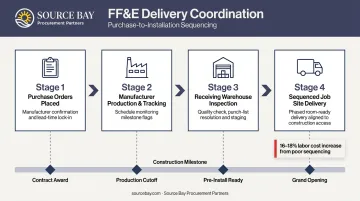
Source Bay Partners provides comprehensive freight management and sequenced warehousing as part of its turnkey service offering, coordinating supply timelines directly to construction milestones rather than manufacturer production schedules.
Quality Control and Damage Management
Upon delivery, every item must be inspected against the original specification before installation begins. Damage claims happen on every large commercial freight shipment — a procurement specialist coordinates with vendors, carriers, and repair professionals to resolve them without disrupting the project timeline.
An item that fails inspection on installation day creates an immediate crisis. Caught at the receiving warehouse, it becomes a manageable claim.
Installation Oversight and Final Handoff
Delivery is not the finish line. The procurement team's role extends through FF&E setup, final placement verification against the FF&E schedule, and a structured handoff to the client — confirming the space reflects the original design intent and is fully operational at turnover.
The Commercial Procurement Process: From Vision to Final Handoff
Step 1: Project Planning and FF&E Scope Development
Procurement begins during the design phase, not after construction. The procurement team works alongside designers and architects to build a detailed FF&E scope tied to the space plan, establish a realistic budget by product category, and set milestone delivery dates aligned with the construction schedule.
This is where Source Bay Partners' Discovery phase operates — a deep analysis of project scope, design intent, and budget goals that addresses the most common project failure point: the gap between what a designer specifies and what the procurement budget can actually support.
Step 2: Sourcing and Vendor Selection
Sourcing identifies the best products for each specification — balancing aesthetic requirements, durability standards, budget constraints, and lead time realities. For a hotel project, that means sourcing through relationships with manufacturers like Blue Leaf Hospitality for casegoods, Schumacher and Fabricut for textiles, and Remington Lighting for custom fixtures — not searching retail channels.
Experienced procurement specialists draw on established manufacturer relationships to find value-engineered alternatives when the original specification exceeds the budget envelope. That conversation happens in sourcing — not during installation, when options are limited.
Step 3: Purchase Orders, Contracts, and Payment Management
Every purchase order must reflect exact specifications — and errors here become expensive corrections at installation. Common PO mistakes that surface during setup include:
Every purchase order must reflect exact specifications. Common PO errors that surface during installation include:
- Wrong finish codes or item numbers
- Incorrect quantities due to miscounted room counts
- Missing delivery instructions that delay receiving
- Lead time commitments not documented for tracking
When any of these slip through, the only fix is substitution or emergency freight — both expensive and avoidable.
Documentation accuracy at the PO stage is unglamorous work. It's also where the installation phase is either set up for success or silently compromised before a single truck is loaded.
Step 4: Tracking, Expediting, and Logistics Coordination
Once orders are placed, active monitoring begins — tracking every item from manufacturer to freight carrier to receiving warehouse to job site. Proactive expediting keeps projects on schedule. Reactive follow-up after a missed delivery window is damage control — it rarely recovers lost time.
This phase requires dedicated operational capacity. Source Bay's operations team monitors supply timelines continuously, coordinating between manufacturers, freight carriers, and construction schedules to flag threats before they become delays.
Step 5: Installation, Inspection, and Handoff
When logistics are managed well, installation proceeds cleanly. The final phase coordinates installation crews, verifies correct placement and functionality, and conducts a walkthrough inspection against the FF&E schedule. Source Bay then hands off the completed space to the client with quality control documentation confirming delivery to specification.
This is the moment a procurement engagement either validates itself or reveals its gaps. A clean handoff means a space that matches the design intent, is ready for occupancy, and requires no emergency fixes post-turnover.
In-House vs. Furniture Dealer vs. Specialist: Which Approach Is Right?
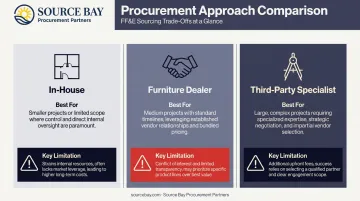
| Approach | Best For | Key Limitation |
|---|---|---|
| In-House | Very small, simple projects with low timeline sensitivity | Hidden complexity; mistakes translate directly to delays |
| Furniture Dealer | Straightforward scopes that align with dealer's existing portfolio | Incentivized by manufacturer agreements; restricted product options |
| Third-Party Specialist | Complex, phased, brand-sensitive, or large-scale projects | Higher upfront cost vs. the illusion of in-house savings |
Managing Procurement In-House
This appears to be the lowest-cost approach. It rarely is. Property management and operations teams underestimate the coordination complexity, lead time management, and vendor accountability that commercial procurement requires. When something goes wrong — and at commercial scale, something always goes wrong — the internal team has no established relationships, no freight infrastructure, and no leverage with vendors to resolve it quickly.
Working with a Furniture Dealer
Dealers are viable when the project's FF&E needs align cleanly with their manufacturer portfolio and selections are relatively straightforward. The key limitation: dealers are typically incentivized by existing manufacturer agreements. That structure can restrict product options and may not yield the best outcome on design fit, durability performance, or total value.
Hiring a Third-Party Procurement Specialist
A brand-agnostic procurement firm works exclusively in the owner's interest. Products are recommended based on project fit — not commission structures — and the firm owns logistics management and design protection from specification through final handoff.
One dual-property California hotel project illustrates the stakes. After missing purchases and installation coordination failures created serious delivery gaps, a specialist firm stepped in — reconciling outstanding needs, sourcing missing items, and coordinating deliveries through to final installation. The project opened on schedule. Without that intervention, it would not have.
The decision framework:
- Go in-house if the project is small, low-complexity, and timeline-flexible
- Use a dealer if selections are straightforward and align with their portfolio
- Hire a specialist for any project that is phased, brand-sensitive, large-scale, or operating under an unforgiving opening deadline — phased hospitality buildouts and senior living openings, in particular, carry no margin for procurement errors
The Real Cost of Getting Commercial Procurement Wrong
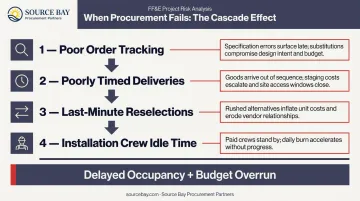
Procurement failures don't create isolated problems. They cascade.
A missed delivery window pushes back installation. Delayed installation pushes back occupancy. Delayed occupancy triggers lost revenue, extended holding costs, and, for hotels, pre-opening staffing and training that's been scheduled around an opening date that no longer exists.
The Most Common Failure Points
- Poor order tracking — items go missing between PO and delivery because no one is actively monitoring
- Poorly timed deliveries — furniture arriving before spaces are ready creates on-site damage risk and storage costs
- Last-minute reselections — out-of-stock discoveries during installation force substitutions that erode design intent
- Installation crew idle time — incomplete deliveries leave crews waiting, converting fixed labor costs into pure waste
McKinsey reports that procurement represents 40–70% of a construction company's total spending, with best-in-class procurement practices generating savings of up to 12%. The inverse is equally true: procurement mismanagement on that same spending base creates proportionally large overruns.
Reframing the Specialist Fee
The cost of professional procurement services should be evaluated against the cost of a single delayed opening or a forced reselection at installation. Handling procurement in-house with staff who lack commercial-scale vendor relationships and logistics infrastructure creates its own category of risk — one that's rarely priced into the project budget.
For a 150-room hotel renovation carrying an $8M FF&E budget, one procurement expert estimated that tariff exposure alone could add $2 million in unbudgeted cost without proactive sourcing management. Against that kind of exposure, a specialist fee isn't an added cost — it's a hedge against a far larger one.
What to Look for in a Commercial FF&E Procurement Partner
Established Vendor and Manufacturer Relationships
A qualified partner brings direct relationships with commercial-grade manufacturers — not access to consumer retail channels. These relationships translate into better pricing, reliable lead time commitments, and the ability to source value-engineered alternatives without compromising quality.
Source Bay Partners draws on a global network spanning hundreds of industry manufacturers — a partial list includes:
- Blue Leaf Hospitality and Kellex Furniture (case goods and seating)
- Serta (commercial sleep solutions)
- Schumacher and Fabricut (textiles and wallcoverings)
- Samsung and BDL (digital and display)
- Remington Lighting (custom fixtures)

That breadth is what makes custom textiles, bespoke fixtures, and value-engineered alternatives available at commercial scale.
Logistics Infrastructure and Operational Capability
Look for a partner with in-house freight management, vetted warehouse and receiving partners, and direct oversight of installation crews — not a firm that subcontracts these functions without accountability.
Ask specifically about:
- How deliveries are sequenced relative to construction milestones
- The process for managing damage claims between delivery and installation
- How the team coordinates with general contractors during the critical installation window
Integrated Design-to-Delivery Capability and Industry Specialization
The strongest partners understand the specific requirements of their client verticals:
- Senior living: fall-risk design, fire codes, dementia-friendly specifications, cleanability requirements
- Hospitality: brand-standard compliance, custom finishes, on-schedule delivery for opening dates
- Multi-family: construction-schedule sequencing, lease-up readiness, model-unit staging
Integrated refurbishment capability sets the strongest partners apart. Source Bay Partners' strategic partnership with Neuco Furniture & Upholstery provides a turnkey solution for owners who need to refresh or restore existing FF&E assets alongside new procurement — at typical savings of 40–60% versus full replacement. For renovation and repositioning projects, this capability eliminates the need to manage a separate refurbishment vendor.
Frequently Asked Questions
What is included in commercial interior design procurement services?
Commercial procurement covers the full scope from FF&E specification and vendor sourcing through purchase order management, freight coordination, sequenced warehousing, quality inspection, and final installation and handoff. It encompasses every step between a finalized design plan and an occupied, finished space.
How is commercial FF&E procurement different from residential procurement?
The differences are scale, compliance, and complexity. Commercial projects involve hundreds of line items, phased delivery sequences tied to active construction, institutional durability standards, and multiple concurrent stakeholders: architects, GCs, and ownership groups — each with distinct requirements.
When should a commercial project engage a procurement specialist?
Ideally during the design phase. Early engagement allows the procurement team to align FF&E scope to the budget, establish realistic lead times, and flag sourcing risks before they become schedule impacts. Bringing in a specialist after construction has started limits options significantly.
How much do interior design procurement services cost for commercial projects?
Fees vary by project scope and are typically structured as a percentage of total FF&E spend or a flat project management fee. Evaluate that cost against the real risks of unmanaged procurement: delays, damage claims, forced reselections, and design-intent erosion that compound quickly at commercial scale.
What are the biggest risks of managing FF&E procurement in-house for a large commercial project?
The most common risks include:
- Underestimating lead times across multiple vendors
- Poor freight coordination leading to late or damaged deliveries
- Inability to manage vendor claims effectively
- Schedule cascades that push back occupancy dates when any milestone slips
Can a procurement partner handle renovation and refurbishment projects, not just new construction?
Experienced procurement firms can manage FF&E for renovations and phased refurbishments. Firms with integrated refurbishment capabilities — such as Source Bay Partners' partnership with Neuco Furniture & Upholstery — offer a strong solution for owners refreshing existing assets alongside new procurement, coordinating both workstreams through a single engagement.