The word "turnkey" gets used loosely. But its real value isn't in the label. It shows up in materials that arrive when trades are ready, in units that look identical on floor one and floor ten, and in punch lists that don't balloon into multi-week disputes.
With multifamily completions hitting a 38-year high of 608,000 units in 2024, and pre-stabilized vacancy already dragging on rent growth, every week of delayed occupancy has a direct cost. Interior finish coordination failures are one of the most preventable sources of that delay.
This article breaks down the concrete operational advantages of turnkey interior finish procurement — and why more multifamily developers are making it a standard part of their project strategy.
Key Takeaways
- Turnkey procurement consolidates FF&E sourcing, design, logistics, and delivery under a single partner
- Single-partner accountability eliminates the "finger-pointing" dynamic that slows corrective action across fragmented vendor models
- Sequenced warehousing and phased delivery keep interior finishes aligned with construction schedules, preventing trade stalls
- Specification consistency across all units reduces punch list exposure and protects long-term asset value
- Preconstruction engagement is where turnkey partnerships deliver the most value — not after specs are set
What Is Turnkey Interior Finish Procurement?
Turnkey interior finish procurement means one partner manages the full scope of interior finishes and FF&E — from specification and sourcing through freight, warehousing, and installation — so the developer deals with one accountable team rather than a collection of disconnected vendors.
In practice, the consolidated scopes typically include:
- Furniture (case goods, upholstered seating, bedroom furnishings)
- Lighting and custom fixtures
- Custom textiles and wallcoverings
- Fixtures and hardware
- Accessories and amenity packages
The driving goal is consistency at scale. What happens in unit 1 needs to happen the same way in unit 201 — same finishes, same installation quality, same timeline accountability. When something slips, one partner owns it immediately rather than three vendors pointing at each other. That's what makes this model increasingly attractive to multifamily developers managing complex, multi-phase builds.
Key Advantages of Turnkey Interior Finish Solutions
The advantages below reflect measurable impacts on project outcomes: cost control, schedule adherence, quality consistency, and risk reduction. They also compound at scale — what saves minor friction on 10 units prevents significant financial exposure on 200.
Advantage 1: Simplified Accountability and Reduced Coordination Overhead
Fragmented interior finish sourcing creates a multi-vendor coordination problem. When cabinetry, countertops, flooring, and lighting are managed by separate teams, no single party owns the outcome when sequencing breaks down. Each vendor points to the others. The developer's project management team absorbs the dispute — and the delay.
Turnkey procurement resolves this structurally. One partner aligns procurement timelines, communicates across scopes internally, and presents a single point of contact for the developer.
Why this matters operationally:
The administrative cost of fragmented coordination is significant. Research from FMI and PlanGrid found that poor project data and miscommunication account for 48% of U.S. construction rework — a $31.3 billion annual burden. The same study found construction professionals spend 35% of their time on non-optimal activities like conflict resolution and searching for project data.
On a multifamily project with 150+ units, that overhead shows up in real ways: RFIs multiply across trades, punch list items require multiple-party sign-off, and corrective actions stall while responsibility is disputed.
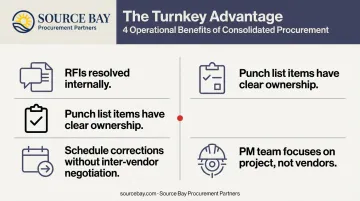
When one partner owns the full finish scope:
- RFIs are resolved internally before they reach the developer
- Punch list items have a clear owner and faster resolution path
- Schedule corrections happen without inter-vendor negotiation
- The developer's PM team focuses on the project, not vendor management
When this advantage matters most: Large-scale developments with 100+ units, multi-phase rollouts, or projects where the developer's internal team is managing multiple active sites simultaneously.
Advantage 2: Schedule Predictability and Budget Protection
Interior finishes sit on the critical path. Cabinet installation drives countertop templating, flooring thickness affects appliance clearances, and a delayed fixture delivery pushes every trade that follows. In a fragmented model, these interdependencies aren't managed by anyone — they're discovered in the field, after the conflict has already stalled work.
Turnkey partners align these sequencing interdependencies during preconstruction, not after they've become problems.
How this works in practice:
- Materials are warehoused and released in phases by building or floor — not delivered all at once to create storage problems on constrained urban sites
- Freight coordination is managed against the construction schedule, not against a supplier's standard lead time
- Established manufacturer relationships provide more predictable lead times than ad hoc vendor sourcing
Why delayed occupancy is a real financial event:
CBRE reported that pre-stabilized properties — newly built with less than 85% occupancy — increased total multifamily vacancy rates by 1.5 percentage points in Q1 2025. Every week a development sits below stabilized occupancy is a week of revenue left on the pro forma. With median asking rents for Q4 2025 completions at $2,034 per unit, the cost of delayed lease-up is not a rounding error.
Budget protection comes from two directions. First, early specification alignment across scopes reduces the late-stage changes that generate costly field corrections. Second, a partner with an established global manufacturer network can often unlock volume-based pricing unavailable to developers sourcing piecemeal.
This matters most on projects with compressed timelines, hard lease-up commitments, or urban sites with restricted delivery windows and limited laydown space.
Advantage 3: Consistent Quality and Scalable Execution Across Markets
In multifamily development, what happens in one unit is replicated hundreds of times. Small quality inconsistencies — a different hardware finish, a substituted flooring product, a fixture spec that drifted between phases — compound into significant punch list exposure and, eventually, resident dissatisfaction.
Turnkey procurement addresses this through standardized specifications established once and maintained across all units. The same standards apply whether the project spans one building or ten, one city or multiple markets.
The resident satisfaction dimension:
Unit quality matters to retention. NAA data shows resident retention at nearly 60% in 2024, with the cost of a unit turn at approximately $4,000 — including lost rent, concessions, and maintenance. Interior renovation quality, specifically upgrading finishes, is cited as a retention tool. A finish package that holds up and looks intentional supports renewal decisions.
Developers expanding geographically also face a recurring cost: vetting and onboarding new local suppliers in each market. A single experienced procurement partner eliminates that overhead. The sourcing infrastructure is already built, and the manufacturer relationships are already in place.
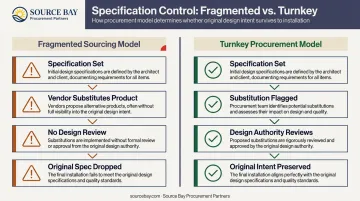
Design integrity is the third dimension — and often the most overlooked. A turnkey partner with in-house design capability ensures that architectural intent established at the specification stage doesn't erode during sourcing. This is where "value substitution" typically occurs in fragmented models: a product gets swapped for a cheaper alternative without design sign-off, and the original specification is dropped without review. With in-house design expertise embedded in the procurement workflow, substitution decisions are evaluated against the original design baseline, not just cost.
When this advantage matters most: Multi-phase portfolios, geographically distributed developments, senior living communities, and any project where design brand standards must hold across all units and common areas.
What Happens When Turnkey Is Missing
The fragmentation problem isn't theoretical. On a 10-unit project, a delayed countertop template or a flooring thickness miscommunication is a manageable inconvenience. On a 200-unit development, the same class of problem runs in parallel across dozens of units simultaneously.
In Q4 2023, NMHC reported that multifamily respondents substituted products for lighting fixtures (39%), appliances (26%), and hardware (23%) — a direct consequence of coordination failures and supply chain gaps that fragmented sourcing struggles to absorb.
The compounding dynamic looks like this:
- Independent vendors operate on their own schedules, uncoordinated with the construction sequence
- A material delivery arrives early and consumes limited on-site storage, creating conflict with active trades
- A delivery arrives late, stalling the trades that follow
- When problems arise, vendors dispute responsibility rather than resolve it, turning a minor correction into a multi-week negotiation
The longer-term cost compounds quietly. Developers managing fragmented finish vendors across multiple markets spend disproportionate internal resources on supplier coordination — work that displaces higher-value activity like underwriting new projects or managing investor relationships.
How to Get the Most Value from Turnkey Interior Finish Solutions
Turnkey partnerships deliver maximum value when the partner is engaged at preconstruction — not brought in after specifications are set and procurement is already fragmented. Early engagement allows the partner to align scopes, establish lead times, and structure delivery sequencing before the critical path tightens.
Three practices that protect the investment:
Engage before specifications are locked — The Discovery phase is where scope alignment, budget feasibility, and design intent are established. This is also where lead time risk is identified and managed, not discovered mid-project.
Track outcomes unit by unit — Specification compliance, delivery performance, and installation quality should be monitored across phases so deviations are caught early, not at final walkthrough.
Require design continuity through sourcing — Confirm that in-house design capability is part of the partner's model, not an external consultant engaged separately. Design authority needs to travel with procurement decisions.
Source Bay Procurement Partners operates this integrated model across multifamily, hospitality, and senior living developments. The firm's capabilities span every stage of the process:
- In-house design led by Senior Designer Barbara Church, keeping aesthetic intent tied directly to procurement decisions
- Global manufacturer relationships including Remington Lighting, Schumacher, Fabricut, and Kellex Furniture
- End-to-end logistics managed by Operations specialists Paul Tomczak and Greg McKinnon, covering sequenced warehousing and direct project handoff

The result is FF&E procurement coordinated as one disciplined system — from Discovery through final installation.
Conclusion
The shift toward turnkey interior finish procurement in multifamily is driven by operational pressure. Tighter timelines, compressed margins, and the compounding cost of coordination failures at scale have made fragmented vendor management an increasingly costly approach.
The core value of a turnkey partner comes down to this: someone who owns the outcome. That means accountability when problems arise, schedule predictability built in before they do, and finish quality that holds up across every unit and every market in a developer's portfolio.
Developers who embed this model early — and hold to it across their pipeline — spend less time managing procurement failures and more time closing projects on schedule. That consistency is what separates a well-run portfolio from one that's perpetually catching up.
Frequently Asked Questions
What is the turnkey procurement process for multifamily developments?
Turnkey procurement involves a single partner managing FF&E sourcing, specification alignment, freight coordination, and installation sequencing from preconstruction through final handoff — replacing the fragmented multi-vendor model with consolidated accountability. One team owns the process end to end.
Who is responsible for a turnkey project for multifamily developments?
The procurement partner holds primary accountability for coordinating all finish and FF&E scopes. The developer retains strategic oversight and approval authority, but day-to-day coordination, supplier management, and delivery sequencing sit with the turnkey partner.
What are the four types of multifamily housing structures?
The four primary types are garden-style (low-rise with exterior entries), mid-rise (multi-story with elevator, typically 5–9 stories), high-rise (9 or more floors with elevator), and mixed-use podium or wrap buildings. Each structure type carries different logistics, delivery sequencing, and FF&E procurement requirements.
How does turnkey FF&E procurement help keep multifamily projects on schedule?
Interior finish scopes are interdependent: cabinet installation drives countertop templating, and flooring thickness affects appliance clearances. A single coordinating partner aligns these sequences in advance, preventing the downstream delays that occur when independent vendors operate without cross-scope visibility.
What is the difference between FF&E procurement and standard interior finish sourcing?
Standard interior finish sourcing typically covers fixed elements like flooring, cabinetry, and countertops. FF&E (Furniture, Fixtures & Equipment) encompasses a broader scope including furniture, lighting, textiles, and accessories. A turnkey FF&E partner manages both categories as one integrated system.
When should multifamily developers engage a turnkey procurement partner?
Preconstruction engagement delivers the most value. Early involvement lets the partner align specifications, establish lead times, and sequence deliveries before the critical path tightens. Engaging after specs are locked removes most of that coordination advantage.