
Introduction
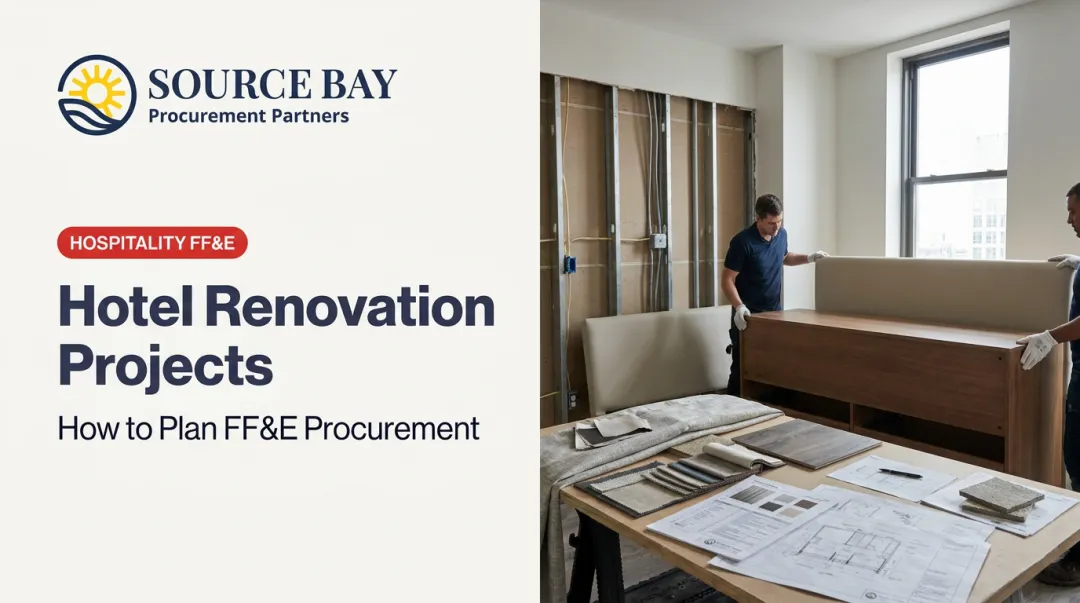
A hotel renovation lives or dies on procurement decisions made months before a single wall gets painted. Most owners underestimate this — they focus on design selections, contractor bids, and brand compliance checklists, then discover too late that the real project risk was in the purchasing process.
Hotel renovation procurement is nothing like the operational buying that runs a property day to day. Ordering linens and toiletries is routine replenishment. Procuring FF&E for a renovation is a capital-intensive, multi-vendor project with lead times that stretch 14–20+ weeks for international products and even longer for custom lighting and drapery.
Miss those windows and rooms stay offline longer, revenue disappears, and the whole project schedule unravels.
This guide covers how procurement actually works — from scope development through final installation handoff — so owners can manage timelines, vendors, and budgets before the mistakes happen, not after.
Key Takeaways
- Hotel renovation procurement centers on FF&E and OS&E, requiring specialized lead time and logistics management
- Custom FF&E items can carry lead times of 14–20+ weeks, making early planning non-negotiable
- Franchised owners must align all procurement with brand flag specifications or risk failed inspections
- Poor procurement sequencing extends room downtime and directly erodes occupancy revenue
- A specialist procurement firm reduces cost overruns, sourcing risk, and logistics complexity
What Is Hotel Renovation Procurement?
Hotel renovation procurement is the strategic process of sourcing, purchasing, coordinating delivery, and overseeing installation of everything a renovation requires: primarily FF&E (Furniture, Fixtures & Equipment) and OS&E (Operating Supplies & Equipment).
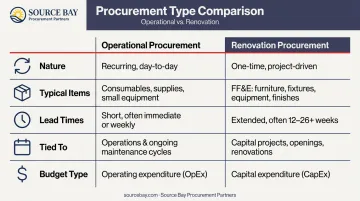
It's a fundamentally different discipline from operational hospitality purchasing — and conflating the two is one of the most common (and costly) mistakes owners make. The differences run deep:
| Dimension | Operational Procurement | Renovation Procurement |
|---|---|---|
| Nature | Recurring supply replenishment | One-time capital expenditure |
| Typical items | Toiletries, linens, cleaning supplies | Casegoods, upholstered seating, lighting, textiles |
| Lead times | Days to weeks | 14–20+ weeks for custom items |
| Tied to | Par levels and stock rotations | Construction schedules and room block releases |
| Budget type | Operating expense | Capital expenditure (CapEx) |
What Falls Within Renovation Procurement Scope
- Guest room furniture and case goods (dressers, nightstands, headboards, desks)
- Commercial sleep solutions (mattresses and bed frames)
- Upholstered seating and soft goods
- Custom textiles, drapery, and window treatments
- Wallcoverings and decorative finishes
- Lobby and public area furnishings
- Lighting fixtures (standard and custom)
- Branded amenity items and OS&E for project handoff
Getting this scope defined accurately before a single purchase order is issued determines whether your project stays on budget and on schedule. Missing even one category at the outset typically means change orders, compressed lead times, and rooms that aren't ready for block release.
Why Procurement Makes or Breaks a Hotel Renovation
The Budget Exposure Is Real
FF&E is a substantial line item in any hotel project. According to HVS's 2025 Hotel Development Cost Survey, FF&E represents 8–10% of total ground-up hotel development cost, with per-room FF&E costs ranging from approximately $16,000 for limited-service properties to nearly $97,000 for luxury hotels. While renovation scopes vary from full replacements to soft goods refreshes, this cost share illustrates why procurement decisions carry significant financial weight.
Mismanaged sourcing — wrong vendors, specification errors, late orders — doesn't just cost more. It cascades. One late custom item can push an entire room block offline past its scheduled opening, driving costs well beyond the piece itself.
Lead Times Punish Late Starters
Lodging Magazine's 2023 procurement interviews documented lead times of 14–18 weeks for most international hotel products and 20 weeks for lighting and drapery. During disruption periods — supply chain stress in 2021, for instance — those timelines stretched to 32–36 weeks.
That means procurement planning needs to be underway well before construction starts — not running parallel to it.
Room Downtime Has a Dollar Value
STR reported 2025 full-year US hotel performance at $160.54 ADR, 62.3% occupancy, and $100.02 RevPAR. Every room-night lost because FF&E didn't arrive on schedule is revenue that doesn't come back. For a property with 150 rooms and an extended delay affecting even 30 rooms for several additional weeks, that math becomes painful quickly.
Brand Compliance Adds Non-Negotiable Constraints
Franchised hotel owners don't get to source freely. Each major brand manages FF&E compliance through its own framework:
- Marriott: Franchise Disclosure Document requires FF&E to conform to brand standards; only designated or restricted suppliers are permitted
- IHG: Hotel Purchasing Services manages approved suppliers, centralized pricing, and brand compliance oversight
- Choice Hotels: Recently reduced SKUs in its Comfort FF&E package by approximately 30%, reporting 16% cost optimization in the process
Non-compliance isn't just an aesthetic issue — it can affect franchise agreement standing and trigger costly replacements post-inspection.
How the Hotel Renovation Procurement Process Works
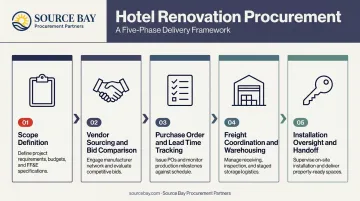
Renovation procurement moves through five connected phases. Each must hand off cleanly to the next; delays compound across the chain.
Step 1: Scope Definition and FF&E Budget Development
Everything starts with a detailed FF&E specification list covering every piece of furniture, fixture, textile, and equipment, broken out by room type, quantity, and specification. This document drives accurate budgeting and vendor outreach. A vague scope produces vague bids and constant change orders.
Source Bay's Discovery phase addresses this directly: the initial project evaluation aligns design intent with operational requirements and budget goals before any sourcing begins, producing a procurement-ready specification that bridges the gap between what a designer envisions and what the budget can actually deliver.
Step 2: Vendor Sourcing and Bid Comparison
With a clear scope in hand, the next phase involves identifying qualified manufacturers, issuing bid packages or RFQs, and evaluating proposals across price, lead time, product quality, and brand compliance.
This is where manufacturer relationships matter. Procurement specialists with established hospitality-grade networks can access better pricing, faster lead time commitments, and products built to commercial durability standards from the start.
Source Bay's sourcing network includes pre-vetted partners across every major FF&E category:
- Blue Leaf Hospitality — case goods and upholstered furniture
- Serta — commercial sleep solutions
- Schumacher and Fabricut — textiles and wallcoverings
- Remington Lighting — custom fixtures
Step 3: Purchase Order Management and Lead Time Tracking
Once vendors are selected and purchase orders issued, the work shifts to proactive monitoring. Lead times must be tracked against the renovation project schedule throughout production, not just at order confirmation. Production delays surface midstream, and identifying them early enough to source alternatives or adjust installation sequencing is the difference between a manageable schedule adjustment and a missed opening.
Step 4: Freight Coordination and Sequenced Warehousing
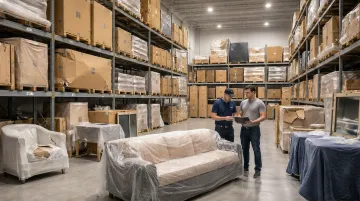
FF&E from multiple vendors arrives at different times. Items must be received, inspected, catalogued, and held in a staging warehouse until the renovation space is ready. Controlled sequencing prevents jobsite congestion and protects finished goods from damage during active construction.
The Logistics phase at Source Bay handles freight management and sequenced warehousing as a core service, coordinating delivery windows to construction milestones rather than flooding the property with all inventory at once.
Step 5: Installation Oversight and Final Project Handoff
The final phase: coordinated delivery to the property, supervised installation according to the design plan, punch-list review for damages or missing items, and formal project handoff. At completion, rooms move from renovation to revenue-generating inventory. Source Bay's Installation phase includes on-site placement oversight and quality control documentation for project closeout so that what was specified and sourced is delivered and installed to standard.
Key Factors That Affect Hotel Renovation Procurement
Not every renovation procurement challenge is the same. These factors shape the complexity and risk profile of any given project:
Renovation scope and type:
- Soft goods refresh (textiles, bedding, window treatments) — shorter lead times, fewer vendors, simpler logistics
- Full FF&E replacement — multi-vendor coordination, longer lead times, larger warehousing footprint
- Ground-up or gut renovation — maximum complexity across all dimensions
Phased vs. full-property renovation: Phased renovations in operational hotels introduce the tightest scheduling constraints. FF&E must arrive aligned to room block release schedules — not before (nowhere to store it safely) and not after (rooms sit empty waiting).
This demands tighter coordination between procurement, operations, and the general contractor than a straightforward full-property closure allows.
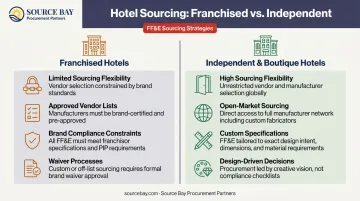
Brand compliance vs. independent flexibility: Franchised properties must source from approved vendor lists or navigate waiver processes. Independent boutique hotels and luxury resorts can specify custom or value-engineered alternatives with far less friction.
| Property Type | Sourcing Flexibility | Key Constraint |
|---|---|---|
| Franchised | Limited to approved lists | Brand compliance or waiver process |
| Independent / Boutique | High — custom or open-market | Design intent and budget |
Custom vs. stock items: Custom-manufactured FF&E — bespoke case goods, custom upholstery, branded textiles — carries higher production risk and much longer lead times than in-stock or semi-custom items. The mix between custom and stock items shapes the entire project timeline.
Logistics infrastructure: The heavier your custom item mix, the more your logistics infrastructure gets stress-tested. That means a qualified staging warehouse near the property, reliable freight routing, and experienced installation crews — all of which become harder to secure on short timelines.
CoStar documented that during 2021 supply chain disruptions, freight costs for a container carrying case goods for 12–15 rooms rose from $1,500 to more than $20,000. An extreme case — but a real illustration of what logistics exposure looks like when planning assumptions break down.
Common Mistakes Hotel Owners Make in Renovation Procurement
Treating It Like Operational Purchasing
The most frequent error. Hotel owners experienced with day-to-day supply management underestimate the lead time requirements and coordination complexity of FF&E procurement. Ordering "when the contractor is ready" is months too late for custom items. Sourcing from vendors without hospitality-grade product knowledge leads to delayed deliveries or mismatched spec items.
Relying on the Interior Designer to Manage Procurement
Designers specify. Managing the procurement process is a separate discipline entirely — one that covers purchase orders, production schedule tracking, freight coordination, and warehouse sequencing. Conflating the two roles leaves critical logistics gaps. By the time rooms are ready to furnish, those gaps have already cost you days or weeks of delays.
These gaps compound quickly when the third mistake enters the picture.
Ordering to Exact Count Without Attrition Buffer
Large renovation projects routinely see FF&E damage during transit or installation. Ordering to exact specification — with no buffer — puts room openings at risk while replacement pieces are sourced and reshipped. Build attrition allowances into the original purchase orders, not as an afterthought. A standard buffer typically runs 3–5% of total units, depending on item fragility and shipping distance. Factoring that buffer upfront eliminates the delay entirely — and rarely adds meaningful cost to the overall project budget.
Common FF&E attrition risks include:
- Case goods and glass elements damaged during long-haul freight
- Upholstered pieces with fabric defects discovered during final inspection
- Custom-finish items that can't be quickly reordered without full lead time
- Hardware and fixture components lost or damaged during installation
When to Partner with a Professional FF&E Procurement Firm
Self-managing procurement is viable for small, straightforward soft goods refreshes with short lead times, limited vendors, and no brand compliance requirements. Beyond that threshold, the risk increases faster than most owners anticipate.
Engage a specialist procurement firm when your project involves:
- Significant custom FF&E with extended lead times
- Multi-vendor coordination across multiple FF&E categories
- Phased renovation with a live, operational property
- Brand flag compliance requirements and approved vendor constraints
- International sourcing with freight complexity
- A first renovation without in-house procurement expertise
Source Bay Procurement Partners gives hotel owners access to the infrastructure that most in-house teams can't replicate at scale. That includes:
- A global network of hospitality-grade manufacturers with established pricing and lead time reliability
- Comprehensive freight management and sequenced warehousing
- Direct installation oversight through final project handoff
That procurement relationship also unlocks a cost lever most owners don't consider until the budget is already strained. Through Source Bay's partnership with sister company Neuco Furniture & Upholstery, existing FF&E can be assessed for structural viability before any replacement order is placed. Full refurbishment typically delivers 40–60% savings versus replacement; commercial upholstery restoration reaches 50–70% savings — a material reduction in renovation CapEx.
Frequently Asked Questions
What is the procurement process in a hotel?
Hotel procurement covers two distinct functions: operational procurement (daily supplies, food and beverage, linens) and capital procurement (FF&E for renovations and fit-outs). Renovation procurement runs a clear sequence: scope definition, vendor sourcing, purchase order management, freight coordination, warehousing, and installation oversight.
What are the 4 types of procurement in a hotel?
The four primary types are direct procurement (items used in service delivery), indirect procurement (operational supplies supporting the business), services procurement (contracted services like maintenance or staffing), and capital/FF&E procurement (furniture, fixtures, and equipment for renovations and fit-outs).
How long does FF&E procurement take for a hotel renovation?
For any project involving custom FF&E, planning should begin at least 6 months before the renovation start date. Most international products carry lead times of 14–18 weeks, with lighting and drapery running closer to 20 weeks — and heavily custom orders require even earlier engagement to absorb production and freight variables.
What is the difference between FF&E and OS&E in hotel renovations?
FF&E (Furniture, Fixtures & Equipment) refers to the capital items that define the guest environment — beds, seating, lighting, case goods. OS&E (Operating Supplies & Equipment) covers smaller operational items like hangers, toiletry dispensers, and service equipment. Both fall within renovation procurement scope but are typically managed and budgeted separately.
How can hotel owners minimize room downtime during renovation procurement?
Start procurement planning early, before construction begins. Structure the renovation in phases aligned to realistic FF&E delivery timelines. Use sequenced warehousing so FF&E is staged and ready for immediate installation when each room block is released by the general contractor.
Should I hire an FF&E procurement specialist or manage hotel renovation purchasing in-house?
In-house management works for small soft goods refreshes with minimal vendor complexity. For renovations involving custom FF&E, multiple vendors, brand compliance, or phased delivery in a live property, a specialist procurement firm is typically the lower-risk path. When attrition, freight complexity, and schedule risk are factored in, it's often the lower-cost path as well.