According to the AGC's 2023 Construction Hiring and Business Outlook Report, 63% of construction firms cited project delays due to supply chain or material availability issues. For FF&E-intensive projects with custom case goods, textiles, and commercial-grade lighting, that risk is amplified by long manufacturer lead times, sequenced delivery requirements, and zero-tolerance installation windows.
This guide walks through a practical, phase-by-phase framework for building a strategic procurement plan — one that keeps projects on budget, on schedule, and true to design intent from the first stakeholder meeting through final installation.
Key Takeaways:
- Strategic sourcing and procurement are distinct but interdependent — both must be planned early
- Current-state analysis and SMART objectives form the foundation of every effective plan
- Supplier evaluation should produce a vetted shortlist, not just the cheapest options
- KPIs and regular review cadences are what separate a living strategy from a static document
- Specialized FF&E procurement partners can compress timelines and surface value-engineered options that in-house teams often miss
What Is Strategic Sourcing and Procurement — and Why It Matters
These two terms are often used interchangeably, but they describe different things.
Strategic procurement is the long-term, structured approach to acquiring goods and services — aligning purchasing decisions with business objectives, setting supplier standards, managing risk, and tracking measurable outcomes. It stands in direct contrast to reactive purchasing, where orders get placed when someone notices something is missing.
Strategic sourcing is a specific activity within that broader framework. It's the process of identifying, evaluating, and selecting the right suppliers based on long-term value rather than lowest unit price. As CIPS defines it, strategic sourcing formalizes information gathering to identify best value aligned with long-term organizational goals — prioritizing total cost of ownership over transactional cost.
Together, sourcing and procurement form an integrated system: sourcing identifies who to buy from, and procurement manages everything that happens after that decision.
Why FF&E Projects Are Particularly Vulnerable
For hospitality, senior living, and multi-family development, the stakes of poor procurement planning are especially high. Consider:
- Custom case goods, upholstered furniture, and commercial lighting all carry manufacturer lead times that can span months
- Delivery sequencing must align precisely with installation schedules or the entire site workflow breaks down
- A single delayed category — say, custom textiles — can hold up room completion across an entire property
A 2021 AHLA survey found supply chain disruptions affected operations at 86% of U.S. hotels — and many of those disruptions traced back to procurement plans that didn't account for lead time risk or secondary sourcing options. Most were preventable with earlier, more disciplined planning.

Phase 1 — Assess Your Current State and Set Clear Objectives
The first phase of a strategic procurement plan is diagnostic: understand what's happening now before deciding what should happen next. For FF&E-intensive projects — hotels, senior living communities, multi-family developments — that means getting clear on spend patterns, supplier relationships, and category gaps before a single purchase order is written.
Start with a current-state analysis — map purchasing behaviors by category, identify who is buying what, and surface gaps in spend visibility. A SWOT analysis of your procurement function or a category positioning matrix (which plots categories by spend volume and supply risk) can give structure to what often feels like an overwhelming amount of data.
Conduct a Spend and Needs Analysis
A spend analysis breaks purchasing activity into meaningful categories — direct materials, FF&E, logistics, services — and examines frequency, volume, and vendor distribution. As CIPS notes, this process answers critical questions about compliance, spend control, and where consolidation or renegotiation opportunities exist.
For a hospitality renovation, this analysis might reveal that lighting fixtures are being sourced from five different vendors with no volume leverage, or that custom textiles are being ordered reactively rather than pre-specified at the design stage.
Procurement planning must begin at the design stage, not after specifications are finalized. By the time a furniture schedule is locked, lead times are already running.
Set SMART Procurement Objectives
Once the current state is understood, define objectives in measurable terms. The SMART framework — Specific, Measurable, Assignable, Realistic, Time-bound — applied to FF&E procurement might look like:
- Reduce procurement cycle time by 20% across all FF&E categories within the next project cycle
- Achieve on-budget delivery across all FF&E categories for the current development
- Secure at least two qualified secondary suppliers for each critical category within 90 days
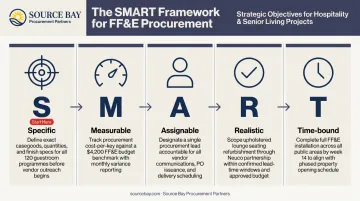
These objectives shouldn't be set by procurement alone. Operations, finance, design, and project management all need to review and agree on them before the strategy is built. Misalignment at this stage is where scope creep starts.
Phase 2 — Analyze the Market and Identify the Right Suppliers
With objectives established, attention shifts outward — to the supply market and the suppliers within it.
External market analysis covers supply availability, pricing trends, manufacturer capacity, and logistical or geopolitical risks that could disrupt sourcing. Structured tools like Porter's Five Forces or a PESTEL analysis help capture this in an organized way.
Gartner's 2024 research found that 42% of procurement leaders identified supply disruption as the top risk to procurement success. 89% of companies experienced a supplier risk event in the prior five years, with nearly two-thirds slow to respond because they lacked a continuous risk monitoring framework.
Evaluate and Shortlist Suppliers
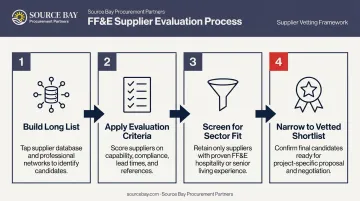
The supplier evaluation process starts broad and narrows deliberately:
- Build a long list from industry databases, trade shows, existing relationships, and referrals
- Apply evaluation criteria: quality standards, delivery reliability, financial stability, scale capacity, and alignment with project specifications
- Screen for sector fit: for hospitality and senior living, suppliers must demonstrate experience with commercial-grade products and relevant compliance standards
- Narrow to a vetted shortlist — not the cheapest options, but the most capable ones
Use RFIs, RFPs, and RFQs Appropriately
Each document type serves a distinct purpose (per ISM):
| Document | When to Use |
|---|---|
| RFI (Request for Information) | Early market assessment; gather capabilities before formal process |
| RFP (Request for Proposal) | Complex requirements; soliciting structured solutions |
| RFQ (Request for Quote) | Fully defined specifications; competitive pricing from qualified suppliers |
The goal of this process is a shortlist of suppliers you'd actually want to work with — evaluated on quality, reliability, and fit, not just price.
For specialized FF&E categories, established manufacturer relationships are what separate a fast shortlist from a months-long research effort. Source Bay Procurement Partners maintains a global network spanning case goods, commercial textiles, custom lighting, sleep solutions, and digital technology — meaning qualified, sector-specific suppliers are already vetted and accessible from day one.
Phase 3 — Build Policies, Manage Suppliers, and Implement the Plan
Strategy without governance doesn't hold. This phase turns decisions into documented policy and activates supplier relationships.
Procurement policies need to cover:
- Approval hierarchies and purchase order thresholds
- Preferred vendor lists and how they're maintained
- Contract terms standards across categories
- Compliance requirements by project type
Clear policies prevent maverick spending and give every stakeholder a defined decision-making framework — especially important on large projects where multiple teams are placing orders simultaneously.
Develop Your Sourcing and Contract Strategy
Not all categories warrant the same procurement approach. The Kraljic Matrix — which maps purchases by profit impact and supply risk — is a useful tool for determining appropriate sourcing treatment:
- Strategic items (custom FF&E): Long-term preferred supplier agreements, performance guarantees, design-review checkpoints
- Non-critical items (standard fixtures, generic textiles): Competitive bidding, shorter contract terms
Contract negotiation for FF&E procurement should specifically address:
- Volume pricing and lead time commitments
- Quality specifications and inspection standards
- Freight responsibilities and packaging requirements
- Damage protocols and replacement procedures
- Punch-list resolution timelines and processes
Supplier Onboarding and Relationship Management
Supplier onboarding establishes the foundation of every working relationship. Before the first order is placed, that means collecting compliance documentation, confirming production timelines, establishing communication protocols, and aligning on performance expectations.
Ongoing supplier relationship management (SRM) keeps those relationships productive throughout the project lifecycle:
- Regular performance reviews against agreed KPIs
- Proactive communication on lead time changes or production issues
- Maintained secondary supplier options for critical categories
For large FF&E projects, a sequenced delivery and warehousing plan — aligned to the supplier's production schedule — is essential for installation readiness. Arriving two weeks ahead of the installation window can be just as disruptive as arriving two weeks late.
This is where logistics coordination becomes as important as sourcing itself. Source Bay's operations team manages freight and sequenced warehousing calibrated to project timelines — so what arrives on site arrives in the right order, at the right time.
How to Track and Refine Your Procurement Strategy
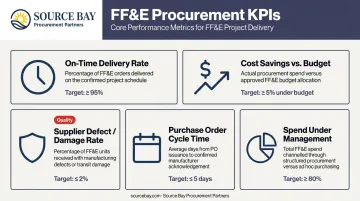
Tracking the right metrics turns a procurement plan into a system that compounds over time. For FF&E and commercial procurement, the most relevant KPIs are:
- On-time delivery rate — percentage of orders delivered per agreed schedule
- Cost savings vs. budget — actual spend against approved FF&E budget
- Supplier defect/damage rate — percentage of units arriving with quality or damage issues
- Purchase order cycle time — days from need identification to issued PO
- Spend under management — percentage of total spend governed by the procurement plan
Review Cadence
Structure reviews at two levels:
- Monthly operational reviews: Track delivery performance, supplier issues, and active order status
- Quarterly strategic reviews: Assess spend trends, upcoming contract renewals, and whether stated objectives are being met
These cadences only work if underperforming KPIs trigger a structured root-cause review, not just a line item in meeting notes. Across successive project cycles, that discipline tends to surface patterns: a supplier consistently missing lead times, a damage rate concentrated in one freight lane, a PO process bottleneck adding days to every order. Fixing those specifically is what shortens timelines and reduces costs project after project.
When to Partner With a Specialized FF&E Procurement Firm
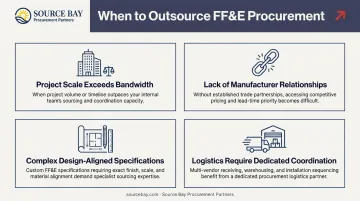
In-house procurement has clear limits. The most common triggers for engaging a specialist:
- Project scale exceeds internal bandwidth — multiple FF&E categories, hundreds of units, tight installation windows
- Lack of established manufacturer relationships — building a qualified supplier network from scratch takes years
- Complex specifications require design-aligned sourcing — selecting commercial-grade products that match design intent isn't a general procurement skill
- Logistics require dedicated coordination — freight management, damage protocols, and sequenced warehousing need operational infrastructure
A qualified partner addresses all of these gaps. At Source Bay Procurement Partners, the engagement model covers design-aligned product specification, manufacturer relationship management, freight coordination, sequenced warehousing, and direct on-site installation oversight.
The Discovery phase alone — which aligns design intent with operational requirements and establishes budget feasibility — resolves many of the misalignments that cause downstream cost overruns and delays.
Source Bay's global network spans manufacturers across every major FF&E category: Blue Leaf Hospitality (case goods), Kellex Furniture (senior living seating), Remington Lighting (custom fixtures), Schumacher and Fabricut (textiles), and Serta (commercial sleep solutions). For clients, supplier identification isn't a search process — those relationships are already in place.
There's also a longer-term consideration: what happens to FF&E assets after installation? Source Bay's partnership with sister company Neuco Furniture & Upholstery provides an integrated refurbishment capability that combines new procurement with artisanal restoration. Clients get a single point of accountability across the full asset lifecycle, from first installation through long-term maintenance.
Frequently Asked Questions
What is the difference between strategic sourcing and procurement?
Strategic sourcing is the targeted process of identifying and selecting suppliers based on long-term value, quality, and fit — not just lowest price. Procurement is the broader end-to-end function encompassing ordering, managing, receiving, and paying for goods. Sourcing is one critical activity within the larger procurement lifecycle.
How long does it take to develop a strategic procurement plan?
A mature strategy typically takes two to five years to fully develop across an organization, but an initial operational plan can be built in weeks. For project-based FF&E procurement, the plan should begin at the earliest stage of design — well before specifications are finalized and lead times start running.
What are the biggest risks in FF&E procurement and how can they be managed?
The primary risks are long lead times, supply discontinuation, freight damage, and installation sequencing failures. Managing them requires secondary supplier designations, early order placement, sequenced warehousing, and contracts that clearly define freight responsibilities and damage protocols.
When should a company outsource its procurement strategy?
Outsourcing makes sense when internal teams lack specialized supplier networks, project complexity exceeds bandwidth, or the cost of errors — delays, overruns, non-compliant products — outweighs the cost of a professional firm. For FF&E-heavy hospitality and senior living projects, that threshold arrives sooner than most developers anticipate.
What KPIs should I track to measure procurement success?
Core KPIs include on-time delivery rate, cost savings versus approved budget, supplier defect rate, purchase order cycle time, and spend under management. The right mix depends on project objectives — a lead-time-focused plan will weight cycle time KPIs differently than one targeting cost consolidation.
How do I choose the right suppliers for a large-scale hospitality or senior living project?
Evaluate suppliers on commercial-grade experience, delivery reliability, production capacity, financial stability, and design specification alignment. A structured RFP or RFQ process with defined scoring criteria is the most reliable way to build a vetted shortlist.