
The consequences of getting it wrong compound quickly: opening delays, budget overruns, brand audit failures, and accelerated replacement cycles that erode returns for years after a property opens. Getting it right, by contrast, creates measurable advantages across guest satisfaction, operational efficiency, tax planning, and long-term asset value.
This article explains what hotel FF&E actually is, why the distinctions around it matter operationally and financially, and how to extract real value from procurement decisions — not just check a design box.
Key Takeaways
- FF&E (Furniture, Fixtures, and Equipment) covers all movable or semi-fixed assets inside a hotel that are not part of the permanent building structure
- According to the HVS 2025 U.S. Hotel Development Cost Survey, FF&E accounts for roughly 8–10% of total hotel development cost, with a median of $21,000 per room
- Strategic FF&E decisions directly affect guest satisfaction scores, brand audit results, and long-term maintenance costs
- FF&E qualifies for depreciation under IRS rules, including accelerated deductions under Section 179
- Poor FF&E planning causes schedule delays, inconsistent guest experience, and costly reactive replacement cycles
What Is Hotel FF&E?
FF&E stands for Furniture, Fixtures, and Equipment. HVS defines it as "pieces of movable furniture, fixtures, or other equipment that have no permanent connection to the structure of a building or utilities" — meaning everything guests see, touch, and use that isn't structurally built in.
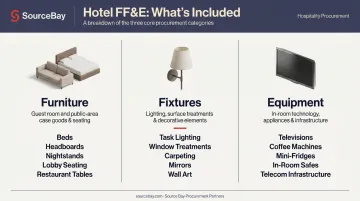
The Three Categories in Practice
Furniture
- Guestroom casegoods: beds, headboards, nightstands, dressers
- Lobby and lounge seating: sofas, armchairs, ottomans
- Restaurant and meeting room chairs and tables
Fixtures
- Task and decorative lighting
- Window treatments, drapes, and carpeting
- Mirrors, wall art, and bathroom fixtures
Equipment
- Televisions and in-room digital displays
- Coffee machines, mini-fridges, in-room safes
- Kitchen and laundry equipment, telecom infrastructure
A completed hotel building without FF&E is an empty shell — architecture provides the frame, but FF&E is what makes it a place worth staying in.
FF&E vs. OS&E: Why the Distinction Matters
FF&E and OS&E (Operating Supplies and Equipment) are frequently confused in budget planning — and that confusion creates real problems.
The difference comes down to how each category is classified and when it needs to be sourced:
- OS&E (linens, towels, tableware, toiletries, housekeeping carts) is an operating expense. Per HFTP's Uniform System of Accounts for the Lodging Industry (USALI), these items sit within hotel operating schedules — not the capital asset category.
- FF&E is a capital expenditure with defined depreciation schedules and formal design approval processes.
Why Mixing Them Up Costs Money
| Category | Budget Classification | Lead Times | Planning Horizon |
|---|---|---|---|
| FF&E | Capital expenditure | 14–18 weeks (international) | Design development |
| OS&E | Operating expense | Shorter cycles | Closer to opening |
The timing gap is where budget problems begin. FF&E requires manufacturer selection, sample approvals, custom production, freight coordination, and sequenced installation — all of which must start months before opening. OS&E can be ordered much closer to that date.
According to the HVS 2025 Development Cost Survey, the median FF&E cost per room is $21,000 against a median total development cost of $218,556 — roughly 8–10% of the total project budget. Misclassifying items between categories distorts both the capital budget and the operating expense forecast — sometimes by hundreds of thousands of dollars on a mid-size property.
Key Advantages of Hotel FF&E
Strategic FF&E investment produces measurable, trackable outcomes — not just a better-looking property.
Guest Experience and Brand Compliance
FF&E is the primary physical interface between a hotel and its guests. Every bed, chair, fixture, and finish shapes comfort, perception, and whether that guest books again or posts a negative review.
The commercial link between physical property quality and revenue is well-documented. A Cornell-linked study, reported by Travel Weekly, found that a 1-point increase in a hotel's online reputation index correlates with 0.89% higher ADR, 0.54% higher occupancy, and 1.42% higher RevPAR. The J.D. Power 2025 North America Hotel Guest Satisfaction Index found satisfaction 68 points higher among guests who experienced a property where investment was evident.
Brand compliance adds a separate risk dimension. Franchise disclosure documents from Marriott, Hilton, and Holiday Inn all require compliance with brand FF&E standards and reserve rights for inspections, Property Improvement Plans (PIPs), default remedies, and in extreme cases, flag termination. Holiday Inn's FDD includes a PIP inspection fee of $6,500 — and that's before any required remediation.
KPIs impacted: Guest satisfaction (CSAT/NPS), online review ratings, brand audit pass rates, repeat booking rate, RevPAR
Most critical for: New openings, brand conversions, post-renovation relaunches, and any PIP-driven project
Operational Efficiency and Maintenance Cost Control
Specification decisions made during procurement carry multi-year cost consequences. Commercial-grade furniture — selected for durability, ease of cleaning, and structural longevity — reduces repair frequency, extends replacement cycles, and lowers total cost of ownership per room.
Under-specified FF&E degrades faster under hotel-use intensity than residential equivalents. A guestroom bed frame takes significantly more stress than a comparable residential piece, and the financial gap widens over time:
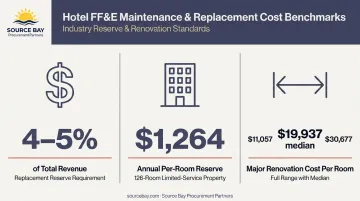
- Hotel lenders and investors typically require replacement reserves of 4–5% of total revenue
- For a 126-room limited-service hotel, that's approximately $1,264 per room annually set aside for replacement
- Major renovations average $19,937 per room, ranging from $11,057 to $30,677
The Association for Contract Textiles sets 50,000 Wyzenbeek double rubs as the commercial high-traffic threshold for upholstery fabrics. Any hotel fabric spec that doesn't reference this threshold is under-specified.
KPIs impacted: Maintenance request frequency, repair and replacement costs, renovation cycle interval, total cost of ownership per room
Most critical for: High-occupancy properties, limited-service hotels with lean maintenance teams, portfolio operators managing multiple properties
Asset Value, Tax Benefits, and Long-Term ROI
FF&E is a capital investment with defined depreciation schedules, which makes procurement decisions financially significant well beyond the immediate project.
Under IRS Publication 946, most hotel FF&E qualifies as depreciable business property. Common MACRS classifications include 5-year property for computers and peripheral equipment and 7-year property for office furniture and fixtures.
Two provisions can accelerate deductions significantly:
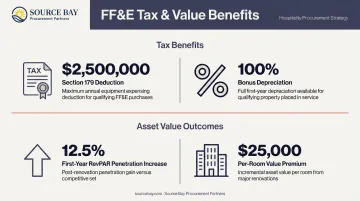
- Section 179: For tax years beginning in 2025, the maximum deduction is $2,500,000, phasing out above $4,000,000 in eligible property placed in service
- Bonus depreciation: Following the One Big Beautiful Bill Act, qualifying property acquired after the specified effective date can qualify for 100% additional first-year depreciation
Beyond tax, planned renovation drives asset value directly. HVS found that major renovations produced a 12.5% first-year RevPAR penetration increase and created a value premium of approximately $25,000 per room — often exceeding the initial capital investment.
KPIs impacted: Tax liability, depreciation schedule, NOI, property valuation, ROI
| Priority | Most Critical For |
|---|---|
| New builds & major renovations | Full depreciation and bonus deduction eligibility |
| Ownership transitions | Asset valuation and NOI improvement |
| Tax-focused projects | Section 179 and accelerated depreciation planning |
Tax provisions change. Consult a qualified tax advisor before making procurement decisions based on specific deduction assumptions.
What Happens When FF&E Is Mismanaged
The costs of poor FF&E planning aren't hypothetical — they're operational and financial, and they compound.
Schedule slippage is the most common consequence. HVS renovation timelines require 16 weeks to order FF&E and 12 weeks to order model-room furniture. Lodging Magazine reported in 2023 that lead times on most international products run 14–18 weeks even after pandemic-era supply chain disruptions eased. Starting procurement late means opening late, and for hotels, delayed openings translate directly to lost revenue.
Brand and revenue consequences follow quickly:
- Inconsistent finishes across room types trigger PIP requirements from franchisors
- Damaged or mismatched fixtures lower guest satisfaction scores
- Lower scores translate to lower ADR, occupancy, and RevPAR — the Cornell data makes that connection clear
The budget penalty is structural, not one-time:
- Reactive replacement (buying outside a planned cycle) eliminates economies of scale
- Design consistency breaks down when replacement items don't match the original specification
- Per-unit costs for unplanned procurement are significantly higher than planned batch purchasing
- Emergency procurement often means accepting whatever a single supplier has available, not what the spec requires
How to Get the Most Value from Your Hotel FF&E
FF&E value is maximized when procurement begins early — during design development, not after construction documents are finalized. HVS's conceptual renovation schedule shows design documents taking 2.5 to 6 months, with FF&E orders requiring 16 weeks and model-room furniture requiring 12 weeks on top of that. Starting procurement after these milestones is already behind schedule.
What early procurement enables:
- Specification alignment with brand standards before orders are placed
- Manufacturer and sample approvals without time pressure
- Coordinated delivery sequenced with construction milestones
- No last-minute substitutions that break design consistency or violate brand standards
Most opening-day delays trace back to one decision: when procurement started. Teams that initiate the process during design development rarely scramble at the finish line. Those that wait until construction is nearly complete almost always do.
Working with a procurement partner who manages the full lifecycle — from design alignment and vendor sourcing through freight coordination, sequenced warehousing, and installation oversight — closes the gaps where most projects lose time and budget.
Source Bay Procurement Partners handles this end-to-end across boutique hotel and luxury resort projects, from initial Discovery through final Installation handoff, with sequenced warehousing ensuring every item arrives when the site is ready to receive it.
Once installation is complete, tracking outcomes matters just as much. Maintenance logs, guest feedback, and brand audit results reveal whether FF&E is performing as specified. That data informs smarter decisions at the next renovation cycle and can identify where refurbishment, rather than full replacement, is the more cost-effective path.
Conclusion
Hotel FF&E is not a design checklist. It is a capital investment that affects guest experience, brand compliance, operational costs, tax planning, and long-term property valuation.
That value holds when procurement is executed correctly: right items, commercial-grade specifications, on-schedule delivery, and proactive maintenance built into the plan from the start. Poor planning, by contrast, creates cascading costs — delayed openings, PIP remediation, early replacement cycles, and guest satisfaction scores that are difficult to recover from.
Given that FF&E represents roughly 8–10% of total development cost — and given its direct line to RevPAR, asset value, and tax efficiency — the procurement decisions made before a single piece of furniture arrives on-site will shape how that property performs for the next seven to ten years. That is not a purchasing decision. It is an asset management decision — and it deserves to be treated as one.
Frequently Asked Questions
What is FF&E for a hotel?
Hotel FF&E stands for Furniture, Fixtures, and Equipment — the movable or semi-fixed assets inside a hotel (beds, casegoods, lighting, TVs, and more) that are not part of the permanent building structure. They shape the guest experience directly and rank among the largest capital expenditures in hotel development.
What is the difference between FF&E and OS&E in hotels?
FF&E covers longer-life physical assets — furniture, fixtures, and equipment — classified as capital expenditures with depreciation schedules. OS&E (Operating Supplies and Equipment) covers day-to-day consumables like linens, towels, and amenities, treated as operating expenses with separate procurement timelines and budget classifications.
Is hotel FF&E tax deductible?
Yes. FF&E owned by the taxpayer, used in business, and with a useful life over one year qualifies for depreciation deductions under IRS rules. Section 179 and bonus depreciation may allow accelerated deductions in the purchase year — consult a tax professional for property-specific guidance.
How much of a hotel's development budget should go toward FF&E?
The HVS 2025 U.S. Hotel Development Cost Survey places FF&E at approximately 8–10% of total development cost, with a median of $21,000 per room. The actual figure varies based on hotel positioning, room count, material grade, and degree of customization.
When should FF&E procurement start for a new hotel or renovation?
Procurement should begin during design development — ideally months before construction is complete. Custom manufacturing, material approvals, and international freight all require significant lead time (14–18 weeks for most international products). Starting late is one of the most common causes of hotel opening delays.
What does an FF&E procurement company do?
An FF&E procurement partner manages the full sourcing lifecycle — from design alignment and vendor selection through freight coordination, warehousing, delivery, and installation — serving as a single point of accountability that keeps complex, multi-vendor projects on schedule and within budget.