
Introduction
Every day, roughly 11,000 Baby Boomers turn 65. By 2030, all Baby Boomers will be 65 or older, creating a demand wave that the current supply pipeline simply cannot absorb. CBRE projects the U.S. needs more than 250,000 additional senior housing units through 2027 — yet only about 20,034 units were under construction as of Q3 2025.
That gap is driving intense activity among a handful of major developers, operators, and REITs who are building far more than apartments. They're constructing full campuses with independent living, assisted living, and memory care under one roof: communities designed so residents can age in place without relocating as their needs change.
This article profiles five of the most prominent developers shaping senior housing in America today — who they are, what sets their approach apart, and what matters most when evaluating them as a development partner.
Key Takeaways
- Brookdale holds the No. 1 operator spot with 53,510+ units across 41 states
- Discovery Senior Living added 4,507 units in a single year, ranking among the sector's fastest-growing operators
- Welltower leads as the largest owner with 112,641+ units across the U.S., Canada, and the UK
- Dominium specializes in affordable senior housing through LIHTC financing, with a $300M development pipeline
- Oakmont targets the luxury end of the market, adding 1,811 units in 2025 across California and the western U.S.
Overview of Senior Housing Development in America
Before profiling specific companies, it helps to understand the roles in play — because "developer," "operator," and "owner" are not interchangeable.
- Developers finance and build the physical community
- Operators manage day-to-day care, staffing, and programming
- Owners/REITs hold the real estate assets and typically contract operators separately
- Many companies play multiple roles — Brookdale operates and owns some of its communities; Welltower holds assets while partnering with outside operators
What the Supply Data Tells Us
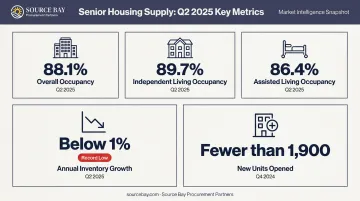
The current pipeline is historically constrained. NIC MAP data shows senior housing occupancy reached 88.1% in Q2 2025, up from 87.3% the prior quarter. Key figures at a glance:
- Overall occupancy: 88.1% (Q2 2025)
- Independent living: 89.7%
- Assisted living: 86.4%
- Annual inventory growth: below 1% year-over-year, a record low
- New units opened: fewer than 1,900 in Q4 2024
High-occupancy markets like Boston, San Francisco, and Baltimore signal where demand pressure is most acute, even as new construction lags nationally.
The five developers profiled below were chosen for their portfolio scale, pipeline depth, geographic reach, and demonstrated ability to deliver large-scale communities across multiple care types.
Top Senior Housing Developers in America
Selection criteria: portfolio size, unit pipeline, geographic diversity, care-type coverage, and demonstrated ability to execute complex multi-care developments.
Brookdale Senior Living
Brookdale is the largest senior living operator in the United States and has held that position on the ASHA 50 ranking since 2019. Headquartered in Brentwood, Tennessee, the company operates 647 communities across 41 states as of year-end 2024.
No other operator matches Brookdale's geographic coverage or care-type range. Its 2024 portfolio included 12,581 independent living units, 33,524 assisted living and memory care units, and 4,734 CCRC units.
In early 2025, the company completed the acquisition of 25 communities and 875 units previously leased from Diversified Healthcare Trust for $135 million, further expanding its real estate ownership position.
| Category | Detail |
|---|---|
| Geographic Reach | 41 states nationwide |
| Managed Units | 53,510+ (2025 ASHA 50) |
| Care Types | Independent living, assisted living, memory care, CCRCs |
Discovery Senior Living
Discovery has grown faster than almost any other major operator in the sector. Headquartered in Bonita Springs, Florida, the company ranked No. 2 on the 2025 ASHA 50 , adding 4,507 units between 2024 and 2025 alone.
The company's differentiation is its Experiential Living model: a lifestyle-first approach to senior housing built around curated programming, chef-driven dining through its Sensations Dining concept, and fitness programming via FitCamp. Discovery operates several distinct brands (Discovery Village, Conservatory, Morada, TerraBella, SummerHouse, and LakeHouse), serving varied markets under one corporate umbrella.
Its geographic concentration in Southeast and Sun Belt states positions it squarely in the highest-growth demographic corridors.
| Category | Detail |
|---|---|
| Geographic Reach | Primarily Southeast and Sun Belt states |
| Managed Units | 39,236+ (2025 ASHA 50) |
| Care Types | Independent living, assisted living, memory care |
Welltower
Welltower is a real estate investment trust (REIT) headquartered in Toledo, Ohio. It doesn't operate communities directly; it owns the assets and partners with operators to manage them. That structure makes it the largest senior housing owner in the country.
The 2025 ASHA 50 placed Welltower at No. 1 on the owner rankings with 112,641 units across 1,067 properties. It added nearly 10,000 units from 2024 to 2025. In Q3 2025, Welltower reported $1.9 billion in pro rata gross investments, including $96 million in development funding , signaling continued aggressive expansion.
Welltower's reach extends beyond the U.S. into Canada and the United Kingdom, making it the most internationally diversified entity on this list.
| Category | Detail |
|---|---|
| Geographic Reach | United States, Canada, United Kingdom |
| Owned Units | 112,641+ (2025 ASHA 50) |
| Investment Focus | Senior housing, outpatient medical, health systems |
Dominium
Dominium occupies a distinct niche: affordable senior housing development. Based in Plymouth, Minnesota, the company manages approximately 40,000 units across nearly 20 states, with senior-focused communities operating under the "Legends" brand, including The Legends of Woodbury and The Legends of Apple Valley.
The company's development engine runs primarily on Low Income Housing Tax Credit (LIHTC) financing. A recent example: a partnership with Blackstone deployed $79 million in LIHTC equity to fund more than 500 affordable family and senior housing units in Arizona. Dominium's active development pipeline stands at $300 million, though this figure spans both family and senior housing.
What Dominium proves is that affordable senior living doesn't have to mean bare-bones design. Its communities routinely include fitness centers, community gardens, and social programming spaces at accessible price points.
| Category | Detail |
|---|---|
| Geographic Reach | Primarily Midwest; expanding nationally |
| Development Pipeline | $300M pipeline (family and senior housing) |
| Specialization | Affordable independent senior living ("Legends" brand) |
Oakmont Senior Living
Oakmont sits at the luxury end of the market, and its growth numbers reflect strong demand at that price point. Headquartered in Irvine, California, Oakmont operates luxury senior living communities across California, Nevada, and Hawaii, ranking No. 12 on the 2025 ASHA 50 operator list with 11,536 units.
The company added 1,811 units in a single year, substantial growth for a luxury-segment operator. Oakmont communities are built around resort-caliber amenities: community theaters, chef-prepared restaurant-style dining, resort pools and spas, and pet-friendly environments. Interior design and FF&E quality are central to the brand's positioning, reflecting the expectations of high-net-worth residents.

That finish quality is where procurement becomes strategic. FF&E partners like Source Bay Procurement Partners work with luxury senior living developers to ensure custom textiles, fixtures, and furnishings align with the design intent and arrive on schedule, protecting the brand promise at every phase of delivery.
| Category | Detail |
|---|---|
| Geographic Reach | California, Nevada, Hawaii (80+ communities) |
| Managed Units | 11,536 (2025 ASHA 50) |
| Specialization | Luxury independent living, assisted living, memory care |
How We Chose the Top Senior Housing Developers
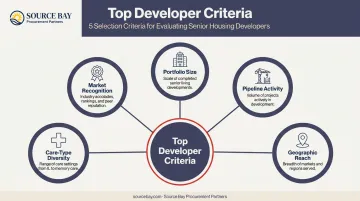
These five were selected using a consistent framework:
- Portfolio size — total managed or owned units as reported by the 2025 ASHA 50
- Pipeline activity — units recently added or under active development
- Geographic reach — ability to serve diverse markets across multiple states or regions
- Care-type diversity — capacity to deliver IL, AL, memory care, or CCRCs
- Market recognition — placement on the ASHA 50, the annual ranking published by the American Seniors Housing Association
Top developers don't succeed on scale alone — they invest in the partner ecosystems around them, including architects, operators, and FF&E procurement specialists. For communities being built or renovated, the difference between a move-in-ready opening and a delayed one often comes down to logistics and supply chain execution.
Firms like Source Bay Procurement Partners, which provide turnkey FF&E procurement with sequenced warehousing and on-site installation oversight, are part of how major developers protect their project timelines.
This list is not exhaustive. Developers with significant senior housing pipelines — including Ryan Companies, The Related Companies, Greystar, and LCS — deserve consideration depending on project type and geography.
Conclusion
The senior housing development landscape is being shaped by fundamentally different types of organizations: national operators like Brookdale, lifestyle-focused growth companies like Discovery, capital-backed REITs like Welltower, affordable housing specialists like Dominium, and luxury community builders like Oakmont. Each brings different strengths to the same underlying demographic reality.
For investors, operators, and development stakeholders evaluating potential partners, brand reputation and unit count are starting points, not endpoints. Execution capability matters: financial stability, care-type expertise, design quality, and the strength of the partner ecosystem surrounding each development.
For senior living developers and operators furnishing new or renovated communities, Source Bay Procurement Partners provides turnkey FF&E procurement built specifically for the senior living sector. Services span custom textiles and specialized fixtures through to coordinated logistics and on-site installation. Reach out at hello@sourcebay.com or (231) 943-3455 to discuss your next project.
Frequently Asked Questions
Who are the largest senior housing developers in America?
The 2025 ASHA 50 places Brookdale as the largest operator (53,510+ managed units) and Welltower as the largest owner (112,641+ owned units). "Largest" depends on what you're measuring — managed units, owned units, or active development pipeline are all distinct categories.
What is the 80/20 rule for 55+ communities?
Under 24 CFR 100.305, at least 80% of occupied units in a qualifying 55+ community must be occupied by at least one person aged 55 or older. The remaining 20% may be occupied by younger residents without the community losing its age-restricted status under the Fair Housing Act.
What types of housing do senior housing developers typically build?
The primary categories are independent living (IL), assisted living (AL), memory care, skilled nursing, and continuing care retirement communities (CCRCs) — which combine multiple levels on a single campus. Most large developers now build communities that include at least two or three of these care types.
How do senior housing developers differ from senior housing operators?
Developers finance and build the physical community; operators manage day-to-day care, staffing, and resident programming. Some companies — like Brookdale — do both. REITs like Welltower own the real estate assets and contract with independent operators to run the communities.
What amenities are standard in modern senior housing communities?
Today's leading communities typically include fitness centers, chef-driven dining venues, wellness and therapy spaces, salons, community gardens, theaters, and curated social programming.
What factors should I consider when evaluating a senior housing developer?
Focus on portfolio track record, geographic presence, care-type expertise, financial backing, and reputation for on-schedule delivery. Also weigh the strength of their partner ecosystem: operators, interior designers, and procurement specialists all shape whether a large-scale project actually lands on time and on budget.