Introduction
In any hotel renovation or new build, casegoods represent one of the most consequential categories in the FF&E budget. They occupy the majority of visual real estate in a guestroom, absorb more daily physical abuse than nearly any other furnishing, and are among the first things a guest notices — and the last things an ownership group wants to replace ahead of schedule.
Poor casegood decisions show up fast: in online reviews, in PIP non-compliance findings, and in premature replacement costs that far exceed what better specifications would have cost upfront. Smart decisions, made early, pay dividends for a decade or more.
What follows is a practical resource for project teams making those decisions — covering material construction, durability standards, brand compliance, technology integration, and the standard-versus-custom tradeoff at every stage of procurement.
Key Takeaways
- Hotel casegoods are hard-surface, storage-forward furniture pieces that define a guestroom's functional layout
- Material construction — face, core, and edge — is the single most consequential early decision in any casegood specification
- Commercial-grade casegoods should be engineered for a 7–10 year minimum lifecycle under daily use
- Brand compliance, technology integration, and sustainability standards must be locked in at spec — not retrofitted later
- Custom and standard casegoods each have a place — the best projects often use both strategically
What Are Hotel Casegoods?
Hotel casegoods are the hard-surface, non-upholstered furniture pieces — built from wood-based panels, metal, or glass — that form the structural backbone of a guestroom. Unlike upholstered pieces (lounge chairs, sofas, headboard fabric panels) or occasional furniture (accent tables, decorative stools), casegoods carry the functional load of how guests actually live in the space.
Common Casegood Pieces Found in Hotel Rooms
Most guestrooms include some combination of the following:
- Nightstands — primary surface for charging, lighting, and guest controls
- Dressers and drawer chests — storage for extended-stay guests
- Wardrobes or open closet units — hanging and folded-item storage
- Writing desks — work and dining surface; increasingly multifunctional
- Luggage benches — built for weight tolerance, not just aesthetics
- Headboards and wall panels — structural anchors for the room's design
- Media consoles — housing for in-room technology
- Minibar or cellarette units — beverage and refrigeration housing
The piece types are fairly universal across hotel tiers. What differs significantly — and what separates a well-specified room from one that ages poorly — is how each piece is built.
How Hotel Casegoods Are Constructed: Face, Core, and Edge
Every casegood panel has three distinct components, as described by hospitality manufacturer Artone:
- Face — the visible surface. Options include high-pressure laminate (HPL), low-pressure/thermally fused laminate (TFL), wood veneer, or painted MDF. The face sets the room's aesthetic tone and determines scratch, moisture, and UV resistance.
- Core — the internal substrate. Plywood offers superior structural strength and screw-holding capacity. Particleboard and MDF are more cost-effective and suit lower-traffic applications or interior components.
- Edge — the perimeter treatment. PVC banding, solid wood edge, or laminate self-edge protect the panel and signal overall build quality. Kimball Hospitality applies a moisture-resistant barrier to every exposed casegood edge to extend service life.
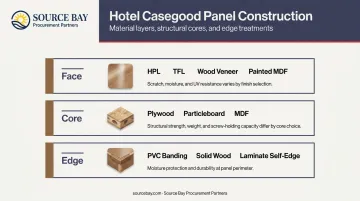
Material combinations are selected by project context. A limited-service property focused on durability and cleanability might specify HPL faces over particleboard cores.
A luxury property prioritizing premium aesthetics typically opts for natural wood veneer faces — which Bernhardt Hospitality notes resist shrinking, swelling, and warping better than solid wood — over plywood cores with solid edge detailing.
Why Casegoods Are Central to Hotel FF&E Planning
Casegoods carry disproportionate weight in the FF&E scope. They take the most physical abuse from daily use, are the most visible to guests at check-in, and are the most expensive category to replace mid-cycle.
The 2025 J.D. Power North America Hotel Guest Satisfaction Index — covering nearly 40,000 branded hotel guests — tracks the condition of guestroom furnishings and décor as a measured component of overall guest satisfaction. That it's tracked at all confirms what experienced operators already know: furniture condition matters to guests, and degraded condition gets noticed.
On the replacement side, TPG Hotels' PIP planning data indicates casegoods typically cycle at approximately 14 years under proper specification — a benchmark that assumes commercial-grade materials and construction from the outset. Under-specified materials compress that cycle significantly, forcing unplanned replacement that disrupts operations and requires brand approval.
Those replacement consequences make early specification critical — because lead times leave no room for late decisions. According to Innvision, domestic casegood production runs 12–16 weeks after purchase order, with overseas manufacturing at 16–18 weeks. Casegoods must be among the first categories locked into the procurement schedule — late specification changes cascade into delays across the entire project opening.
What to Consider When Choosing the Right Hotel Casegoods
Casegood selection touches every downstream outcome that matters: guest satisfaction, asset lifecycle, and total cost of ownership. Each factor below connects a specification decision to a real project result.
Material Quality and Construction Standards
Material selection is the most consequential early decision in the specification process:
- Face material determines aesthetic durability — resistance to scratches, moisture, and surface wear
- Core material determines structural integrity under sustained use and load
- Edge treatment signals build quality and protects against moisture infiltration at the most vulnerable point of any panel
HPL, as described by Wilsonart, is bonded under high heat and pressure exceeding 1,000 psi, making it one of the most durable options for high-touch commercial furniture surfaces. TFL/LPL is appropriate for interior cabinet components and vertical surfaces where extreme wear resistance is less critical.
From a compliance standpoint, commercial-grade casegoods should meet BIFMA X5.5 (desk and table products) or X5.9 (storage units) voluntary performance standards. More critically, any composite wood product sold or installed in the US must comply with TSCA Title VI — the federal formaldehyde emissions law — with specific emission limits of 0.05 ppm for hardwood plywood, 0.09 ppm for particleboard, and 0.11 ppm for MDF. Specifying materials without confirming TSCA Title VI compliance creates real legal and brand-audit risk.
Durability and Expected Asset Lifecycle
Hospitality casegoods should be built for a minimum 7–10 year lifecycle under daily commercial use — a benchmark cited by casegood manufacturer WoodgeniX. Hitting that target requires specifying beyond aesthetics:
- Abrasion resistance on face materials
- Hinge cycle ratings — ANSI/BHMA A156.9-2026 requires 100,000 cycles for Grade 1 cabinet hinges
- Moisture tolerance, particularly in rooms with in-room beverage stations or humid climates
- Screw-holding capacity of core materials, which is significantly higher in plywood than particleboard
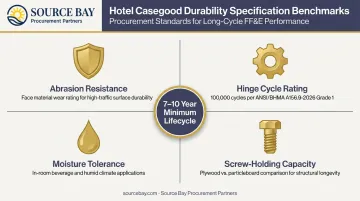
The hidden cost of under-specifying is significant. Replacing casegoods before a property's standard renovation cycle requires brand approval, disrupts operations, and produces replacement costs that consistently exceed the upfront difference between commercial-grade and value-grade materials.
Brand Compliance and Design Alignment
For franchised properties — Marriott, Hilton, Hyatt, IHG, Wyndham — casegoods must comply with brand-approved finish palettes, hardware specifications, and dimensional standards. The consequences of non-compliance are real: Hyatt's franchise agreements permit termination for brand-standard defaults, and Marriott's 2024 franchise disclosure documents list a $10,000 re-evaluation fee for incomplete PIP work.
For independent and boutique properties, brand compliance gives way to design alignment — ensuring casegoods fit the property's identity, target guest profile, and competitive positioning.
Either way, coordinating casegoods within the full interior package requires early alignment across three parties:
- Procurement team (lead times, cost, compliance)
- Interior designer (finish palettes, dimensional fit, material spec)
- Brand liaison (approval authority, PIP requirements)
Decisions made in isolation tend to surface as conflicts late in the project, when correction is expensive.
Functionality and Technology Integration
Modern guests expect their room furniture to support connected living. Sonesta's 2023 brand standards formally require nightstand USB and standard outlets, along with wireless charging capability — and Innvision's 2023 industry reporting confirms that an increasing number of hotel brands and clients are requiring USB, power receptacles, and wireless charging in casegoods as standard practice.
These features must be specified during procurement — retrofitting power integration post-installation is costly and often structurally disruptive.
Additional functionality factors worth specifying:
- Drawer depth and accessibility for extended-stay guests
- Luggage bench weight ratings
- Wardrobe configuration for business traveler target segments
- Multifunctional desk surfaces for rooms where dining and work happen in the same footprint
Sustainability and Environmental Standards
Sustainability in casegood procurement spans two areas:
Material sourcing:
- FSC-certified wood (FSC 100%, FSC Recycled, or FSC Mix labels)
- Recycled-content laminates — Wilsonart's HPL averages 26% post-consumer recycled content
- Low-VOC adhesives and finishes
Manufacturing compliance:
- TSCA Title VI (federal formaldehyde emissions — required nationwide)
- CARB Phase 2 (California-specific, but closely aligned with federal standards)
- GREENGUARD Gold certification (limits more than 360 VOCs, required for LEED-sensitive projects)
Under LEED v4.1, at least 75% of furniture by cost must satisfy the furniture emissions evaluation or qualify as inherently non-emitting to earn the Low-Emitting Materials credit. For hotel projects pursuing LEED certification, casegood specification directly affects credit eligibility.
Sustainable choices don't necessarily cost more. Recycled-content laminates are increasingly cost-competitive with virgin-material alternatives while supporting ESG reporting and LEED credit strategies.
Procurement Timeline and Logistics Coordination
Casegood procurement involves simultaneous dependencies that compound quickly when mismanaged:
- Design approval and specification lock
- Manufacturer lead times (12–16 weeks domestic, 16–18 weeks overseas)
- Freight coordination and damage risk management
- Sequenced warehousing for phased room delivery
- Site-ready installation coordination
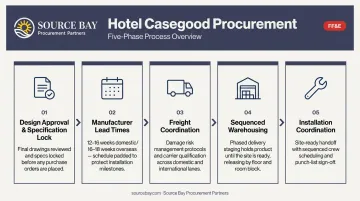
In multi-room renovation projects, where guestrooms must return to service on a rolling schedule, delivery sequencing is as important as the product itself. FF&E that arrives all at once when only a fraction of rooms are construction-ready creates storage liability and installation bottlenecks.
Managing these logistics well requires direct manufacturer relationships, proven freight protocols, and warehouse staging capabilities. When those systems are in place before procurement begins, timeline slippage becomes the exception rather than the default.
Standard vs. Custom Hotel Casegoods: Choosing the Right Approach
The core tradeoff is straightforward: standard casegoods move faster and cost less upfront; custom casegoods give you full control over dimensions, finishes, and design intent. Which matters more depends on your property type, timeline, and how much the room aesthetic drives your competitive position.
| Standard Casegoods | Custom Casegoods | |
|---|---|---|
| Lead Time | Shorter — catalog items | Longer — 12–18+ weeks |
| Cost | Lower upfront | Higher upfront |
| Design Flexibility | Limited — fixed configurations | Full control over dimensions, finishes, hardware |
| Best For | Tight-timeline limited-service renovations; prescribed FF&E packages | Design-forward properties; non-standard room dimensions; brand differentiation |
Standard casegoods work well for franchise properties with prescribed FF&E packages or limited-service renovations with hard timelines. Custom casegoods are warranted when the design intent can't be achieved off-the-shelf, when room footprints require non-standard dimensions, or when design differentiation is a direct competitive strategy.
In practice, most projects don't land cleanly in either column. A hybrid approach is often the most effective path: custom pieces for high-impact, high-visibility items — headboards, media consoles, entry millwork — paired with standard pieces for functional items like luggage benches and open shelving. This concentrates the design budget where guests actually look, without inflating costs across the entire room.
How Source Bay Procurement Partners Can Help
Source Bay Procurement Partners manages the full hotel casegood procurement lifecycle — from specification and sourcing through freight coordination, staged warehousing, and final installation handoff. The model is structured to keep design intent, budget, and logistics aligned across every phase of a project.
For hotel projects, Source Bay's four-phase process (Discovery → Sourcing → Logistics → Installation) is built around the variables that matter most: brand-standard compliance, custom finishes, on-schedule delivery, and turnkey installation. Budget alignment, specification decisions, and logistics planning are locked in before sourcing commitments are made — so conflicts surface early, not during construction.
Key capabilities relevant to hotel casegood procurement:
- Global manufacturer network including Blue Leaf Hospitality (casegoods and upholstered furniture) and 100+ additional partners, enabling value-engineered casegood solutions across property tiers
- Senior Designer Barbara Church provides custom finish sourcing and specification-level design guidance that translates design intent into procurement-ready documentation
- Operations team (Paul Tomczak and Greg McKinnon) manages comprehensive freight coordination and sequenced warehousing, ensuring guestroom FF&E lands on construction schedule for phased renovations
- Partnership with Neuco Furniture & Upholstery provides an integrated refurbishment path for properties that want to extend the lifecycle of existing casegoods rather than full replacement — delivering 40–70% savings compared to full replacement
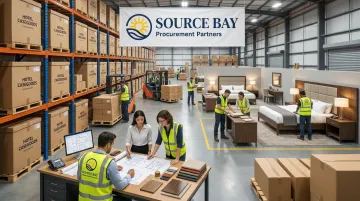
For properties that don't need full replacement, the Neuco partnership allows Source Bay to scope a mixed strategy: restore structurally sound pieces, replace what can't be cost-effectively refurbished, and manage both tracks under a single procurement engagement.
Conclusion
Selecting the right hotel casegoods requires aligning material quality, brand compliance, functionality, sustainability standards, and procurement logistics into a specification strategy that holds up across the full renovation cycle.
Casegoods reward early attention. Properties that lock in specifications before the schedule tightens — and treat FF&E as a long-term asset rather than a line-item afterthought — consistently see stronger guest satisfaction scores, longer asset lifespans, and lower total cost of ownership.
Revisit those standards at every major renovation interval. Working with a procurement partner who understands both the design intent and the logistics of delivery is what turns a solid specification into a room that performs years from now. That's where Source Bay Procurement Partners operates — bridging the gap between what's specified and what gets installed, on time and on budget.
Frequently Asked Questions
What are casegoods in hotels?
Hotel casegoods are the non-upholstered, hard-surface furniture pieces that define a guestroom's functional layout — including nightstands, dressers, wardrobes, desks, headboards, and media consoles. They're built from materials such as wood-based panels, laminates, and metal, and determine how guests live and work within the space.
What is the difference between casegoods and FF&E?
FF&E (Furniture, Fixtures, and Equipment) is the broad category covering all movable, non-structural items in a hotel. Casegoods are a specific subset of FF&E focused on hard-surface, storage-forward furniture — distinct from soft seating, lighting fixtures, and equipment such as televisions or minibars.
What materials are best for hotel casegoods?
The best materials depend on property tier and use intensity. HPL faces with plywood cores offer strong durability for high-traffic properties; wood veneer faces with solid edge treatments suit luxury or design-forward properties. All commercial-grade casegoods must comply with TSCA Title VI formaldehyde emission limits regardless of tier.
How long do hotel casegoods typically last?
Well-specified, commercial-grade hotel casegoods are engineered for a 7–10 year lifecycle under daily use, after which properties typically undergo a PIP or renovation cycle. Properly specified pieces can reach 12–14 years before replacement. Under-specified materials compress that window considerably.
What is the difference between standard and custom hotel casegoods?
Standard casegoods are catalog-sourced in fixed configurations — faster and lower cost to procure. Custom casegoods are built to specific design and dimensional requirements, offering full control over finishes, materials, and hardware at a higher investment and longer lead time. Many projects use both strategically.
How do I find the right hotel casegoods procurement partner?
Look for a partner with direct manufacturer relationships, proven freight and logistics capabilities, and experience with your specific property type and brand standards. The right partner manages the full procurement lifecycle — discovery through installation — not just sourcing.