
This guide cuts through the confusion. You'll find a clear definition of turnkey development, a breakdown of every component the model should include, an honest comparison with traditional multi-contract approaches, and practical guidance on who holds responsibility at each stage.
Key Takeaways
- A single contractor or coordinated team owns every phase—planning, design, construction, fit-out, and handover
- Truly turnkey commercial projects include FF&E procurement, installation, and commissioning—not just the building shell
- Fixed-price contracts provide cost certainty and reduce the risk of runaway change orders
- The model is built for hospitality, senior living, and multi-family developments with hard opening dates and converging trades
- Specialist partners in construction, design, and FF&E procurement determine whether the finished space delivers on the original vision
What Is Turnkey Development?
The Core Idea
The term comes from a simple concept: the client turns a key, and the project is ready to use. No finishing work, no outstanding installations, no internal setup sprint before opening day. That's the promise at the center of every legitimate turnkey contract.
In formal construction and commercial real estate contexts, a turnkey contract is one where the contractor assumes full responsibility for planning, designing, building, and delivering a project to an agreed specification at a fixed price and by a fixed date. FIDIC, the international federation that publishes standard construction contract forms, titles its fixed-price standard the Conditions of Contract for EPC/Turnkey Projects (the Silver Book, 2nd Edition 2017).
Under that framework, the contractor provides everything necessary for a specified purpose: design, procurement, construction, and commissioning, as a single unified obligation.
How Turnkey Applies Across Sectors
The model means different things depending on where you apply it:
- Construction generally: One entity handles permits, site prep, structural work, MEP systems, and finishing
- Commercial real estate: A property is delivered rent-ready or operations-ready with no repairs required
- Hospitality and senior living: Scope extends to interior fit-out, FF&E installation, technology integration, and operational readiness
That last category is where scope definition becomes most critical—and where the distinction between partial and full turnkey matters most.
Full Turnkey vs. Partial Turnkey
No single authoritative construction standard draws a bright line between these two terms, but in practice the distinction is clear enough:
- Partial turnkey excludes certain deliverables—typically interior fit-out or FF&E—leaving those phases for the owner to manage separately
- Full turnkey covers every deliverable from foundation to final room setup, delivering a property ready to operate
When evaluating any turnkey proposal, the first question should be: what exactly is in scope? A proposal that omits FF&E or technology integration isn't turnkey in any meaningful sense for a hotel or senior living project.
Why the Model Has Grown
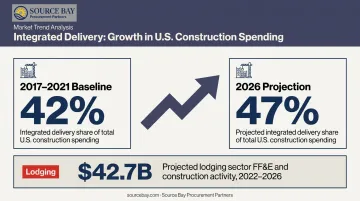
DBIA and FMI forecast that integrated delivery approaches will represent up to 47% of assessed U.S. construction spending by 2026, up from 42% during 2017–2021—with lodging alone projected at $42.7B over 2022–2026. That growth reflects what developers are actually looking for: predictable costs, minimal day-to-day involvement, and a faster path to revenue. The turnkey model is purpose-built to address each of those pressures.
Key Components of a Turnkey Development Project
Planning, Design, and Permitting
In a turnkey arrangement, the contractor translates the client's vision into a compliant design, secures all necessary permits, and ensures the project plan accounts for local code, zoning, and operational requirements before construction begins. The client doesn't manage separate architect and permitting consultant relationships—that coordination lives inside the turnkey scope.
Site Preparation and Construction
The physical build phase includes site clearing, grading, utilities, structural work, MEP systems, and all finishing work. One entity coordinates all trades rather than leaving the owner to referee disputes between separate subcontractors. Single-point coordination is where much of the model's value is delivered.
FF&E Procurement and Installation
For commercial developments—especially hotels, senior living communities, and multi-family properties—Furniture, Fixtures, and Equipment defines project completion. A property isn't operationally ready when the walls are painted—it's ready when every guest room, dining area, and common space is fully furnished and equipped.
FF&E represents a meaningful share of total project cost. HVS's 2025 Hotel Development Cost Survey reports FF&E averages 9.0% of total hotel project cost, ranging from 7.0% for luxury properties to 10.0% for limited-service and midscale extended-stay hotels. For senior living, CBRE's 2022 development cost report places FF&E at an average of $9,700 per revenue unit.
Managing this phase well requires specialist expertise. Source Bay Procurement Partners handles the full FF&E scope across four structured phases—Discovery, Sourcing, Logistics, and Installation—covering manufacturer sourcing, freight management, sequenced warehousing timed to construction milestones, on-site placement oversight, and final quality control documentation.
The sequencing matters: FF&E can be procured during construction rather than after it, which compresses the overall project timeline without creating delivery congestion on site.
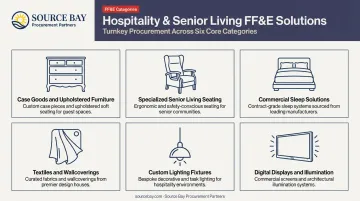
FF&E categories for a full hospitality or senior living scope typically include:
- Case goods and upholstered furniture: dressers, desks, sofas, accent chairs
- Specialized seating designed for senior living environments
- Commercial sleep solutions built for durability (such as Serta hospitality lines)
- Textiles and wallcoverings, including custom fabrics and drapery
- Custom lighting fixtures tailored to the design intent
- Digital displays and illumination systems
Technology and Systems Integration
Turnkey commercial development now routinely includes audio-visual systems, security, building management systems, and technology infrastructure. Each must be procured, installed, and tested before handover. Leaving systems integration as a post-opening task adds cost, delays, and operational risk the owner should not be absorbing.
Final Commissioning and Handover
The closing phase covers quality inspections, systems testing, punch-list resolution, and formal handover of a fully operational facility. In a genuine turnkey model, the client receives a property ready to open on day one—not a building that needs another month of internal coordination before operations can begin. Every week of delayed handover translates directly into deferred revenue.
Benefits of Turnkey Development
Single Point of Accountability
The most operationally significant advantage is that the client deals with one responsible party. When something goes wrong in a multi-contractor project, accountability diffuses quickly across parties.
That diffusion is measurable. Dodge Construction Network's 2024 research found that commercial contractors average 17 daily interactions with other firms, with 8 involving conflicts. Coordination failures are the root cause of quality challenges—errors and rework—for 33% of contractors, and they drive an average 9% budget increase. Under a turnkey model, those coordination interfaces exist inside the turnkey contractor's scope, not across the owner's desk.
Cost Certainty Through Fixed-Price Contracts
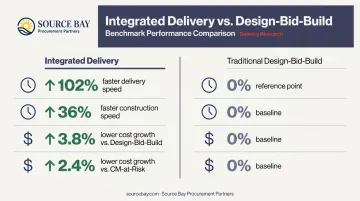
Turnkey contracts are typically structured with a fixed price agreed upfront, giving developers and their lenders a predictable budget. Research comparing integrated delivery against traditional multi-contract approaches found that design-build projects (the closest U.S. commercial analog to turnkey) showed 3.8% lower cost growth than design-bid-build and 2.4% lower cost growth than construction manager-at-risk arrangements.
The initial quoted price may appear higher than individual phase estimates in a traditional structure. In practice, a comprehensive fixed price often eliminates the costly change orders and coordination gaps that inflate traditional project totals over time.
Time Efficiency and Faster Delivery
With one entity coordinating construction, procurement, logistics, and installation, phases can overlap. FF&E procurement—which involves long manufacturer lead times—can run concurrently with construction rather than sequentially after it. The same integrated delivery research found design-build projects delivered at 102% faster delivery speed and 36% faster construction speed than design-bid-build approaches.
Reduced Operational Burden for Owners
The turnkey model frees developers to focus on financing, pre-opening sales, and other portfolio decisions while the turnkey team manages daily project execution. This is particularly valuable for owner-operators who don't maintain in-house project management teams.
The client's role narrows to approving key milestones and accepting the final handover. Day-to-day subcontractor management stays entirely within the turnkey contractor's scope.
Key responsibilities the owner retains under a turnkey structure:
- Approving design and specification milestones
- Reviewing budget updates at agreed checkpoints
- Accepting the completed space at final handover
Turnkey vs. Traditional Development
Traditional (multi-contract) development places the owner in the role of project manager by default. When scope gaps appear between contractors, the owner absorbs the risk.
Separate contractors handle site work, construction, interior design, FF&E procurement, and technology installation—each managing their own scope, timeline, and billing independently.
Here's how the two models compare across three dimensions:
| Dimension | Turnkey | Traditional Multi-Contract |
|---|---|---|
| Risk distribution | Contractor owns the outcome; owner is relieved of coordination burden | Risk spreads across parties; coordination burden falls on the owner |
| Cost predictability | Fixed price agreed upfront; lower cost growth in research benchmarks | Costs can escalate at each phase; change orders compound |
| Timeline management | Phases can overlap strategically; single team coordinates all disciplines | Inter-contractor handoffs create delay exposure; phases typically run sequentially |
That said, the table's conclusions don't make turnkey universally superior—context determines fit.
When Traditional Contracting Still Makes Sense
Traditional multi-contract approaches remain appropriate when:
- Strong in-house project management capacity exists and direct control is a priority
- Day-to-day design decisions require close owner involvement throughout construction
- Development is phased over time, with scope that will evolve significantly between phases
Who Is Responsible for a Turnkey Development Project?
In a turnkey arrangement, the primary contractor or turnkey developer holds full legal and operational responsibility from project kickoff to handover. That entity manages all subcontractors, suppliers, and specialist partners internally. The client holds no separate contracts with them.
The Client's Role
The owner or developer provides the initial brief, approves key design milestones, signs off on scope changes, and accepts the final handover. Day-to-day project management decisions stay inside the turnkey contractor's scope.
Limited client involvement doesn't mean passive oversight. Clients should still conduct milestone reviews and maintain visibility into project progress through their primary contractor. A turnkey structure focuses owner involvement on decisions that actually require owner judgment — not on managing the day-to-day.
How Specialist Partners Fit In
Commercial turnkey projects frequently include specialist entities—FF&E procurement firms, technology integrators, interior designers—who operate within the primary contractor's coordination framework. Their expertise is deployed at the right project phase, and the client receives a single unified deliverable at handover rather than managing each specialist relationship directly.
For a hospitality or senior living development, this typically means an FF&E procurement specialist like Source Bay Procurement Partners manages the full furnishing scope as a single coordinated workstream. That scope usually includes:
- Vendor selection and custom product development
- Freight management and sequenced warehousing
- On-site installation and final quality control documentation
The client receives one unified deliverable — a fully furnished, installation-ready space — rather than managing each supplier relationship separately.
Frequently Asked Questions
What is turnkey development?
Turnkey development is a project delivery model where a single contractor or coordinated team manages every phase—from design and permitting through construction, fit-out, and handover—delivering a fully operational facility with no additional work required from the client.
Who is responsible for a turnkey development project?
The primary turnkey contractor holds full responsibility for delivering the completed project, managing all subcontractors and specialist partners internally. The client's role is limited to approving milestones and accepting the final handover.
What is the difference between turnkey and traditional development?
Traditional development requires the owner to hire and coordinate multiple separate contractors, absorbing the coordination risk when scope gaps appear between them. Turnkey development places that responsibility on a single entity, typically in exchange for a fixed price and defined delivery date.
What are the disadvantages of turnkey development?
Turnkey projects can carry a higher upfront quoted price, offer less flexibility for scope changes once the contract is signed, and may reduce the owner's day-to-day visibility into project decisions. Vetting a contractor's track record and contract transparency before signing is the most effective way to manage these risks.
What does FF&E mean in turnkey development?
FF&E stands for Furniture, Fixtures, and Equipment—the moveable items that outfit a commercial space. In a fully turnkey hospitality or senior living project, FF&E procurement, delivery, and installation are included in scope, ensuring the property is operationally ready at handover.
Is turnkey development more expensive upfront?
The fixed price in a turnkey contract often looks higher than individual phase estimates, but the structure eliminates the change orders and coordination gaps that inflate costs in traditional delivery. A faster path to revenue typically offsets the difference.