Many developers underestimate this. Procurement gets handed to teams without the depth to manage it strategically, or distributed across fragmented vendor relationships with no single point of accountability. That decision shows up later as delays, budget overruns, and design compromises that are difficult to recover from on a fixed timeline.
This article breaks down the measurable, operational value that professional procurement delivers — not as an abstract promise, but across the real-world stages of a hotel development.
Key Takeaways
- Professional hotel procurement integrates sourcing, supplier relationships, logistics, quality control, and installation into one continuous operation
- Established manufacturer relationships and volume leverage unlock pricing that one-off buyers simply can't access
- Supply chain control protects the critical path by mapping lead times to construction milestones from day one
- Design integrity depends on procurement oversight at every stage — from specification through final handoff
- Without professional oversight, specification drift and reactive cost overruns accumulate fast on a fixed construction timeline
What Is Professional Hotel Procurement?
Professional hotel procurement is the end-to-end management of sourcing, purchasing, logistics, quality control, and installation coordination for all FF&E and OS&E on a hotel project.
The scope is larger than most people picture. A single hotel project may involve thousands of individual items — case goods, upholstered seating, sleep systems, textiles, lighting, digital displays — sourced from dozens of manufacturers across multiple geographies, each with distinct lead times, freight requirements, and brand compliance thresholds. Professional procurement manages all of that as one integrated operation.
The goal is specific: a hotel that opens on time, on budget, and to the quality standard brand requirements and guest expectations demand. Achieving that consistently requires managing design, purchasing, logistics, and installation as a single coordinated effort — not as separate handoffs between disconnected teams.
That's how Source Bay Procurement Partners approaches every hotel project — through four sequential phases that keep each stage connected to the next:
- Discovery — Aligning design intent, operational requirements, and budget goals before any sourcing begins
- Sourcing — Strategic acquisition through a global manufacturer network, including value-engineered and bespoke custom solutions
- Logistics — Comprehensive freight management and sequenced warehousing coordinated to project timelines
- Installation — On-site placement oversight, quality control documentation, and formal project handoff
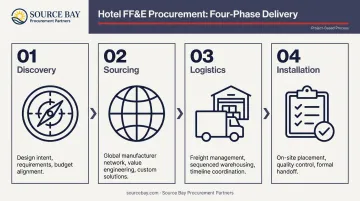
This structure prevents the cost overruns, delivery failures, and brand non-compliance that surface when those phases are managed in isolation — each team optimizing for its own piece without visibility into the whole.
Key Advantages of Professional FF&E Procurement for Hotel Projects
The advantages below are operational, not theoretical. Each connects directly to outcomes hotel developers, owners, and operators track: cost, schedule, quality, and risk. They also compound — the more complex the project or compressed the timeline, the more pronounced the impact.
Cost Efficiency Without Compromising Design Quality
Professional procurement delivers cost efficiency through strategic sourcing — not by chasing the lowest bid.
Accepting the lowest bid often means accepting substitutions, longer lead times, or lower-spec products that create downstream problems. Strategic sourcing means selecting the right suppliers, negotiating value-based contracts, and applying value engineering to find specification-equivalent products at better price points — without touching the design intent.
This works in practice because of relationship depth. Source Bay's network spans hundreds of global hospitality manufacturers, including partners like Blue Leaf Hospitality for case goods, Serta for commercial sleep solutions, Schumacher and Fabricut for textiles, and Remington for custom lighting.
That breadth of established relationships produces pricing not available to one-off buyers. It also enables custom and value-engineered development that requires manufacturer trust, not just a purchase order.
Relationship depth also creates earlier cost protection. Budget exposures in FF&E procurement tend to cluster around a few predictable failure points:
- Underestimated specifications that inflate costs when corrected mid-project
- Hidden freight charges not captured in initial vendor quotes
- Quality substitutions that go unreviewed until delivery
- Late-stage change orders triggered by spec misalignment
Professional procurement identifies each of these before commitments are made.
To put scale in context: HVS reports a 2025 median U.S. hotel development cost of $219,000 per room, with FF&E representing 2%–5% of total development cost depending on chain scale. On a 150-room select-service property, that's a multi-million dollar procurement budget. The contingency, freight, and warehousing assumptions in HVS's own cost guides — freight ranging 5%–10.5% of FF&E value, warehousing 2.5%–6% — illustrate how quickly unmanaged costs accumulate around the core spend.
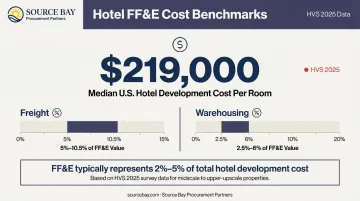
KPIs impacted: Total FF&E spend vs. budget; cost variance by category; savings vs. open-market pricing; change orders attributable to procurement errors
When it matters most: New builds and full renovations with large multi-category budgets; projects with compressed timelines where rushed purchasing eliminates negotiating leverage; multi-property rollouts where standardization and volume can be maximized
Supply Chain Control and On-Time Delivery
Hotel FF&E procurement means coordinating thousands of items from a global manufacturing network, each with distinct lead times and freight requirements. CoStar documented FF&E products with wait times of three to six months during recent supply chain disruptions — and a single 950-room hotel renovation that incurred $3 million in excess freight costs during peak disruption.
Those costs were avoidable. They resulted from coordination breakdowns, not vendor failures — which is exactly what professional supply chain oversight prevents.
Professional procurement creates supply chain control through several mechanisms:
- Procurement schedules aligned to construction milestones — so lead times are built into the project plan before commitments are made, not discovered when items haven't arrived
- Proactive supplier communication — maintaining visibility across all vendor relationships simultaneously rather than receiving goods passively
- Sequenced warehousing — staging deliveries so the right items arrive at the right phase of construction, preventing both costly delays and on-site bottlenecks
- Direct logistics oversight through to installation — closing the gap between delivery and verified placement
Supply chain failures in hotel projects rarely result from a single vendor error. They result from coordination breakdowns across multiple parties. Professional oversight manages those moving parts in real time — keeping the critical path intact rather than forcing reactive firefighting once problems surface.
Source Bay's operations team, led by Paul Tomczak and Greg McKinnon, manages this logistics infrastructure across global sourcing channels, with sequenced warehousing and freight coordination purpose-built for the complexity of large-scale hotel projects.
KPIs impacted: On-time delivery rate; emergency sourcing events; freight cost variance; days to handoff vs. planned opening
When it matters most: Internationally sourced FF&E; tight construction-to-opening windows; multi-phase rollouts where sequencing is critical
Brand and Design Integrity From Specification to Handoff
Professional procurement acts as the bridge between what the designer specifies and what actually arrives on site. Without that bridge, specification drift happens across dozens of vendor relationships where no single party owns the full scope.
The process requires active oversight at every stage:
- Reviewing and approving products against original specifications before orders are placed
- Managing the approval process for any required substitutions to ensure design intent is preserved, not just acknowledged
- Quality control during production and pre-shipment, not only at delivery
- On-site setup oversight confirming that what is installed matches what was specified
This matters commercially, not just aesthetically. J.D. Power's 2025 North America Hotel Guest Satisfaction Index found that when guests experienced problems, satisfaction dropped 217 points — from 677 to 460. Year-over-year improvements in guestroom furnishings, decor, bathroom fixtures, and bed comfort all tracked positively in the same study, linking physical environment quality directly to guest experience outcomes.
Franchisor compliance adds another financial dimension. Hilton's 2026 Canopy FDD documents brand non-compliance fees of $65–$145 per room per six-month period, with past-due renovation fees of $16,000 every six months. Marriott's 2024 Westin FDD lists re-evaluation fees of $20,000 and charges up to $50,000 for retaining non-recommended design firms.
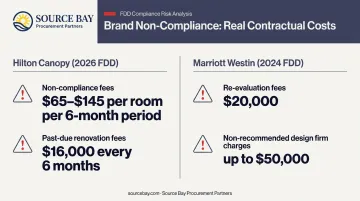
These are contractual cost exposures — not theoretical ones — that professional procurement directly prevents.
Source Bay's Senior Designer, Barbara Church, integrates design expertise throughout the sourcing process — ensuring that vendor selections and value-engineered alternatives are evaluated against original design intent, not just price and availability.
KPIs impacted: Specification compliance rate; quality inspection pass rate; post-delivery remediation items; brand audit scores; guest satisfaction scores
When it matters most: Branded properties with strict franchisor requirements; luxury and boutique properties where design differentiation is a competitive asset; renovations where new FF&E must integrate with existing brand standards
What Happens When Professional Procurement Is Missing
Projects that manage FF&E procurement internally — or through fragmented vendor relationships — run into the same problems, predictably.
Specification drift. With no single party owning the full scope, what was designed and what gets ordered gradually diverge. Individual vendors interpret specs independently. Substitutions happen without formal approval. By the time items arrive on site, the cumulative drift is visible in the finished space — and expensive to remediate.
Compounding costs. Reactive procurement consistently results in higher per-unit costs, emergency freight premiums, and last-minute substitutions that strain both budget and design integrity. HVS cost benchmarks for freight (5%–10.5%) and warehousing (2.5%–6%) assume managed logistics. Unmanaged procurement typically exceeds those ranges.
The real-world consequences are well-documented. A hospitality case cited by HospitalityNet illustrates the stakes directly: missing decorative lighting delayed electrical inspection readiness, triggering a recovery plan just to protect the opening schedule.
Schedule vulnerability. Without a coordinated procurement operation managing lead times across all categories simultaneously, the critical path is exposed. A single delayed shipment in a poorly managed supply chain can cascade into weeks of project delay — with meaningful revenue consequences during a missed opening window.
Accountability gaps. When procurement is distributed across multiple parties with no dedicated oversight, issues surface late, ownership is unclear, and resolution is slow. At opening, there's no time to reconstruct who approved what — or who's responsible for fixing it.
How to Get the Most Value from Professional Hotel Procurement
The value from professional procurement is maximized when the engagement starts early — ideally during or immediately after design development, before specifications are finalized. At that stage, sourcing strategy aligns with budget, lead times build into the project schedule, and supplier relationships activate before deadline pressure eliminates negotiating leverage.
Engaging late — after construction has begun, or when procurement decisions need to be made reactively — compresses every phase and eliminates the proactive cost management that delivers the most measurable return.
What ongoing collaboration looks like in practice:
- Regular communication between the procurement team, design team, project managers, and ownership — not a handoff model where procurement operates in isolation
- Design decisions and substitution approvals made with full procurement visibility, so cost and lead-time implications are understood before commitments are made
- Budget tracking maintained transparently across the procurement cycle, with spend tracked against approved categories throughout
The right partner makes that collaboration possible. Here's what to evaluate:
- Depth of manufacturer relationships — established, not transactional
- Demonstrated logistics infrastructure: freight management, warehousing, and sequencing capacity
- Experience across comparable project types and scales
- A process that covers the full scope from sourcing through installation oversight
Source Bay Procurement Partners covers that full scope in-house: global manufacturer sourcing, freight coordination, sequenced warehousing, and on-site installation oversight — managed as a single integrated process across every project phase.
Conclusion
Professional procurement adds value to hotel projects not through a single action, but through disciplined management of cost, supply chain complexity, and quality across every phase — from specification to handoff.
Its advantages compound when applied consistently. Supplier relationships deepen, logistics coordination tightens, and design integrity holds in ways that piecemeal purchasing simply can't match. The cost exposures that derail hotel budgets — specification drift, emergency freight, compliance failures — get managed before they become crises.
When procurement is managed as a strategic function rather than an afterthought, the project reflects it — a hotel that opens on schedule, holds its design intent, and protects the brand well beyond ribbon-cutting.
Frequently Asked Questions
What is the procurement process for hotel projects?
Professional procurement covers seven integrated stages:
- Needs assessment and specification
- Supplier sourcing and vetting
- Contract negotiation and order placement
- Logistics and freight coordination
- Quality control and installation oversight
All stages run as a single coordinated operation, not a series of handoffs between separate parties.
What is bulk procurement for hotel projects?
Bulk procurement involves consolidating purchasing across multiple categories or properties to leverage volume pricing with manufacturers. It requires established supplier relationships and sufficient project scale to unlock real savings. Volume without established relationships rarely delivers the same pricing outcomes.
What are the 5 Ps of procurement?
The 5 Ps — People, Process, Product, Price, and Performance — each carry specific weight in hotel FF&E procurement. Professional procurement teams are structured to manage all five simultaneously, with performance tracked against both budget and schedule.
What is the difference between FF&E and OS&E in hotel procurement?
FF&E (Furniture, Fixtures & Equipment) covers the physical items that furnish a hotel: beds, seating, lighting, case goods, and textiles. OS&E (Operating Supplies & Equipment) covers what's needed to run the property operationally, including linens, kitchen equipment, and in-room amenities. Both categories require coordinated procurement on a hotel project.
When should a hotel developer bring in a procurement specialist?
During or immediately after design development — before specifications are finalized. Early engagement allows sourcing strategy, lead times, and budget alignment to be built into the project plan from the outset, rather than retrofitted under time pressure when options are limited.
How do professional procurement companies charge for hotel projects?
Common models include a percentage of total procurement spend, a fixed project fee, or hybrid arrangements. Evaluate the cost against the risk it prevents: specification errors, emergency freight, and delayed openings routinely exceed procurement fees.