
Introduction
The numbers tell a stark story. The U.S. population aged 80 and older stands at 14.7 million in 2025 — and NIC MAP projects nearly 28% growth by 2030, with Moody's Analytics forecast data indicating this cohort nearly doubles by 2040. Meanwhile, annual senior housing inventory growth has dropped below 1% for the first time since 2006, and construction starts are approaching 21st-century lows.
The collision of these two trends: surging demand and stalled supply — isn't a future problem. It's arriving now.
That gap has to be filled by someone, and public programs cannot do it alone.
Medicaid doesn't cover room and board at most assisted living or independent living communities. Federal construction programs are limited in scope. The engine capable of expanding both supply and quality across every care level is private capital — and the window to deploy it effectively is narrowing.
Key Takeaways
- The 80+ population is projected to grow 28% by 2030 and almost double by 2040, creating sustained demand across all senior housing segments
- Senior housing occupancy hit 89.1% in Q4 2025 while inventory growth stayed below 1% — the supply gap is widening, not closing
- Private capital improves communities by funding modern design, upgraded amenities, and technology that underfunded facilities can't support
- Investment strategies span REITs, ground-up development, acquisitions, and debt financing — with varying risk and return profiles across each vehicle
- Over half of existing U.S. senior housing inventory is more than 25 years old — modernization is as urgent as new supply
The Senior Housing Supply-Demand Gap: Why Private Capital Is Needed Now
An Aging Population and a Shrinking Construction Pipeline
No real estate sector has a more defined demand trajectory than senior housing. The 80+ cohort (the primary driver of assisted living and memory care demand) is growing above 4% annually through 2030, far outpacing overall U.S. population growth. NIC MAP projects nearly 23 million Americans will be 80 or older by 2035, representing more than 55% growth from today's base.
The construction pipeline isn't keeping pace. Key data points:
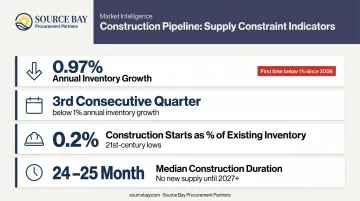
- Annual inventory growth fell to 0.97% in Q2 2025 — the first time below 1% since 2006
- Inventory growth remained below 1% for a third consecutive quarter through Q4 2025
- Construction starts are approaching 21st-century lows, with activity slipping to just 0.2% of existing inventory
- The national median construction duration is 24-25 months from groundbreaking to opening — meaning today's unstarted projects won't deliver until 2027 or later
The capital requirement is substantial. ASHA's 2025 ASHA 50 report cites a nearly 370,000-unit shortfall by 2030, and NIC MAP projects a $275 billion investment gap to maintain market equilibrium by that same year.
Why Private Funding Must Lead
Occupancy has recovered strongly, climbing from a pandemic low of 78.8% in Q1 2021 to 89.1% in Q4 2025. Yet the supply response has remained muted — not because of cyclical hesitation, but because of a structural reality: senior housing is predominantly a private-pay business.
Federal law prohibits Medicaid from covering room and board at assisted living facilities. Some states use supplemental programs to defray housing costs, but independent living and most assisted living communities depend on private-pay residents as their primary revenue base.
The wealth profile of today's senior cohort supports this model. The Federal Reserve's 2022 Survey of Consumer Finances reports:
- Median net worth for households aged 65–74: $409,900
- Median net worth for households aged 75+: $335,600
- 65–74 households saw 33% median net-worth growth from 2019 to 2022
That wealth concentration directly underpins private-pay affordability — and it explains why institutional capital continues to flow into senior housing even as new construction slows.
How Private Investment Directly Improves Senior Housing Quality
Private capital doesn't just add beds. It raises the standard of what a senior living community can be.
The Design Gap Between Old Stock and New Expectations
ASHA's 2023 survey of 7,000+ respondents — roughly 80% Baby Boomers — found that up to 83% rated exterior maintenance, 24-hour security, and in-unit appliances as essential or highly desirable. Nearly 60% were considering a move within four years, including to a retirement community.
What they'll encounter when they look: over half of U.S. senior housing inventory is more than 25 years old, and nearly half opened before 2000. These properties were designed for a generation with different priorities — residents who weren't yet expecting integrated technology, flexible care models, or lifestyle-driven amenities.
Ground-up development funded by private capital closes that gap. Purpose-built communities incorporate wellness infrastructure, flexible care levels, and technology integration from day one, baked into the design rather than bolted on later.
Repositioning Stressed Assets
New construction is only one path. For investors, the existing stock represents an equally compelling opportunity. COVID drove occupancy to a pandemic trough of 78.8%, distressing operators and compressing valuations. Private investors who acquired and renovated these properties since 2021 have captured both the occupancy recovery and the value-add upside from physical improvement.
Improvements private capital funds directly:
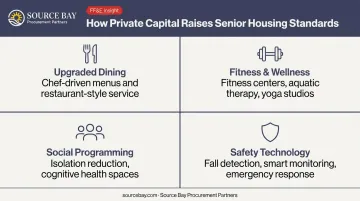
- Upgraded dining programs with chef-driven menus and restaurant-style service environments
- Fitness and wellness amenities — fitness centers, aquatic therapy, yoga studios — that competing underfunded properties can't staff or maintain
- Social programming spaces designed to reduce isolation, a documented driver of cognitive decline
- Safety technology infrastructure including fall detection, smart monitoring, and emergency response systems
A prospective cohort study of 326 residents across 28 assisted living facilities found measurable links between the physical environment — lighting evenness, room privacy, homelikeness, maintenance quality — and neuropsychiatric symptoms and quality of life outcomes. The data is consistent: better physical spaces reduce behavioral symptoms and improve resident wellbeing. For investors, that's not just a care outcome — it's a retention and reputation driver that shows up in occupancy numbers.
Investment Strategies That Are Expanding Senior Housing Options
Ground-Up Development and Active Adult
New development remains the highest-impact path for closing the supply gap, particularly in supply-constrained submarkets with strong 80+ population growth, high barriers to entry, and limited competing pipelines. Developers focused on micro-markets — affluent pockets where demand is structurally high and new supply is structurally limited — are finding the most durable return profiles.
Active adult rentals offer a strong adjacent entry point. NIC data shows:
- Stabilized active adult occupancy at 95.6% in Q1 2025
- Approximately 118,000 units across nearly 800 properties nationally
- Median property age under 10 years, compared to 21 years for independent living
- Monthly rents in primary markets ranging from ~$2,500 (Boston, Seattle) to nearly $3,500 (Miami)
Active adult carries no required healthcare licensure, a meaningful regulatory distinction from assisted living or memory care. That makes it a lower-complexity development category for investors new to the sector.
Acquisitions, REITs, and Repositioning
Direct acquisitions of underperforming or COVID-stressed assets offer attractive basis and value-add upside through operational improvement and physical renovation. The occupancy recovery from 2021 to 2025 demonstrates that well-capitalized operators who acquired distressed properties have captured significant returns.
Senior housing REITs provide the most accessible private investment vehicle for individual and non-institutional investors. Public REIT disclosures make the performance case clearly:
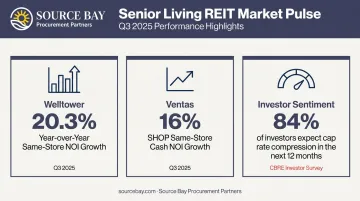
- Welltower reported 20.3% year-over-year same-store NOI growth in its Seniors Housing Operating portfolio in Q3 2025
- Ventas reported 16% SHOP same-store cash NOI growth in Q3 2025
- CBRE's H2 2025 investor survey found 84% of respondents expected senior housing cap rates to decrease over the next 12 months
REITs provide portfolio-scale exposure without the operational complexity of direct ownership, making them a practical starting point for investors new to the sector.
Debt and Mezzanine Capital
Debt financing availability for senior housing has improved entering 2026. CBRE's senior housing platform facilitated $13.7 billion in U.S. senior housing financing volume from 2014 to 2025. HUD's FHA Section 232 program provides mortgage insurance for assisted living, nursing, and board and care facilities for construction, acquisition, and substantial rehabilitation.
What lenders evaluate closely: operator quality, procurement discipline, and the credibility of project budgets. Specialists like Source Bay Partners, whose four-phase procurement process includes upfront budget alignment, value-engineered sourcing, and sequenced logistics, provide the cost-certainty documentation that construction lenders need to underwrite draw schedules and completion guarantees with confidence.
Modernizing Aging Senior Housing Stock: The Quality Imperative
The existing inventory problem is as urgent as the supply gap. Over half of U.S. senior housing stock is more than 25 years old. Nearly half opened before 2000. These properties were designed for residents with different expectations, different mobility profiles, and no assumption of technology access.
Incoming Baby Boomers will walk in expecting something different.
The Highest-Impact Modernization Priorities
Physical upgrades that drive the most meaningful improvements in occupancy, retention, and resident wellbeing:
- Residential interiors — updated finishes, furniture, and fixtures that feel contemporary, not institutional
- Ergonomic and adaptive furnishings — seating and sleep solutions selected for comfort, safety, and accessibility
- Lighting — improved illumination for aging eyes, with reduced glare and better contrast for common areas and corridors
- Technology integration — smart systems, health monitoring, and high-speed connectivity infrastructure
- Common areas — refreshed social, dining, and wellness spaces that support active engagement and community
The Business Case for Modernization
Quality upgrades are both a resident experience investment and a financial one. Higher-quality communities command stronger occupancy, support premium rent levels, and generate better resident retention — each of which flows directly to investor returns.
The procurement pathway covers design quality, regulatory compliance, and budget discipline — without requiring operators to manage those variables independently.
Risks and Considerations for Private Investors
Senior housing carries real operational risks. Three stand out as most consequential for investors entering the sector:
- Labor cost pressure: Nursing assistants at assisted living and CCRC facilities earned a median annual wage of $38,500 in May 2024; direct care workers more broadly earned $16.10 per hour in 2023. Turnover is high and care staff vacancy rates remain elevated.
- Regulatory complexity: Requirements scale with care level — independent living carries minimal oversight, while assisted living is state-licensed with varying staffing ratios and inspection rules, and memory care or skilled nursing adds federal compliance layers.
- Technology-driven move-in deferral: McKinsey estimates aging-in-place retrofits — sensors, remote monitoring, pressure pads — can cost $5,000–$20,000, potentially letting some seniors stay home longer than historical patterns suggest.
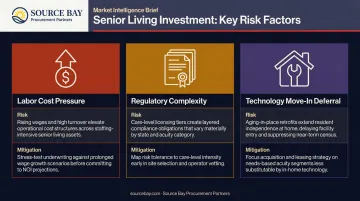
Each risk has a different mitigation profile. On labor costs, NIC data shows senior housing asking rents have historically grown 2%–4% annually — but margin compression occurs when wage acceleration outpaces rent adjustments. Investors should stress-test underwriting against prolonged wage pressure before assuming pass-through recovery.
On regulatory complexity, the practical step is mapping risk tolerance to care-level intensity early. Independent living and active adult are the lightest to operate; skilled nursing and memory care demand experienced operators and dedicated compliance infrastructure.
On technology deferral, the risk is real but bounded. Needs-based demand for assisted living and memory care is event-driven — triggered by health crises that no amount of home monitoring can prevent. Concentrating on higher-acuity segments, where move-in decisions aren't discretionary, limits exposure to this risk meaningfully.
Frequently Asked Questions
Is senior housing a good investment?
Senior housing has proven recession-resilient: NIC identifies it as the only commercial real estate asset class to maintain positive asking rent growth through the Great Recession. Demographic demand is strong and multi-decade in duration. Success depends heavily on operator quality and market selection — the asset class rewards disciplined underwriting more than most.
What are the best senior housing development investments?
Supply-constrained submarkets with strong 80+ population growth and limited competing pipelines offer the best risk-adjusted returns. Assisted living and memory care generate needs-based, durable demand, while active adult rentals provide a lower-regulatory entry point with high stabilized occupancy and growing institutional interest.
What types of senior housing benefit most from private investment?
Assisted living and memory care benefit most, as private capital funds staffing, safety upgrades, and physical improvements that underfunded facilities cannot support. Independent living and active adult communities gain through amenity upgrades, improved design quality, and lifestyle differentiation that drive occupancy and premium rent positioning.
How does private investment improve the quality of senior housing communities?
Private capital funds the design upgrades, technology integration, and physical renovations that underfunded properties cannot support. Higher-quality environments show measurable links to resident wellbeing and satisfaction, making physical investment both a care improvement and a return driver.
What are the biggest risks of investing in senior housing?
Labor costs represent the largest operating expense, with care worker wages rising and turnover remaining high. Regulatory complexity increases significantly with care level — from minimal requirements for active adult to intensive state and federal oversight for memory care and skilled nursing. Conservative underwriting and thorough operator due diligence are the primary risk mitigation tools available to investors entering the sector.