Key Takeaways
- Senior housing occupancy hit 89.1% in Q4 2025, with the 80+ population projected to grow 55% by 2035 — operators who build partnerships now will hold a structural advantage as demand accelerates
- Partnerships across development, healthcare, wellness, and procurement create compounding advantages that organic growth alone cannot replicate
- RIDEA structures align REIT and operator incentives, consistently outperforming traditional triple-net leases on NOI
- Healthcare integration reduces avoidable hospitalizations and extends resident length of stay — directly protecting census
- FF&E and procurement partnerships protect project timelines, budgets, and long-term asset value when treated as strategic relationships
Why Strategic Partnerships Are Non-Negotiable Right Now
The numbers tell a clear story. Senior housing occupancy closed Q4 2025 at 89.1% — the 18th consecutive quarter of gains, with independent living above 90% and assisted living at 87.7%. Meanwhile, fewer than 1,900 new units opened in Q4 2025, with only around 17,000 units under construction across primary markets — the lowest pipeline since 2012.
Supply is constrained. Demand is accelerating. The leading edge of the baby boom turned 80 in 2026, and the 80+ population is projected to grow from 14.7 million in 2025 to nearly 23 million by 2035 — a 55% increase. Operators who are not actively building partnerships to expand capacity, improve care quality, and differentiate their communities are ceding ground to those who are.
The "Grow or Miss the Window" Problem
Organic growth — opening a new community every few years, optimizing one department at a time — cannot match the pace of this demand wave. The math simply doesn't work at current velocities.
Lending made the gap worse in 2025. Constrained capital access, elevated construction costs, and lender selectivity all limited new supply, leaving operators with fewer organic development options than at any point since 2012.
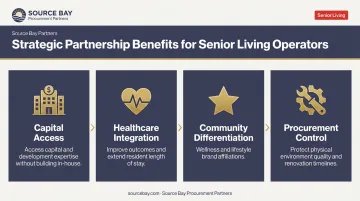
Strategic partnerships have become the primary engine for growth as a result. They allow operators to:
- Access capital and development expertise without building those capabilities in-house
- Improve resident outcomes and extend length of stay through healthcare integration
- Differentiate the community experience through wellness and lifestyle brand affiliations
- Control physical environment quality and renovation timelines through procurement partnerships
Every quarter without a partnership strategy is a quarter competitors use to lock in the relationships, referrals, and resident loyalty that drive long-term census growth.
The Partnership Ecosystem: Four Categories Operators Should Build
Strategic partnerships in senior living span multiple domains. The strongest operators build a deliberate ecosystem rather than a collection of isolated vendor agreements.
Developer and Capital Partnerships
Co-development models work because both parties have skin in the game from day one. When an operator brings care expertise and operational requirements into the design process alongside a developer's construction capability, the result is a building that actually functions well for residents and staff, not just one that photographs well.
Belmont Village's collaboration with Turnberry on Belmont Village Aventura — an 11-story, 153-residence luxury community that opened in March 2026 — illustrates this dynamic. Turnberry brought high-end real estate development expertise; Belmont Village brought senior living programming and care operations. Neither party could have produced the same outcome independently.
Secondary-market strategies are also expanding. Senior living property transactions in secondary markets grew 68% between 2022 and 2024, compared to 45% in primary markets, according to NIC MAP data cited by Senior Housing News. Operators partnering with developers to target underserved geographies with strong demographics can find markets where high-quality projects still pencil out, even in a challenging capital environment.
REIT and Capital Partner Relationships
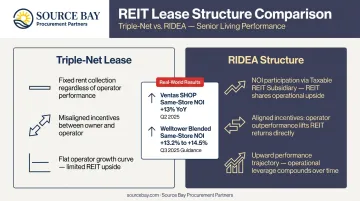
The shift from triple-net leases to RIDEA structures changed the economics of operator-REIT relationships fundamentally. Under a RIDEA structure, REITs participate in net operating income through a Taxable REIT Subsidiary rather than collecting fixed rent. Both parties benefit when operations improve, and both absorb the impact when they don't.
That alignment shows up in performance. Ventas reported SHOP same-store cash NOI grew 13% year-over-year in Q2 2025. Welltower guided blended same-store NOI growth of 13.2% to 14.5% for Q3 2025. These figures reflect the compounding effect of operators and capital partners working toward the same outcome.
Those performance numbers also explain why REITs are selective about which operators they back. REITs consistently favor operators with geographic density. Specifically, they look for:
- Clusters of communities in a region that share management infrastructure
- Reduced oversight costs through centralized operations
- Consistent, predictable performance across multiple assets
Operators building toward that density make themselves significantly more attractive to capital partners.
Wellness, Lifestyle, and Brand Partnerships
Embedding a recognized wellness brand into a community does more than add programming. It signals a philosophy of care that resonates with boomer prospects. Buckner Senior Living's partnership with Cooper Wellness Strategies at Ventana by Buckner — and its subsequent expansion into The Stayton at Museum Way, serving nearly 300 active-aging residents — shows how these arrangements shape both brand identity and physical design.
LeadingAge case studies show measurable results. Acts Retirement-Life Communities' engagement technology partnership with Linked Senior produced more than twice the daily average resident engagement and a 94% reduction in social isolation — outcomes that directly affect resident satisfaction and retention.
Healthcare Partnerships: The Census and Outcomes Connection
Senior living communities are no longer operating in isolation. The most competitive operators function as part of a connected care network alongside physician groups, home health agencies, pharmacy partners, and hospice providers. NIC research confirms that top-performing senior housing communities measurably reduce emergency department utilization, hospitalizations, and skilled nursing transitions for older adults.
Why Integrated Staffing Outperforms Reactive Outsourcing
The distinction between embedded clinical partners and on-call outsourced care matters. Integrated staffing creates:
- Builds continuity — residents see familiar clinicians rather than rotating agency staff
- Catches deterioration early — onsite providers spot warning signs before they become emergencies
- Reduces care gaps — service transitions are coordinated, not fragmented
Research published in peer-reviewed literature found that 16% of assisted living residents experienced at least one avoidable hospitalization, with 17% of all hospitalizations attributable to ambulatory-care-sensitive conditions (conditions preventable with proper outpatient care). Integrated care partnerships are the mechanism for moving those numbers.
Technology-Enabled Care and the Census Link
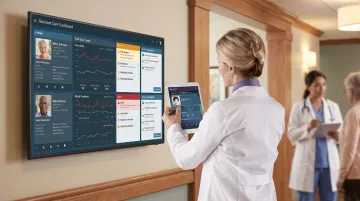
Resident openness to technology is higher than many operators assume. AARP reported that telehealth and remote monitoring use among adults 50+ grew from 35% in 2024 to 46% in 2025. Real-time health data, predictive analytics, and cross-team information sharing allow care teams to identify risks earlier and coordinate responses before a hospitalization occurs.
Those clinical improvements connect directly to census. Better outcomes extend average length of stay, and fewer hospitalizations mean fewer unexpected vacancies. Communities known for strong outcomes also generate referrals from hospitals, physicians, and families who have witnessed results directly — a compounding pipeline that paid marketing rarely matches at the same cost.
FF&E and Procurement Partnerships: The Physical Environment as Strategy
For the boomer demographic, how a community looks, feels, and functions is not an afterthought — it is a purchase decision driver. Operators positioning communities for this generation are investing in hospitality-style amenities, refreshed common areas, and physical environments that communicate quality.
Major senior living common-area renovations typically occur every 12 to 15 years, with per-door renovation budgets reaching $20,000 to $30,000 for common areas and apartments at well-capitalized operators. Average seniors housing development cost reached $317,400 per unit as of 2022, according to CBRE — and that figure has only grown since. Getting the physical environment right matters financially.
What a Strong Procurement Partnership Delivers
A capable FF&E procurement partner does not simply fulfill a product list. For senior living operators, the right partner manages:
- Custom textiles and specialized fixtures designed specifically for accessibility, safety, and resident comfort — sourced from senior living-specific manufacturers, not repurposed hotel or office specs
- Value-engineered product selection that hits per-unit cost targets without sacrificing design integrity
- Sequenced warehousing and freight coordination timed to renovation phases, so occupied communities experience minimum disruption and phased new builds can open wing by wing
- On-site installation oversight and final quality control documentation through project closeout

Source Bay Procurement Partners works with senior living operators across all four of these areas, drawing on a global manufacturer network that includes senior living-specific partners such as Kellex Furniture for specialized seating and Serta for commercial sleep solutions. Their partnership with sister company Neuco Furniture & Upholstery adds an integrated refurbishment capability — operators can restore existing assets alongside procuring new FF&E, rather than replacing everything at full cost.
That combination extends asset lifecycle, reduces total project spend, and keeps the physical environment aligned with rate positioning over time. For operators managing multiple communities or phased capital plans, it means a single procurement relationship that scales across projects rather than starting from scratch each cycle.
How to Evaluate and Structure New Partnerships
Not every business relationship qualifies as a strategic partnership. The distinction matters because strategic partners require management time and organizational investment — treating every vendor as a potential strategic partner dilutes focus. A simple vetting framework keeps that focus intact.
A Three-Question Vetting Framework
Before committing to a formal partnership, run any candidate through these three filters:
- Demonstrated senior living expertise — Does this partner have a verifiable track record in senior living, or are they adapting a hospitality or healthcare model without sector-specific knowledge?
- Accountability mechanisms — Can they provide shared data, performance benchmarks, or co-investment that creates mutual responsibility for outcomes?
- Geographic and operational capacity — Can they actually serve your communities at scale without overextension on their end?
Structuring for Performance
Once a partner clears the vetting threshold, structure the relationship to succeed:
- Start with a limited scope — A single community, one wing renovation, or a defined care coordination pilot reduces exposure if the fit proves weaker than expected
- Build in performance milestones — Especially for development and healthcare partnerships where misalignment compounds downstream
- Formalize communication cadences — Regular reviews with shared data prevent the drift that turns strategic relationships into transactional ones
REIT and operator relationships point to one consistent differentiator: leadership proximity. When decision-makers on both sides are directly accessible — not filtered through a distant central office — partnerships hold together under pressure. How quickly a partner responds to a routine question is usually how quickly they'll respond when something goes wrong.
Frequently Asked Questions
What types of strategic partnerships benefit senior living operators most?
The highest-impact categories span four areas, each addressing a different dimension of competitive performance:
- Developer and capital partnerships — growth capacity and project financing
- Healthcare partnerships — resident outcomes and census stability
- Wellness and lifestyle brand partnerships — market differentiation
- FF&E procurement partnerships — physical environment quality
How do senior living operators find and vet development partners?
Look for developers with track records in luxury or mixed-use projects who understand senior living's operational requirements, not just its construction complexity. Co-development structures where the developer shares financial stakes from the outset create alignment that sequenced arrangements rarely achieve.
What is a RIDEA structure and how does it affect senior living partnerships?
RIDEA allows REITs to participate in a property's net operating income through a Taxable REIT Subsidiary, rather than collecting fixed rent under a triple-net lease. This aligns REIT and operator incentives: both parties benefit directly from improved operations and resident outcomes, not just occupancy figures.
How do healthcare partnerships improve resident outcomes in assisted living?
Integrated clinical staffing, real-time data sharing, and coordinated care transitions reduce avoidable hospitalizations, create consistency for residents, and extend average length of stay. Communities with strong healthcare partnerships also generate referrals from hospitals and physicians who recognize the care quality.
What role does geographic density play in operator and REIT partnerships?
Operators with clusters of communities in a region share management infrastructure, reduce overhead, and respond faster to resident needs — making them more efficient and more accountable. REITs consistently favor these operators because density correlates with better financial and operational performance.
How can smaller or regional senior living operators compete through partnerships?
Regional operators hold a genuine advantage in proximity and relationship depth. By building dense local networks of healthcare, wellness, and procurement partners, smaller operators can deliver service quality and responsiveness that large national operators often cannot match at the community level.