This guide covers how the procurement process actually works, what drives cost and schedule risk, and where hotel owners most commonly go wrong — so you can avoid the decisions that derail projects before they open.
Key Takeaways
- FF&E spans every movable, non-structural item in a hotel — from guestroom casegoods to lobby seating and corridor lighting
- Procurement covers specification, vendor sourcing, PO management, freight, warehousing, and installation
- Custom and made-to-order items carry production lead times of 18–24 weeks or more
- Per-key FF&E investment ranges from $12,000 (limited-service) to $80,000+ (luxury), per the HVS 2024 Hotel Development Cost Survey
- Engaging a procurement partner before design is finalized protects both budget and project schedule
What Is FF&E Procurement in Hospitality?
FF&E stands for Furniture, Fixtures, and Equipment — the movable, non-structural items not permanently attached to a building. In a hotel context, this spans:
- Guestrooms: beds, casegoods, upholstered seating, area rugs, portable lamps
- Lobbies: lounge furniture, decorative lighting, artwork, accent tables
- F&B spaces: dining chairs, banquettes, bar fixtures, tabletops
- Corridors: console tables, artwork, decorative sconces
OFCI vs. OFOI: Who Installs What
Two designations govern how FF&E is handled on a project:
- OFCI (Owner-Furnished, Contractor-Installed): Items supplied by the owner but installed by specialized trades under the general contractor — carpet, wallcovering, hardwired lighting
- OFOI (Owner-Furnished, Owner-Installed): Items fully managed outside the GC's scope — furniture, artwork, upholstered seating, portable lighting
Understanding this distinction matters because OFOI scope — the largest share of typical hotel FF&E — falls entirely on the owner to coordinate. That's where most procurement complexity originates, and why so many hotel projects run into delays or cost overruns before the first guest checks in.
FF&E vs. OS&E
Hotel owners often mix up these two categories, which creates accounting headaches and budget shortfalls down the line:
| Category | Definition | Examples | Accounting Treatment |
|---|---|---|---|
| FF&E | Semi-permanent capital assets | Beds, casegoods, lighting fixtures | Depreciable property (USALI) |
| OS&E | Consumable operating supplies | Linens, toiletries, cleaning supplies | Expensed, not depreciated |
The ISHC recommends a project responsibility matrix precisely because item classifications vary by brand and owner. The accounting boundary — capital vs. operating — is clearer than the product lists.
Why Procurement Is More Than Purchasing
"Procurement" in this context covers the full project chain — not just purchasing. That includes:
- Specification development and vendor qualification
- Proposal evaluation and purchase order management
- Production tracking and lead time monitoring
- Freight logistics, warehousing, and sequenced delivery
- On-site installation coordination and final handoff
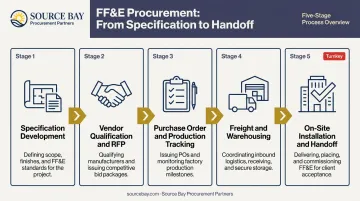
Hotels that treat procurement as a simple buy-and-deliver exercise often find out the hard way: missed opening dates, damaged goods arriving without a receiving plan, and installation crews waiting on furniture that's still in a container.
Why Hotels Need a Structured FF&E Procurement Process
Guest Experience Depends on Physical Space
The 2023 J.D. Power North America Hotel Guest Satisfaction Study — based on 33,754 guests — identified guest room and hotel facility as two of six core satisfaction factors. Overall satisfaction was 302 points higher when guests rated guest-room value for price paid as excellent or perfect.
The physical environment isn't background noise. It's a primary driver of the scores that shape your reputation and booking rates.
Brand Standard Compliance Is Non-Negotiable for Flagged Properties
Hotels operating under Marriott, Hilton, IHG, Hyatt, or Wyndham flags must source FF&E from approved vendor lists and meet specific finish, dimension, and material standards. Failure to comply results in:
- Failed PIP (Property Improvement Plan) inspections
- Mandatory reorders at full cost
- Timeline penalties and delayed flag approval
A structured procurement process that validates selections against brand standards before purchase orders are placed eliminates this risk entirely.
Budget and Timeline Exposure Are Real
According to HVS's 2024 U.S. Hotel Development Cost Survey, FF&E costs per room by segment are:
| Segment | FF&E Per Room |
|---|---|
| Limited-service | $12,000–$15,000 |
| Select-service | $18,000–$22,000 |
| Full-service | $30,000–$40,000 |
| Luxury | $60,000–$80,000 |
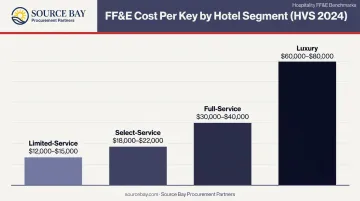
Without structured procurement, scope creep, emergency substitutions, and freight errors compound these numbers quickly. Each unplanned reorder or last-minute change eats directly into margin.
Timeline risk is equally concrete. Custom and made-to-order items — drapery, lighting, upholstered pieces — commonly carry 18–24 week production lead times. Procurement that starts too late forces a choice between expedited freight costs, inferior in-stock substitutes, or a delayed opening.
How the FF&E Procurement Process Works
FF&E procurement runs parallel to design and construction — engage too late, and delays compound quickly as an opening date approaches. Hotels also cannot receive an entire property's worth of FF&E at once. Sequenced delivery, timed to construction turnover by floor or zone, is standard practice.
Here is how the process unfolds across four phases:
Step 1: Budget Development and FF&E Specification
Procurement begins alongside the design process — not after it. During this phase, a procurement partner works with the design team to:
- Review the full FF&E specification (every item by room type, quantity, finish, dimension)
- Validate budget feasibility against selections before they are finalized
- Flag items with long lead times or availability risks early enough to act
- Apply value engineering where selections exceed budget thresholds
At Source Bay Procurement Partners, this is the Discovery phase — a deep alignment of design intent with operational requirements and budget reality. Their Senior Designer, Barbara Church, works with clients and interior designers at this stage to translate design vision into procurement-ready specifications before sourcing begins.
Step 2: Vendor Sourcing, RFP Management, and Award
With the specification confirmed, procurement partners issue RFPs to qualified manufacturers, evaluate responses across price, lead time, quality, and brand compliance, and present recommendations to ownership.
Experienced procurement firms maintain established manufacturer relationships that provide access to better pricing and reliability than open-market purchasing. Source Bay's network includes partners such as Blue Leaf Hospitality (casegoods), Kellex Furniture, Serta (commercial sleep), Schumacher and Fabricut (textiles and wallcoverings), Samsung and BDL (digital and illumination), and Remington Lighting — part of a network spanning 100+ industry manufacturers.
Step 3: Purchase Order Management and Production Tracking
Once vendors are awarded, procurement managers:
- Issue formal purchase orders and lock in production timelines
- Approve samples and submittals for custom items
- Monitor production milestones and manage change orders
- Surface and resolve manufacturer delays before they affect the construction schedule
Active production tracking is what makes managed procurement fundamentally different from a purchasing transaction. Problems get caught before they affect the schedule, not after.
Step 4: Freight Coordination, Warehousing, and Installation
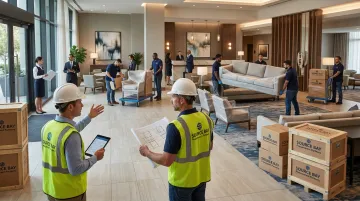
FF&E ships from multiple manufacturers across different countries and timelines. A procurement partner consolidates freight, receives and inspects items at a warehouse, resolves damage claims, and coordinates sequenced delivery aligned to construction turnover.
Source Bay manages this entire phase in-house, covering freight management, sequenced warehousing, and direct on-site oversight through final project handoff. Operations team members Paul Tomczak and Greg McKinnon oversee logistics and installation, ensuring every fixture and furnishing arrives in the correct sequence and condition.
Key Factors That Affect Hotel FF&E Procurement
- Custom drapery and made-to-order lighting typically require 18–24 weeks from order through installation; model room processes run 4–6 months. Build both into your project schedule from day one.
- Larger properties require earlier procurement engagement, more complex warehousing logistics, and phased installation planning that smaller projects simply don't demand.
- Approved vendor lists restrict sourcing flexibility. Value-engineering substitutions require formal brand approval — skipping this step causes failed inspections.
- Current market conditions add real cost pressure: the UNCTAD Shipping Cost Index stood at 115% above its pre-pandemic average as of October 2024, and a 2025 U.S. proclamation imposed a 25% duty on certain upholstered wooden products effective October 2025. Budget with dated freight allowances, not static percentages.
- Per-key FF&E investment varies substantially — limited-service properties typically run $12,000–$15,000 per key, while luxury properties land at $60,000–$80,000. Use these ranges as your baseline when setting contingency reserves.
Common FF&E Procurement Mistakes Hotel Owners Make
Starting Too Late
Many hotel owners engage a procurement partner only after construction is underway or design is finalized. This compresses production lead times and forces expensive alternatives: expedited freight, design substitutions, or storing completed FF&E on an unfinished job site where damage risk is high.
The ideal time to engage is during — or before — the interior design phase.
Treating FF&E as a Commodity
Contract-grade hospitality furniture is engineered for high-cycle commercial use and must meet fire code and brand performance standards. Selecting residential or budget-grade alternatives to reduce upfront cost typically results in premature replacement cycles and higher long-term expense.
Total cost of ownership is the correct lens for FF&E purchasing decisions — not unit price alone.
Attempting to Self-Manage Procurement
Hotel owners who attempt to self-manage procurement routinely underestimate the administrative burden — and face cascading delays as a result. A single project requires:
- Coordinating manufacturers across multiple countries and lead times
- Managing production schedules against construction milestones
- Handling freight claims and damage disputes
- Sequencing on-site installation across multiple delivery waves
An experienced procurement partner with integrated logistics capability — one that owns the process from specification through installation — keeps all of this on track without pulling your team away from the project itself.
Frequently Asked Questions
What is FF&E in hospitality?
FF&E stands for Furniture, Fixtures, and Equipment — the movable, non-structural items in a hotel such as beds, seating, lighting, and casegoods. These items are not permanently attached to the building but are essential to guest experience and hotel operations.
Is FF&E a hard cost?
FF&E is typically classified as a soft cost in hotel development budgeting. That said, FF&E items are depreciable capital assets under IRS guidelines. Qualifying guestroom furniture generally falls under Asset Class 57.0 with a 5-year GDS recovery period, which carries direct tax and financial reporting implications.
What is the difference between FF&E and OS&E in hotels?
FF&E covers semi-permanent capital items like furniture, fixtures, and equipment that depreciate over time. OS&E covers Operating Supplies and Equipment — consumable items like linens, toiletries, and cleaning supplies that are replenished regularly as part of hotel operations.
How long does FF&E procurement take for a hotel project?
The full procurement cycle, from specification through installation, typically spans several months. Custom and made-to-order items carry production lead times of 18–24 weeks or more. Engaging a procurement partner during or before the design phase is the most reliable way to keep the project on schedule.
What is OFCI vs. OFOI FF&E?
OFCI (Owner-Furnished, Contractor-Installed) refers to items supplied by the owner but installed by trades under the general contractor — such as carpet and wallcovering. OFOI (Owner-Furnished, Owner-Installed) refers to items managed entirely outside the GC scope, such as furniture, artwork, and portable lighting.
How much does FF&E cost per key for a hotel renovation?
Per HVS 2024 data, per-key FF&E costs range from $12,000–$15,000 for limited-service, $18,000–$22,000 for select-service, $30,000–$40,000 for full-service, and $60,000–$80,000 for luxury properties. Scope, brand standards, and the degree of custom work all affect your final budget.