Key Takeaways
- Anti-ligature furniture eliminates anchor points through geometry and construction — not just durability.
- Joint Commission NPSG.15.01.01 EP 1 and CMS 42 CFR 482.13(c)(2) mandate documented environmental risk assessments in psychiatric and high-risk clinical spaces.
- Specify smooth continuous surfaces, tamper-resistant fasteners, solid-core construction, and no removable hardware as baseline design requirements.
- Match specification strictness to risk level — acute inpatient rooms demand tighter standards than supervised group spaces.
- Build structured inspection schedules into lifecycle management — procurement decisions alone don't sustain compliance.
Why Anti-Ligature Furniture Matters in Healthcare Settings
The physical environment in a behavioral health unit works around the clock. Staff rotate, monitoring protocols have gaps, and unobserved moments happen in every facility. What stays constant is the furniture.
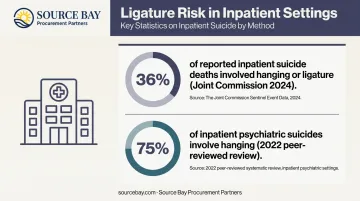
Joint Commission's 2024 Sentinel Event Data found that hanging or ligature was the leading method in 36% of voluntarily reported suicide or self-inflicted-injury deaths across 122 events. Among inpatient psychiatric suicides specifically, a 2022 peer-reviewed review reports that approximately 75% involve hanging — making the physical environment a direct patient safety variable, not a secondary concern.
Environmental modification has measurable impact. A VA study tracking outcomes before and after mandatory Mental Health Environment of Care Checklist (MHEOCC) implementation found suicide rates declined from 4.2 to 0.74 per 100,000 admissions, sustained over seven years. That's passive environmental safety running in parallel with clinical protocols.
The Compliance Stakes
Three regulatory frameworks define the compliance baseline for behavioral health environments:
- Joint Commission NPSG.15.01.01, EP 1: Requires an environmental risk assessment identifying physical features usable in a suicide attempt, with documented action to minimize them. Scope covers patient rooms, bathrooms, corridors, and common care areas.
- 42 CFR 482.13(c)(2): CMS grounds ligature risk management in the patient's right to care in a safe setting. CMS memo QSO-23-19 (2023) clarifies that the requirement applies wherever at-risk patients are served, but does not mandate identical configurations throughout a facility.
- Immediate jeopardy exposure: Unmitigated ligature risks in a psychiatric unit can trigger immediate jeopardy findings under CMS survey. When timelines are extended, monthly progress documentation (including invoices and vendor communications) is required alongside a 60-day correction window.
Anti-Ligature vs. Heavy-Duty: A Critical Distinction
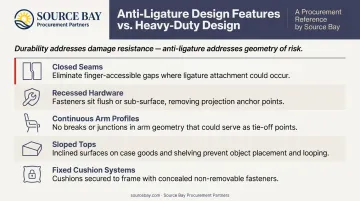
Heavy-duty furniture is built to resist damage. Anti-ligature furniture is built to eliminate anchor points. They are different engineering goals with different design outcomes.
A heavy-duty chair may withstand years of institutional use and still present tie-off risks. Anti-ligature design addresses the geometry of risk through features that durability-focused specs simply don't cover:
- Closed seams with no exposed gaps at frame joints
- Recessed or tamper-resistant hardware
- Continuous arm profiles without open-loop ends
- Sloped tops that prevent draping or looping
- Fixed cushion systems without removable attachments
The Therapeutic Environment Factor
Furniture that avoids an overtly institutional appearance has clinical value beyond safety. A 2024 systematic review on therapeutic built environments associates homelike character, comfortable furniture, and spaces supporting social interaction with positive patient outcomes. Trauma-informed design and milieu therapy principles both emphasize that the physical environment communicates safety and dignity — or the absence of both.
Anti-ligature furniture that looks and feels comfortable serves the clinical strategy directly, not as a secondary consideration.
Key Anti-Ligature Design Features to Understand
Anti-ligature furniture isn't just durable — it's designed to remove specific structural features that create risk. Knowing what those features are helps you evaluate products before committing to a specification.
Smooth, Continuous Surfaces and Sloped Edges
Any gap, protrusion, or horizontal surface can become a tie-off point. Anti-ligature design eliminates these through:
- Curved transitions between seat, back, and arms — no right-angle joints
- Closed seams with no exposed fabric edges that can unravel
- Sloped tops on wardrobes and casework to prevent items being placed or tied off above
- No under-bed void — platform designs that run continuous to the floor
Tamper-Resistant Fasteners and Concealed Hardware
Standard screws and bolts can be removed and used as anchor points or weapons. Anti-ligature specifications address this through:
- Six-lobed or tamper-proof fasteners (per NYS OMH 35th edition specifications) requiring specialized tools
- Recessed or concealed hardware that cannot be gripped or manipulated
- Continuous hinges instead of standard pin-style hinges on any doors or access panels
- Hardware-free construction on foam-core or rotationally molded pieces
One-Piece or Solid-Core Construction
Rotationally molded plastic and integral foam construction eliminate failure modes that standard furniture doesn't address:
- No splinter or fragment risk if the piece is struck or damaged
- No cavities that serve as contraband hiding spaces
- Resistance to prying apart at seams or joints
Weight, Anchoring, and Stability
Furniture that can be tipped, dragged, or thrown creates a separate hazard. Options include:
- Weighted bases added during manufacturing
- Floor-anchored pieces bolted through the substrate for high-acuity spaces
- Wall-secured casework for wardrobes, headboards, and shelving units
The right choice depends on unit workflow, cleaning rotation, and whether staff need to reposition furniture regularly.
Material and Hygiene Compliance
Healthcare-grade anti-ligature furniture must meet requirements beyond safety geometry:
- Fire ratings: Verify current applicable standards with your compliance officer. California Technical Bulletin 133 was repealed in 2019 and is no longer a valid US compliance reference for seating.
- Disinfectant resistance: Surfaces must withstand hospital-grade cleaning agents (quaternary ammonium, bleach-based solutions) without delamination or seam failure.
- Emissions compliance: TSCA Title VI (mandatory for composite wood products since March 2019) and CARB Phase 2 reduce formaldehyde emissions — they don't eliminate them. GREENGUARD Gold certification indicates lower VOC levels suitable for sensitive environments.
Types of Anti-Ligature Furniture for Healthcare Environments
Anti-ligature requirements vary by furniture category and the acuity level of the care space. The specifications below cover what to confirm before procurement in each category.
Beds and Sleeping Furniture
Platform beds are the standard specification for high-risk inpatient rooms. Key features to confirm:
- Solid sides with no under-bed clearance — eliminates the most common anchor space in patient rooms
- No exposed bed rails or frame gaps
- Floor-mount-ready base options for highest-acuity rooms
- Tamper-proof fasteners throughout, no standard hex-head bolts accessible to patients
- No restraint hardware or attachment points on the frame
NYS OMH's 35th edition (2026) specifies fully enclosed platform beds for high-risk bedrooms as the documented state standard — a useful reference even outside New York.
Seating: Chairs, Rockers, and Sofas
Anti-ligature seating eliminates the gaps, attachments, and hardware that standard chairs retain:
- Armless or continuous-arm profiles — no space between arm and seat where material can be looped
- No removable cushion attachments — foam is integral to the frame, not attached with zippers or ties
- Weighted or floor-anchor options for rooms where furniture movement is a risk
- Ergonomic foam construction that provides comfort without voids or cavities
- Rocking chairs for de-escalation areas — sensory-informed designs that meet anti-ligature geometry requirements while supporting calming, therapeutic use
Tables: Dining, Activity, and Bedside
| Feature | What to Verify |
|---|---|
| Edge profile | Fully rounded or enclosed — no exposed 90° corners |
| Base design | Pedestal or integrated base — no under-table voids or cross-bracing |
| Surface material | Solid molded or reinforced composite — no particle board delamination risk |
| Fasteners | Recessed and tamper-resistant throughout |
| Surface treatment | Antibacterial coating and disinfectant-compatible finish |
Activity tables, game tables, and bedside units follow the same specification framework. Confirming these features at the sourcing stage — before items reach a facility — prevents costly substitutions during installation review.
Mattresses, Pillows, and Soft Goods
Soft goods are frequently overlooked in anti-ligature planning. Specifications for compliant mattresses and pillows include:
- Fluid-proof, tear-resistant covers — welded or heat-bonded seams, not sewn
- Inverted seams that prevent unraveling (loose threads or fabric strips are ligature materials)
- Flame-retardant certified foam meeting applicable healthcare fire standards
- Minimal surface topography — no handles, ties, or raised edges that create concealment opportunity
FGI guidelines specify that seclusion rooms should contain only a behavioral health care mattress — the most restrictive furniture specification in any clinical space.
How to Assess Your Facility's Anti-Ligature Needs
Room-by-Room Risk Stratification
Not every space requires the same specification level. A practical framework:
| Space Type | Risk Level | Furniture Specification |
|---|---|---|
| Acute inpatient rooms | High | Full anti-ligature — anchored, tamper-proof, solid construction |
| Patient bathrooms | High | Full anti-ligature — no hooks, rails, or exposed hardware |
| Seclusion / crisis stabilization | Highest | Anti-ligature mattress only; fixed, minimal furnishing |
| Corridors and common areas | High (inpatient psychiatric) | Anti-ligature per NPSG.15.01.01 scope |
| Supervised group / therapy rooms | Medium | Reduced-ligature; risk assessment governs |
| Staff-only areas | Low | Standard commercial may apply |
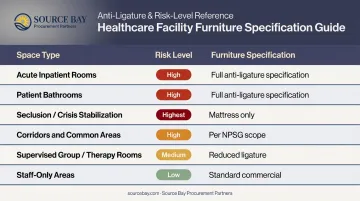
NYS OMH's three-tier framework (high risk: unsupervised patient use; medium risk: controlled access with no solitary use; low risk: staff-only) offers a practical operational model for structuring these stratification decisions.
Acuity and Patient Population Factors
Short-term crisis stabilization units and long-term inpatient wards have different furniture priorities:
- Crisis stabilization units see rapid turnover, so prioritize easy sanitization, minimal surface complexity, and durability under intensive use cycles
- Long-term inpatient settings require comfort and dignity alongside safety — furniture should support therapeutic milieu, not amplify an institutional feel
Operational and Staff Workflow
Furniture that creates daily friction defeats its safety purpose. Before finalizing specifications:
- Involve nursing staff, environmental services, and facility managers in the selection process
- Confirm that floor-anchored pieces won't block cleaning equipment
- Verify that tamper-resistant fasteners don't require tools that aren't available on the unit
- Check that weighted furniture can be moved safely during code situations
Procurement, Maintenance, and Lifecycle Considerations
Upfront Cost vs. Lifecycle Value
Anti-ligature furniture carries a higher initial unit cost than standard commercial furniture. The case for evaluating total cost of ownership instead:
- Fewer emergency replacements from damage or compliance failures
- Lower incident rates reduce liability exposure and corrective-action costs
- Longer durability under intensive clinical use cycles
- Documented compliance supports survey readiness — avoiding costly remediation
Evaluate specifications against lifecycle performance, not catalog unit price. Maintenance discipline is what sustains that performance over time.
Maintenance and Inspection Schedule
Damage to anti-ligature furniture reintroduces the hazards it was designed to eliminate. A structured maintenance program is essential.
| Frequency | Responsible Party | What to Check |
|---|---|---|
| Daily | Clinical / nursing staff | Surface integrity, visible hardware status, cushion seams |
| Weekly | Charge nurse or supervisor | Early wear indicators, fastener tightness, fabric condition |
| Monthly | Facility management | Full inspection, documentation log update |
| Annually | Vendor or manufacturer rep | Replacement triggers, component assessment, warranty review |
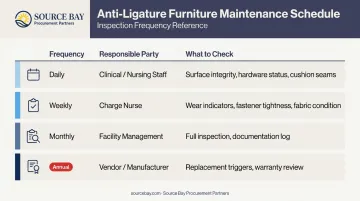
VHA Directive 1167 (2024) requires MHEOCC inspections of inpatient mental health units twice annually with daily environment-of-care rounds — a useful operational benchmark even outside the VA system.
Documented maintenance logs serve a dual purpose: they catch risk creep early, and they demonstrate proactive compliance posture during Joint Commission or CMS surveys.
Sourcing and Procurement Planning
Healthcare FF&E procurement for anti-ligature environments requires coordination across designers, architects, clinical staff, and compliance officers before a single purchase order is issued. Misaligned specifications discovered after delivery are expensive to correct.
Working with an experienced FF&E procurement partner helps facilities align specifications to space acuity, manage freight and sequenced delivery logistics, and avoid the substitution errors that commonly occur when sourcing and logistics are handled by separate parties.
Source Bay Procurement Partners works with healthcare and senior living facilities through a four-phase process: Discovery, Sourcing, Logistics, and Installation. That structure keeps compliance requirements tied to specifications from the initial planning phase through final installation — reducing the gap where substitution errors and documentation failures typically occur.
Conclusion
Anti-ligature furniture is infrastructure, not an upgrade. When specified correctly, maintained on schedule, and matched to the acuity level of each space, it works continuously alongside observation protocols and clinical staff to reduce risk at every hour — during shift changes, off-hours, and the moments between direct observation.
Facilities planning new builds, retrofits, or replacement cycles should treat anti-ligature procurement as a systems decision from the outset. Getting specifications right before procurement begins — not after installation — protects long-term value and prevents costly mid-project corrections.
That means aligning furniture decisions to:
- Space risk level and observation coverage
- Patient population and acuity profile
- Clinical workflow and staff interaction patterns
- Applicable compliance standards and inspection requirements
Frequently Asked Questions
What is anti-ligature furniture?
Anti-ligature furniture is engineered for behavioral health and psychiatric environments to eliminate tie-off points where cord or fabric could be used for self-harm. Design features — smooth continuous surfaces, rounded edges, no removable hardware, sealed construction — drive compliance, not simply material weight or durability.
What furniture does not have formaldehyde?
No composite wood furniture is truly formaldehyde-free. Products labeled CARB Phase 2 compliant or carrying TSCA Title VI certification meet regulated emission limits — not zero emissions. GREENGUARD Gold certification indicates lower VOC levels appropriate for sensitive environments like healthcare. Request material safety data sheets and third-party certifications when evaluating clinical furniture.
What is the difference between anti-ligature and heavy-duty furniture?
Heavy-duty furniture is built for durability and abuse resistance but may still contain open frames, exposed hardware, or gaps that function as tie-off points. Anti-ligature furniture specifically addresses the geometry of risk — eliminating anchor points through design, not just material strength. A piece can be both heavy-duty and non-compliant from an anti-ligature perspective.
Which areas of a healthcare facility require anti-ligature furniture?
Joint Commission NPSG.15.01.01 and CMS requirements apply to inpatient psychiatric units — patient rooms, bathrooms, corridors, and common care areas. Non-psychiatric settings aren't required to match that standard, but must implement documented, risk-based mitigation for patients identified as at risk.
How long does anti-ligature furniture typically last in a healthcare setting?
No authoritative fixed-year benchmark exists — lifespan depends on material type, usage intensity, and maintenance quality. Plan replacement based on observed condition indicators (compromised seams, loose fasteners, surface damage) rather than a fixed schedule.
How do healthcare facilities document anti-ligature compliance for audits?
Maintain records of completed environmental risk assessments, furniture specification sheets confirming anti-ligature design features, maintenance and inspection logs, and incident reports. Joint Commission and CMS surveyors expect to review this documentation during accreditation surveys.