Introduction
Eco-conscious travelers are reshaping what hotels must deliver — and the pressure is real. According to Booking.com's 2024 Sustainable Travel Report (surveying 31,550 respondents across 34 countries), 83% of travelers say sustainable travel is important to them, and 75% want to travel more sustainably in the next 12 months.
For hoteliers, that signal translates directly to furniture, fixtures, and equipment. FF&E is no longer a purely aesthetic decision. It's now an environmental commitment, a financial lever, and a compliance consideration — often evaluated simultaneously.
This guide walks through what sustainable FF&E looks like in practice: from materials and certifications to refurbishment strategies and procurement decisions that hold up under scrutiny.
Key Takeaways:
- 83% of global travelers value sustainable travel — eco-visible FF&E choices directly influence guest perception
- LED retrofits cut electricity use by 50% or more per room
- Water-efficient fixtures cut consumption by up to 35% per occupied room
- Refurbishing existing FF&E eliminates shipping, disposal, and replacement costs entirely
- Green certifications like LEED and Green Key evaluate FF&E decisions at the procurement level
Why Sustainable FF&E Is No Longer Optional for Hotels
Sustainability used to be a differentiator. Today, it's a baseline expectation — from guests, brand flag programs, and institutional investors scrutinizing ESG commitments.
The stakes are tangible. The Sustainable Hospitality Alliance reports that the hotel sector accounts for approximately 1% of global carbon emissions and must reduce those emissions by 66% per room by 2030 and 90% per room by 2050. FF&E decisions — materials sourcing, manufacturing, transportation, disposal — contribute directly to that footprint.
The Financial Argument
FF&E is a substantial ongoing cost center. Industry data has long benchmarked FF&E reserves at 4% to 5% of gross revenue, with total capital needs reaching 7% to 11% when technology and permanent components are included. More recent trade reporting from 2025 puts average hotel capex closer to 8%, with some advisors now recommending FF&E reserves of 15% to 25% given deferred renovation backlogs.
Sustainable FF&E choices — durable materials, LED fixtures, water-conserving equipment — don't eliminate that spend. They reshape it: lower ongoing replacement frequency, reduced utility bills, and fewer emergency substitutions.
Brand and Compliance Pressure
Eco-conscious guests do more than book once; they recommend and review. Visible sustainable design choices (natural materials, low-energy lighting, responsibly sourced textiles) reinforce brand perception in ways that generic amenity upgrades don't.
There's also a compliance dimension most hoteliers underestimate. Major flag programs are now embedding sustainability standards directly into Property Improvement Plans (PIPs). Hotels that delay action face:
- Non-compliance costs triggered by brand-mandated PIPs
- Forced renovation expenditure on the brand's schedule, not the owner's
- Accelerated capital spend that sustainable sourcing decisions today could have spread out
Key Categories of Sustainable Hotel FF&E
"Sustainable FF&E" isn't a single category. It spans furniture, lighting, window treatments, bedding, bath fixtures, and room controls — each with distinct opportunities to cut environmental impact without sacrificing design quality.
Sustainable Furniture and Soft Furnishings
Furniture carries the largest environmental footprint of any FF&E category. Key sustainable choices include:
- FSC-certified solid wood — ensures responsible forestry practices across the supply chain
- Bamboo and cork — fast-growing renewable alternatives to virgin hardwood
- Reclaimed or recycled-content frames — diverts material from landfill, often with distinctive character
- Low-VOC finishes and treatments — standard MDF and particle board off-gas formaldehyde; avoiding them directly improves indoor air quality
For soft goods, look for:
- OEKO-TEX Standard 100 certified fabrics — tested for harmful substances across all textile layers
- Organic or recycled-fiber bedding — reduces chemical inputs and virgin material use
- Thermal or blackout drapery — serves dual purpose: sustainable materials plus better temperature regulation, reducing HVAC load
Energy-Efficient Fixtures and Lighting
Lighting is one of the fastest-payback sustainability investments a hotel can make. ENERGY STAR data for lodging properties shows that LED retrofits can reduce lighting electricity use by 50% or more, with an additional 10% to 20% reduction in cooling energy from lower heat output.
Beyond LED fixtures themselves:
- Smart lighting controls with motion sensors eliminate energy waste in unoccupied corridors and rooms
- Energy Management Systems (EMS) coordinating HVAC with reservation and checkout data can reduce energy costs by 35% to 45%
- Programmable thermostats and sensor-activated HVAC are now standard FF&E specifications at the room level
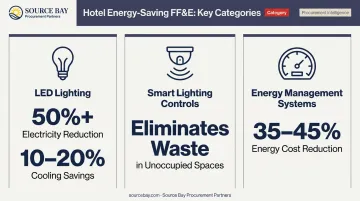
Each of these specifications generates measurable returns within the first renovation cycle — and lays the groundwork for water conservation gains as well.
Water-Saving Fixtures
Water conservation fixtures fall squarely within FF&E specifications and represent significant savings, particularly in water-scarce markets. Hotels can use an average of 1,500 liters per room per day according to the Sustainable Hospitality Alliance.
The impact of retrofitting is well-documented. An EPA WaterSense case study of a Holiday Inn in San Antonio found that replacing standard toilets, faucet aerators, and showerheads with high-efficiency alternatives cut water use by 35% (from 202 to 132 gallons per occupied room per day). That single retrofit saved over $68,000 annually in combined water, sewer, and energy costs.
Fixture upgrades worth specifying:
- Low-flow showerheads (1.75 gpm vs. standard 2.5 gpm)
- Aerating faucets (1.5 gpm vs. standard 2.2 gpm)
- Dual-flush toilets (1.1 gpf vs. standard 3.5-5.0 gpf)
Choosing Materials Built to Last — and Built for the Planet
The most sustainable procurement decision a hotel can make is simply choosing materials that don't need to be replaced every five years. Longer asset life means fewer manufacturing runs, fewer shipments, and less disposal — which adds up to real environmental and financial savings across a property's lifecycle.
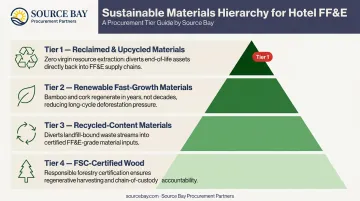
The Sustainable Material Hierarchy
| Tier | Material Type | Why It Matters |
|---|---|---|
| 1 | Reclaimed/upcycled materials | Reuses what already exists; zero virgin resource extraction |
| 2 | Renewable fast-growth materials (bamboo, cork) | Minimizes impact; regenerates quickly |
| 3 | Recycled-content materials | Diverts waste from landfill |
| 4 | FSC-certified wood | Ensures responsible forestry, not just a sustainability label |
Materials to avoid: PVC-heavy composites, high-VOC finishes, standard particle board, and single-use soft goods that require full replacement rather than component refresh.
Value Engineering and Durability
Sustainable doesn't mean premium-priced at all costs. Value engineering (specifying materials and constructions that achieve design intent at the right price point) is how hotels access durable, responsible materials without blowing the FF&E budget.
This is where experienced procurement specialists add real value:
- Identifying which materials perform at each price tier before costly substitutions happen
- Verifying genuine third-party certifications versus self-declared claims
- Confirming which constructions hold up to commercial-grade use over time
Circular Design Thinking
More manufacturers now design furniture with end-of-life in mind:
- Replace individual components rather than disposing of whole units
- Disassemble cleanly at end of life for easier material recycling
- Return frames and fixtures through manufacturer take-back programs when replacement is unavoidable
Specifying these options from the outset reduces downstream disposal costs — and gives owners concrete, documented data points for ESG and green building reports.
Extending FF&E Lifecycle: The Greenest Choice of All
Before specifying new FF&E, the most environmentally and financially defensible question is whether existing assets can be extended.
Replacing furniture generates costs across taxes, freight, storage, labor, installation, and disposal. Maintaining and refinishing existing pieces eliminates most of those line items. Branded hotels typically follow a seven-year renovation cycle, and some properties have deferred improvements for 10 to 12 years — meaning there's often more life left in existing assets than operators assume.
Industry guidance distinguishes between asset types:
- Hard goods (case goods, dressers, desks, lamps) often retain structural integrity well beyond their cosmetic life
- Soft goods (sofas, linens, drapes) typically require replacement or reupholstery on a shorter cycle
What Lifecycle Extension Looks Like in Practice
Source Bay Procurement Partners and sister company Neuco Furniture & Upholstery offer an integrated refurbishment pathway covering both asset categories. A typical engagement includes:
- Reupholstering frames in more durable or sustainable fabrics, extending the asset life of structurally sound seating
- Refinishing wood case goods where surface wear has degraded appearance but the underlying piece remains solid
- Re-engineering structurally damaged pieces rather than substituting whole units
- Replacing worn soft components while retaining the durable base
The result is a turnkey process (from initial asset assessment through material sourcing, restoration, and reinstallation) that keeps refurbished and newly procured pieces visually cohesive. For hotels managing tight CAPEX or sustainability commitments, engaging this pathway early in renovation planning delivers measurably better outcomes than last-minute replacement decisions.
Preventative Maintenance as a Sustainability Strategy
Hotels that build FF&E maintenance schedules into their asset management programs reduce emergency replacement needs, keep rooms out of service for shorter periods, and make more predictable CAPEX decisions. It's consistently one of the highest-ROI sustainability actions a property can take.
Green Certifications and What They Mean for FF&E Decisions
Pursuing a green certification isn't purely a PR exercise — it directly affects booking volume. GBTA's 2022 sustainability report found that 78% of global business travel professionals prioritized suppliers with recognized sustainability certification, and 81% prioritized energy-efficient hotels when selecting venues.
More recently, Deloitte's 2025 corporate travel study found that roughly 40% of corporate booking tools now flag sustainability certifications and ratings — meaning certified properties gain a visibility advantage at the point of purchase. That visibility advantage starts with how you specify FF&E.
How Major Certifications Evaluate FF&E
| Certification | Key FF&E Relevance |
|---|---|
| LEED | Materials sourcing, low-emitting products, energy-efficient fixtures, water conservation, indoor air quality |
| Green Key | Energy-efficient appliances, recognized eco-labels for purchased products, water-saving fixtures |
| EarthCheck | LED lighting, smart controls, FSC/PEFC timber preference, low-flow fixtures, supplier sustainability credentials |
| ENERGY STAR | Building-level score (75+ required); product-level certification for fixtures and equipment via Product Finder |
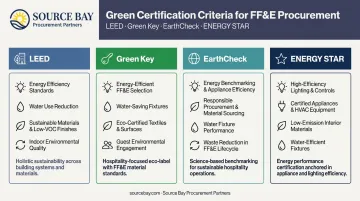
Every FF&E procurement decision — material sourcing, fixture specifications, finish selections — either builds toward or erodes your certification score. Map your FF&E specification sheet against certification requirements at the start of the renovation planning process, before procurement begins.
Working with the Right Sustainable FF&E Procurement Partner
Executing sustainable FF&E at scale requires a procurement partner with direct relationships to certified manufacturers — and the expertise to verify sustainability claims rather than take catalog descriptions at face value.
Vetting suppliers for legitimate certifications (FSC, OEKO-TEX, GREENGUARD) is a specialized skill. The difference between a product that carries genuine third-party certification and one with a self-declared sustainability label isn't always visible in the catalog.
What to Look for in a Procurement Partner
- Global manufacturer network with access to sustainably certified product lines
- In-house design expertise to value-engineer eco-friendly specifications without sacrificing aesthetics
- Turnkey logistics including consolidated freight management, sequenced warehousing, and installation oversight that minimize transportation waste and delivery inefficiencies
- Integrated refurbishment capability for hotels seeking lifecycle extension alongside or instead of full replacement
Source Bay Procurement Partners brings all four of these together. Their global manufacturer relationships, Senior Designer Barbara Church's design expertise, and end-to-end logistics operations give hotel clients the infrastructure to execute green hospitality projects from specification through setup.
The right partner also helps hotels balance sustainability requirements with brand standards and budget realities. Green choices don't require compromising design integrity or guest experience — experienced procurement support ensures they won't.
Frequently Asked Questions
What is sustainable FF&E in hospitality?
Sustainable FF&E refers to furniture, fixtures, and equipment selected for their reduced environmental impact through eco-friendly materials, energy efficiency, water conservation, and long asset lifecycles. The goal is real environmental performance without sacrificing guest comfort or design quality.
How does sustainable FF&E reduce hotel operating costs?
Energy-efficient lighting and fixtures lower utility bills; durable materials reduce replacement frequency; water-saving fixtures cut consumption costs. Over a full FF&E lifecycle, those savings consistently offset any upfront cost premium.
What certifications should hotels look for when sourcing sustainable FF&E?
FSC certification for wood products, OEKO-TEX for textiles, GREENGUARD Gold for low-VOC emissions, and ENERGY STAR for fixtures and equipment. These product-level certifications also contribute to property-level green ratings like LEED, Green Key, and EarthCheck.
Is sustainable FF&E significantly more expensive than conventional options?
Some sustainable materials carry a modest upfront premium. Total cost of ownership — factoring in durability, energy savings, and reduced replacement frequency — typically favors sustainable options over lower-quality conventional alternatives.
How can hotels make existing FF&E more sustainable without full replacement?
Reupholster structurally sound frames with sustainable fabrics, refinish case goods instead of replacing them, swap worn soft goods while retaining durable bases, and implement a preventative maintenance schedule to extend asset life over time.
What materials are most sustainable for hotel furniture?
FSC-certified solid wood, bamboo, reclaimed wood, and recycled-content materials top the list for furniture frames. OEKO-TEX certified textiles work well for soft goods. Avoiding high-VOC finishes, standard particle board, and virgin plastic composites is just as critical — these materials degrade indoor air quality and shorten asset life.