Introduction
Most project teams treat FF&E procurement as a downstream task — something to handle once the building is taking shape. That instinct is expensive.
For hospitality, senior living, and multi-family developments, procurement decisions made late in the process don't just create paperwork headaches. They force design compromises, generate expedited freight premiums, and in the worst cases push opening dates back weeks or months — directly cutting into revenue.
Preconstruction planning and procurement is the strategic phase where project scope, costs, timelines, supplier relationships, and material selections are locked in before construction begins.
When procurement belongs to this phase — not the one after it — projects open on time, on budget, and looking exactly like they were supposed to.
This guide is written for developers, project owners, interior designers, and construction managers working on hospitality, senior living, or multi-family projects. It covers what preconstruction procurement actually involves, why the stakes are higher in these sectors than most, and how to avoid the common mistakes that derail otherwise well-planned projects.
Key Takeaways
- Preconstruction converts a design concept into a buildable, financially viable plan — procurement belongs here from day one
- FF&E for hospitality and senior living carries lead times that can span months; ordering after construction starts is often too late
- Tying a procurement schedule to construction milestones — with vendors engaged early — is what separates on-budget finishes from costly delays
- The most common procurement failures share one cause: FF&E treated as an afterthought rather than a planning priority
- Engaging a specialized FF&E procurement partner during preconstruction protects design intent and keeps delivery aligned with your construction schedule
What Is Preconstruction Planning & Procurement?
Preconstruction is the organized body of work that happens before physical construction begins. It covers feasibility assessment, design development, budgeting, scheduling, permitting, and procurement planning — transforming a client's concept into a fully scoped and executable project plan.
According to AIA Contract Documents, preconstruction services can include design assist, cost estimating, scheduling, logistics planning, material selections, and value engineering — all before a single shovel hits the ground.
The AIA also maintains a dedicated Interiors family of contract documents specifically for FF&E procurement services. On well-run projects, procurement planning during preconstruction is formally scoped and contractually structured, not handled informally as an afterthought.
What Procurement Planning Means in This Phase
Procurement planning within preconstruction involves:
- Identifying every required material, furnishing, fixture, and piece of equipment
- Qualifying and engaging vendors before construction starts
- Establishing purchase timelines keyed to production windows
- Aligning delivery sequencing with construction milestones
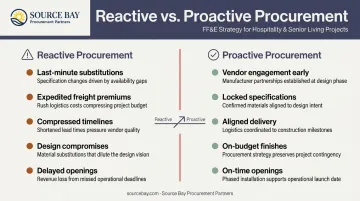
This is categorically different from reactive procurement — the common practice of ordering FF&E after design is finalized and construction is already underway. Reactive procurement is the single greatest source of schedule disruption on hospitality and commercial builds. It produces last-minute substitutions, compressed freight timelines, and budget pressure that compounds as the opening date approaches.
Proactive procurement planning eliminates most of that exposure. The difference isn't total effort — it's timing. Decisions made during preconstruction carry far less cost and schedule risk than the same decisions made under construction pressure.
Why Preconstruction Planning & Procurement Matters in Hospitality and Senior Living
These sectors don't have the luxury of generic procurement timelines. A hotel guestroom requires contract-grade casegoods, custom upholstered seating, branded textiles, and specialty lighting — none of which ship off a shelf. A senior living community adds accessibility-compliant fixtures, specialized seating, and materials subject to fire safety and durability codes.
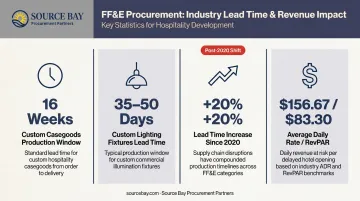
The numbers tell the story directly. Kimball Hospitality documents that custom hospitality projects move from purchase order through full production in 16 weeks. ASC Lighting puts custom decorative hospitality fixtures at 35–50 days from approved drawings through production completion, with additional time for new tooling. Hotel Management reported in 2024 that hotel FF&E lead times increased by nearly 20% since 2020. Plan around these timelines, not against them.
The Cost of Getting Procurement Timing Wrong
The schedule and budget consequences of delayed procurement decisions are well-documented across construction broadly. The AGC's 2025 Construction Outlook found:
- 22% of contractors identified project delays from availability or supply-chain issues as a top concern
- 45% accelerated purchases after winning contracts to mitigate supply-chain problems
- 25% specified alternative materials or products to avoid rework or schedule slippage
In hospitality, a delayed opening isn't abstract. CoStar/STR data shows December 2024 U.S. hotel average daily rate at $156.67 and RevPAR at $83.30. Senior housing occupancy ended 2025 at 89.1%, per NIC. Every day a property can't open is measurable lost revenue — and if FF&E procurement is the reason, that's a preventable loss.
Design Integrity and Early Procurement
When procurement is embedded early, interior designers and procurement specialists can run value engineering before specifications are finalized. When it's embedded late, the conversation shifts from "what best serves the design" to "what's available in time." That distinction shapes the final product.
Major hotel brands have formalized this understanding at scale. Hilton Supply Management's FF&E Project Procurement team handles new builds, conversions, and renovations from supplier negotiations through installation, backed by $16 billion in collective spend. IHG similarly provides centralized purchasing agents for owner access to FF&E pricing.
For developers and owners who don't have that infrastructure in-house, the practical answer is the same: bring procurement into the process before design is locked, not after.
How the Preconstruction Procurement Process Works: Phase by Phase
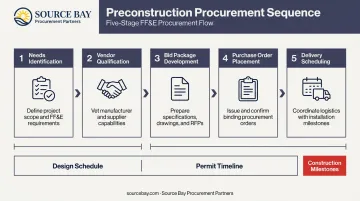
Preconstruction procurement moves through a defined sequence: needs identification → vendor qualification → bid package development → purchase order placement → delivery scheduling. Each stage must sync with the design schedule, permit timeline, and construction milestones — and falling behind in any one phase compounds delays in every phase that follows.
Feasibility and Scope Definition
Procurement planning starts at feasibility — not after construction documents are issued. During this stage, the project team should:
- Estimate FF&E budgets alongside construction costs
- Identify brand flag requirements, ADA compliance needs, or senior living fire and safety standards that will constrain product selection
- Flag categories with long lead times that must be ordered well before construction is complete
- Confirm whether any custom or bespoke items require early design approval milestones
This is the phase where Source Bay Procurement Partners conducts their Discovery process — a deep analysis of project scope, alignment of design intent with operational requirements, and budget feasibility planning. Establishing these parameters before any sourcing begins is what prevents the expensive misalignments that show up later.
Vendor Qualification and Procurement Scheduling
Qualifying vendors involves more than finding manufacturers who make the right product. A rigorous qualification process evaluates:
- Production lead times and current capacity
- Track record on comparable projects at comparable scale
- Freight coordination capabilities
- Financial stability sufficient to fulfill a large contract order
From this, the team builds a procurement schedule — a living document that maps each product category's specification approval deadline, order placement date, production window, freight timeline, and on-site delivery date back to the construction completion milestone. It updates throughout the project as timelines shift.
Bid Package Development and Value Engineering
Bid packages compile scope of work, drawings, specifications, and contractual terms for each product category, then go to qualified vendors for competitive pricing. This is where value engineering happens — identifying alternatives that meet design intent at lower cost or shorter lead time.
Effective value engineering requires procurement specialists with deep manufacturer relationships — the kind that tell you which manufacturer can deliver a custom upholstered chair in 12 weeks versus 20, or which textile supplier carries a comparable option in stock when the specified one is backordered. That institutional knowledge doesn't come from catalog searches.
Purchase Order Placement and Delivery Coordination
Once specifications are approved and bids are evaluated:
- Issue purchase orders with confirmed specifications and delivery requirements
- Monitor production status actively — not just at order placement but throughout the manufacturing window
- Coordinate freight and logistics across domestic and international supply chains
- Plan sequenced delivery so FF&E arrives on site only when spaces are ready to receive it
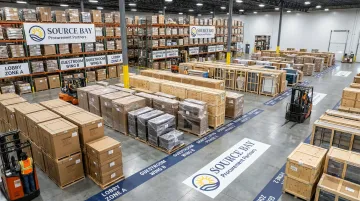
Furniture delivered to an unfinished site risks damage, theft, and unplanned storage costs. Source Bay's logistics stage addresses this directly through sequenced warehousing — staging FF&E in a coordinated release schedule that matches construction readiness rather than manufacturer shipping convenience.
Key Best Practices for Preconstruction Procurement in Hospitality and Senior Living
Start Procurement Planning at Design Development
Waiting until construction documents are finalized before engaging suppliers is the single most common mistake on hospitality and senior living projects. By the time CDs are issued, some long-lead items should already be in specification review. The procurement schedule should be built alongside the design schedule — not after it.
Build a Procurement Schedule Tied to the Master Construction Timeline
A useful procurement schedule tracks:
- Product categories and specification approval deadlines
- Order placement dates by category
- Production windows by manufacturer
- Freight transit windows (domestic vs. international origin)
- Site delivery sequencing by space or floor
This document is not static. It should be reviewed and updated at every major construction milestone, with the procurement team flagging any lead time risks before they become schedule crises.
Engage a Specialized FF&E Procurement Partner Early
Generic procurement firms don't carry the manufacturer relationships that matter in hospitality and senior living. Source Bay Procurement Partners works with a global network that includes Kellex Furniture for senior living seating, Serta for commercial sleep solutions, Schumacher and Fabricut for textiles and wallcoverings, Remington Lighting for custom fixtures, and Blue Leaf Hospitality for casegoods and upholstered furniture.
That network enables real lead time visibility, value-engineered sourcing alternatives, and coordinated multi-vendor delivery sequencing across a complex project.
Bringing that expertise in at preconstruction protects the project from the substitutions and schedule slippage that follow late engagement.
Plan for Sequenced Warehousing
For phased projects or buildings where spaces don't reach completion simultaneously, delivery sequencing requires an interim staging plan. FF&E that arrives before its destination is ready needs secure, climate-controlled storage — not an unfinished floor or an unsecured loading dock. Building this into the logistics plan during preconstruction prevents a common and expensive problem.
Conduct Value Engineering Before Specifications Are Finalized
Value engineering is most effective before specifications are locked. Once a product is specified and approved, substituting it triggers a redesign and re-specification cycle that costs both time and money.
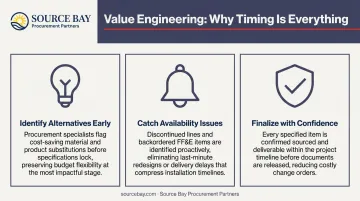
When procurement specialists join the design review process early, as Source Bay does during the Sourcing phase, teams can:
- Identify cost-saving alternatives before specifications are locked
- Catch discontinued or backordered items before they create delays
- Finalize specifications with confidence that products can actually be delivered
Common Mistakes in Preconstruction Procurement
Three procurement errors show up repeatedly on hospitality and senior living projects — and all three are avoidable with earlier planning.
Treating FF&E Procurement as a Post-Construction Activity
The belief that furniture and fixtures can be ordered once the building is complete reflects a fundamental misunderstanding of contract-grade hospitality manufacturing. Custom pieces require months of production time. By the time construction finishes and a team starts looking for vendors, it's already too late to open on schedule without paying expedited freight premiums or compromising the specified design.
Underestimating What Bid Package Development Requires
Many project teams assume procurement means placing orders. In reality, bid package development, specification management, vendor coordination, and freight logistics represent the majority of procurement hours on a large project. Teams that understaff this effort face last-minute errors, specification omissions, and change orders that show up as cost on the back end.
Confusing Lowest Bid with Best Value
Selecting vendors on unit price alone — without evaluating lead time reliability, quality control, or project track record — leads to delays, damaged goods, or substitutions that violate brand standards. The relevant metric is total cost of delivery, not purchase price.
A vendor that's $5,000 cheaper but four weeks slower on a project with a fixed opening date isn't the better choice.
Conclusion
Preconstruction planning and procurement aren't sequential — they're parallel disciplines that must run together from the earliest stages of a project. For hospitality, senior living, and multi-family developments, the FF&E procurement process is particularly time-sensitive, technically complex, and consequential to both the opening schedule and the long-term quality of the finished space.
The projects that open on time and look like they were supposed to are almost always the ones where a procurement partner was at the table during preconstruction — not called in after the structure was up.
Source Bay Procurement Partners works alongside developers, designers, and owners from day one — integrating procurement into preconstruction before lead times become liabilities. Our four-phase process covers every stage:
- Discovery — aligning procurement scope with design intent and project budget
- Sourcing — vetting manufacturers and locking in specifications early
- Logistics — coordinating freight and sequenced warehousing around the construction schedule
- Installation — overseeing final FF&E setup and project handoff
To avoid the risks of late procurement, costly substitutions, or delayed openings, reach out to Source Bay at hello@sourcebay.com or (231) 943-3455 to initiate a Discovery consultation.
Frequently Asked Questions
What is the pre-construction planning phase?
It's the strategic phase before physical construction begins where teams define project scope, develop designs, establish budgets, obtain permits, and plan procurement. Everything that happens during preconstruction sets the foundation for how the construction phase executes, and whether it stays on schedule and within budget.
What are the best practices for procurement planning in the pre-construction phase?
Start procurement planning at design development, not after construction documents are issued. Build a detailed procurement schedule tied to construction milestones, engage qualified vendors early, and involve a specialized procurement partner to manage lead times, value engineering, and delivery logistics before timeline gaps compound.
What factors should be considered when preplanning a large construction site?
Site logistics, regulatory and permitting requirements, long-lead material identification, stakeholder coordination, phasing and sequencing, and budget contingencies all need early attention. For hospitality and senior living specifically, FF&E procurement timelines must be factored into site planning from the start because they directly determine when spaces need to be ready to receive furniture.
What are the main phases of a construction project?
Typically: predevelopment and feasibility, preconstruction (planning, design, permitting, and procurement planning), construction, and commissioning and closeout. Procurement spans multiple phases but must be initiated during preconstruction to avoid the lead time and schedule risks that come with late-stage FF&E ordering.
What is long-lead procurement and why does it matter in preconstruction?
Long-lead items are materials or furnishings with extended production or delivery timelines — often 16+ weeks for custom hospitality furnishings. Identifying and ordering these items during preconstruction, before construction is complete, is essential to ensuring the project can open on schedule.
How does FF&E procurement fit into the preconstruction phase?
FF&E procurement planning should begin during design development. The procurement team identifies product categories, builds a procurement schedule, engages vendors, and coordinates delivery sequencing so that furniture, fixtures, and equipment arrive on site ready for installation, without delaying the project opening.