That definition sounds straightforward. The execution is anything but.
Hotel renovations are partially occupied, brand-standard-driven, and time-critical. A procurement misstep — a late purchase order, a substitution that fails brand review, a delivery that arrives before the floor is ready — doesn't just create paperwork. It creates idle installation crews, extended room closures, and design inconsistencies that show up in guest reviews long after the renovation closes out.
FF&E procurement shows up as a line item in most renovation budgets. It rarely gets the operational planning depth it requires. This article covers the full process: what FF&E procurement actually involves, what drives its complexity in hospitality, and how to execute it correctly from scope definition through final installation.
Key Takeaways
- FF&E includes every semi-permanent furnishing in a hotel: guestroom beds, case goods, lobby seating, and technology hardware.
- Poor procurement planning is one of the most common causes of hotel renovation delays and budget overruns, according to HospitalityNet.
- Procurement must run concurrently with design development — not after it.
- Freight, warehousing, and installation are budget line items, not afterthoughts.
- Brand standards, phasing schedules, and material lead times must be factored into the procurement plan from day one.
What Is FF&E Procurement in Hotel Renovations?
FF&E — Furniture, Fixtures & Equipment — covers every moveable or semi-permanent element that furnishes a hotel space:
- Guestroom beds, headboards, and case goods
- Upholstered seating (desk chairs, lounge chairs, ottomans)
- Window treatments, lighting fixtures, and artwork
- Lobby, lounge, and F&B area furnishings
- Technology hardware (televisions, in-room panels)
The procurement process transforms a design specification into delivered, installed product that meets brand standards, budget parameters, and project deadlines. That transformation involves more operational complexity than most renovation teams anticipate at the outset.
How FF&E Differs from Construction Procurement
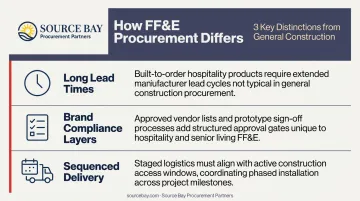
General construction procurement operates largely through established trade relationships and relatively predictable supply chains. FF&E procurement is different in three important ways:
- Lead times are long by design. Hospitality-grade products — upholstered goods and custom case goods especially — are built to order. No warehouse of contract-grade hotel furniture sits ready to ship.
- Brand compliance adds approval layers. Flagged properties must source from approved vendor lists, and many require prototype sign-off before a full production run is authorized.
- Delivery must be sequenced, not simultaneous. In a rolling renovation, FF&E cannot arrive all at once. Teams must stage delivery around construction access, which demands warehousing, active coordination, and precise logistics oversight.
Why FF&E Procurement Planning Is Critical in Hotel Renovations
The hospitality context creates pressures that don't exist in other commercial renovation types.
Many hotel renovations are conducted while the property remains partially operational. That means procurement decisions directly intersect with revenue-generating rooms. Every additional day of downtime beyond the planned schedule has a measurable cost — not just in construction overruns, but in lost room revenue and displaced bookings.
HospitalityNet documents that misalignment among design, delivery, and installation creates cascading delays, cost overruns, and operational disruption — a pattern that plays out predictably when procurement is treated as a downstream activity rather than a concurrent workstream.
What Goes Wrong Without a Structured Plan
- Late orders result in back-ordered product and compressed delivery windows
- Substitution requests compromise design integrity when the original specified product isn't available
- Delivery misalignment leaves installation crews idle while product sits in a warehouse — or worse, on-site before the floor is ready
- Budget overruns occur when last-minute sourcing replaces value-engineered solutions that were available earlier
Brand Standards Add a Compliance Layer
For flagged hotel properties, structured procurement is often contractually required, not just operationally preferred. Major brands each impose their own timelines and approval gates:
- Marriott (Autograph Collection): FF&E must align with approved design and Product Quality Standards; furnished guestroom models may be required before purchase orders are authorized
- Hilton: Hilton Supply Management offers dedicated FF&E project and logistics services across its brand portfolio
- IHG: Its procurement program connects owners with approved suppliers to support brand-standard compliance across renovations
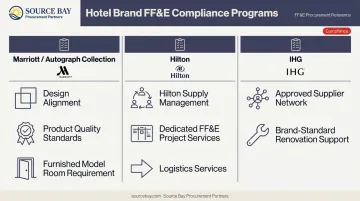
These requirements can add weeks to the procurement timeline — which is exactly why brand compliance milestones need to be built into the master schedule before any orders are placed.
How to Plan FF&E Procurement for a Hotel Renovation, Step by Step
FF&E procurement runs in parallel with design development and construction scheduling — not after them. For a full renovation, the procurement workstream should begin 12–18 months before a planned opening or relaunch, with vendor engagement and specification development starting alongside schematic design.
Step 1: Establish Scope and Design Intent
Work with the interior designer or design-build firm to produce a complete FF&E scope of work identifying every room type, public space, and back-of-house area requiring product.
The gap between what a designer specifies and what the FF&E budget can actually deliver is where projects stall. Catching that gap at scope definition costs far less than discovering it after purchase orders are issued. Source Bay Procurement Partners structures their Discovery phase specifically to reconcile design vision with budget reality before sourcing begins.
For branded properties, identify applicable brand standards at this stage for each product category — mattress specifications, case goods finishes, soft goods palettes — to avoid rework later.
Step 2: Build a Realistic FF&E Budget
FF&E budgets are typically built using per-key benchmarks segmented by property tier. The HVS 2021 Hotel Cost Estimating Guide provides the most widely referenced tier benchmarks — though these combine construction and FF&E costs rather than isolating FF&E only:
| Hotel Tier | Softgoods Renovation per Key | Additional for Full Renovation |
|---|---|---|
| Economy | $2,261–$3,277 | $2,187–$2,819 |
| Midscale | $5,207–$7,122 | $4,897–$6,342 |
| Upscale | $7,239–$9,912 | $9,223–$12,125 |
| Upper Upscale | $9,182–$12,551 | $14,296–$19,811 |
| Luxury | $15,329–$21,054 | $24,283–$32,954 |
HVS explicitly excludes freight, warehousing, contingency, and sales tax from these baseline figures. Per HVS guidance, freight runs approximately 5–10.5% and warehousing approximately 3–6.5% of product cost, varying by tier. These are not optional add-ons — they are budget line items that must be included from the start.
HVS recommends a 10% contingency for detailed budgets. Treating freight, warehousing, and contingency as separate from the FF&E budget is one of the most common — and costly — planning errors in hotel renovation procurement.
Step 3: Develop Specifications and a Procurement Schedule
A complete FF&E spec package includes:
- Product descriptions and approved finish/fabric callouts
- Quantity counts by room type
- Applicable compliance standards (fire codes, CAL 117 flammability, ADA)
- Approved alternates for each specified item
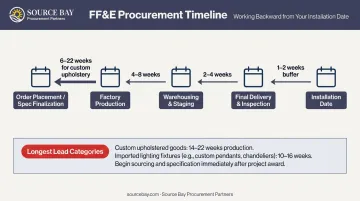
The procurement schedule maps every product category to its required order date, working backward from the installation date using confirmed manufacturer lead times. Custom upholstered goods and imported lighting require the longest lead times — order dates for these categories often fall 6+ months before installation.
Step 4: Source and Vet Vendors
Hospitality FF&E procurement requires manufacturers who can:
- Produce contract-grade product at the required volume
- Meet brand approval requirements for flagged properties
- Commit to firm lead times aligned to your installation schedule
- Provide prototypes or samples for approval prior to full production
Vetting criteria should include production capacity, references from comparable hospitality projects, and sample review. For flagged properties, vendor eligibility must be verified against the brand's approved vendor list before design work is finalized around a specific product.
Source Bay's sourcing network matches product capability to project requirements rather than defaulting to a single regional supplier. Their manufacturer relationships include:
- Blue Leaf Hospitality — case goods and upholstered furniture
- Serta — commercial sleep solutions
- Schumacher and Fabricut — textiles and wallcoverings
- Remington — custom lighting fixtures
Step 5: Manage Orders, Lead Times, and Logistics
Once purchase orders are placed, active management becomes the work. This phase requires tracking:
- Factory production schedules against confirmed lead times
- Freight forwarding and transit status
- Customs clearance for internationally sourced goods
- Receiving inspection at warehousing facilities
With imported goods, international customs, and multiple manufacturers running on different production cycles simultaneously, this phase demands daily oversight — not periodic check-ins. A specialized procurement partner manages these workstreams concurrently, ensuring each product category arrives in the sequence needed for installation rather than all at once.
Step 6: Coordinate Delivery, Warehousing, and Final Installation
FF&E cannot arrive on-site all at once, particularly in phased renovations where only certain floors or wings are accessible. Product must be:
- Warehoused off-site in a controlled environment
- Released to site in sequence aligned to the construction schedule
- Placed, assembled, and inspected to design specification before punch-list sign-off
Source Bay provides on-site oversight and quality control documentation through project closeout — creating a formal, accountable record that every item was received, placed, and verified against the approved specification.
Key Factors That Affect Hotel FF&E Procurement
Lead Times
Custom or upholstered hospitality goods require early ordering. Hotel Management reported in 2026 that procurement delays remained elevated compared to pre-2020 conditions. Any delay in design approvals or purchase order issuance compresses the procurement window and increases the risk of substitution or project delay.
Project Phasing
Rolling renovations — where floors are taken out of service sequentially — require staged purchase orders, partial deliveries, and coordinated warehousing. A single mass order is not feasible. Each delivery wave must be timed to construction access.
Brand Standard Compliance
Flagged properties must source from approved vendor lists and typically require prototype room sign-off before full production runs are authorized. Build this process into the master schedule from day one. It adds weeks to the timeline and cannot be treated as a post-design discovery.
Budget Volatility
Raw material costs, freight surcharges, and tariffs can shift between the design phase and purchase order issuance. The USTR's Section 301 List 3 tariff rate on goods from China rose to 25% in May 2019, and furniture or lighting imported from affected regions can carry meaningful duty exposure depending on HTS classification.
Two practices reduce this exposure:
- Lock in pricing through purchase orders as early as the design schedule allows
- Maintain a contingency reserve — HVS recommends 10% for detailed budgets — to absorb cost variation
Cross-Team Dependencies
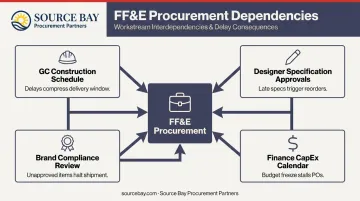
FF&E procurement intersects with multiple parallel workstreams, each capable of pushing your timeline:
- GC's construction schedule — sets delivery sequencing and site access windows
- Designer's specification approvals — must be finalized before purchase orders can be issued
- Brand's compliance review — adds review cycles for flagged properties
- Finance team's CapEx calendar — determines when purchase orders can be authorized
Map each dependency against your procurement milestones at project kickoff. A delay in any one of these tracks compresses the window for everything downstream.
Common Mistakes in Hotel FF&E Procurement
Three errors come up repeatedly in hotel renovation projects — and each one is preventable with earlier planning.
Starting Procurement Too Late
Many hotel owners don't engage a procurement partner until construction drawings are finalized. By that point, lead times may already compromise the project timeline. Procurement planning must run concurrently with design development — not after it.
Conflating FF&E and Construction Budgets
FF&E is a distinct capital expenditure category with its own vendor base, lead time dynamics, and compliance requirements. When the two budgets are treated as interchangeable, the consequences compound quickly:
- FF&E scopes get underfunded
- Last-minute substitutions compromise design quality
- The delivered product doesn't match the approved specification
Confusing FF&E and OS&E
OS&E (Operating Supplies and Equipment) covers consumables and operational items — linens, tableware, cleaning equipment. FF&E covers semi-permanent furnishings. Per HFTP's pre-opening expenditures guidance, the two categories are distinct in both procurement timeline and vendor channel. Treating them as one creates budget gaps and invoice confusion.
Frequently Asked Questions
What is included in FF&E for a hotel renovation?
FF&E covers guest room furniture, case goods, upholstered seating, lighting fixtures, window treatments, artwork, lobby and public area furnishings, and technology hardware such as televisions. It does not include fixed architectural elements (millwork, tile, built-ins) or OS&E consumables such as linens and tableware.
How far in advance should FF&E procurement be started for a hotel renovation?
For a full renovation, 12–18 months before the planned opening or relaunch, with vendor engagement and specification development beginning alongside schematic design. Properties with complex brand approval processes or heavily customized product should plan for the longer end of that range.
What are typical FF&E lead times for hotel projects?
Standard case goods typically run 8–14 weeks; custom and upholstered pieces often require 14–22 weeks or more. International manufacturing and custom fabric programs push timelines further. Confirm lead times directly with manufacturers at the specification stage — generic estimates routinely cause delays.
How is an FF&E budget determined for a hotel renovation?
Per-key benchmarking by property tier is the standard methodology. The HVS 2021 guide provides useful reference ranges, though these combine construction and FF&E costs. Freight (approximately 5–10.5%), warehousing (approximately 3–6.5%), and installation must be included as separate line items. HVS recommends a 10% contingency for detailed budgets.
What is the difference between FF&E and OS&E in a hotel renovation?
FF&E covers semi-permanent furnishings, fixtures, and equipment. OS&E covers operating supplies and consumables used in hotel operations. Per HFTP guidance, the two have distinct procurement timelines, vendor channels, and budget sources. Conflating them creates planning gaps and invoice confusion on both sides.
How do hotel brand standards affect FF&E procurement?
Flagged properties must source from brand-approved vendor lists, and many require prototype room approval before full production is authorized. Marriott's FDD confirms this for the Autograph Collection; Hilton Supply Management and IHG Procurement both operate structured FF&E programs across their brand portfolios. Engage with brand purchasing guidelines at scope definition, not mid-procurement, to avoid costly delays.