Introduction
In luxury hospitality, developers routinely pour capital into amenities, lobbies, and service training — then watch reviews stall because the room itself fell short. The guest experience begins and ends in that room, and interior design is what determines whether they return.
A poorly executed interior undermines every other investment on the property, while a well-designed room drives repeat bookings, stronger reviews, and measurable revenue gains.
Research from Cornell University and ReviewPro found that a single point increase in a hotel's Global Review Index correlates with up to 0.89% ADR growth, 0.54% higher occupancy, and a 1.42% RevPAR lift. Guest perception — shaped significantly by room design — feeds directly into those numbers.
This guide covers what defines luxury hotel room design, the FF&E decisions that bring it to life, lighting and material strategy, sustainability expectations, and the trends defining 5-star interiors today. Whether you're a developer, procurement specialist, or designer, every section is built for practical application.
Key Takeaways
- Luxury hotel room design is built around guest experience — sensory, emotional, and functional — not just visual opulence
- FF&E decisions are the single most consequential step in translating a design concept into a room guests actually experience — get them wrong and nothing else compensates
- Neutral-dominant color strategies and intentional spatial zoning create cohesion without visual fatigue
- Lighting requires three distinct layers working in concert: ambient, task, and accent
- Sustainable and biophilic design elements are now baseline expectations among high-end travelers
What Defines Luxury Hotel Room Interior Design
Beyond "Expensive": The Experience Standard
There's a meaningful difference between a room that costs a lot to build and one that feels genuinely luxurious to inhabit. AAA's Five Diamond designation frames it well: these properties deliver "ultimate luxury, sophistication and comfort with extraordinary physical attributes" — a standard that encompasses aesthetics, operational precision, and personalized service together.
True luxury design integrates four dimensions :
- Sensory: Scent, texture, acoustics, and visual warmth work together
- Emotional: The room should evoke calm, occasion, or a sense of place
- Functional: Layout serves how guests actually move, work, and rest
- Brand-coherent: Every element reinforces the property's identity
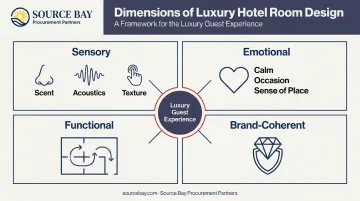
When these dimensions align, the room becomes a coherent experience — one where even a guest who can't articulate why a space feels right will remember it.
The Multi-Sensory Dimension
What guests describe as "luxurious" is rarely just what they see. Signature hotel fragrances, acoustic insulation that eliminates corridor noise, plush bedding that communicates care through touch — these elements collectively shape emotional memory in ways that a beautiful photograph cannot.
This is why 5-star properties invest in soft furnishings that absorb sound, in velvet and cashmere upholstery that rewards physical contact, and in thoughtful fragrance programs that begin at the entrance and extend into the room. Materials that perform across multiple senses — not just visually — are also the ones that hold up over time.
Timeless Over Trendy
Properties that chase design trends face accelerated renovation cycles and inconsistent guest perception across time. The most enduring luxury interiors — built around natural stone, custom millwork, and high-quality fabrics — maintain their perceived value for a decade or more. This protects asset value and keeps renovation costs lower over the property's lifecycle.
Core Design Principles: Color, Layout, and Cohesion
The Luxury Color Palette
The most effective luxury hotel room palettes follow a clear structure: a neutral foundation creates calm and perceived spaciousness, while carefully placed accents add depth and personality.
- Neutral base: Ivory, taupe, warm gray, greige — timeless and restful
- Accent layer: Emerald, sapphire, deep burgundy, aged gold — adds richness without fatigue
- Material texture: Substitutes for color variation, preventing the neutral base from reading as flat
The 70/30 principle — roughly 70% of the room's visual space in the dominant neutral, 30% in accent tones, textures, and statement pieces — maintains visual balance without tipping the space toward sterile or overwhelming. The exact split shifts depending on the property's design concept, but the underlying logic holds across most luxury contexts.
Spatial Flow and Zoning
A luxury room serves wildly different guests — the road warrior checking out at 6am, the couple who won't leave until checkout, the leisure traveler treating it as a temporary apartment. Effective layout design accommodates all of them without physical dividers or compromises.
Effective spatial planning includes:
- Sleep zone: Bed as the visual anchor, with symmetrical bedside furniture and consistent lamp heights — signals calm before guests consciously register it
- Work zone: A properly scaled desk or activity table with task lighting — Four Seasons properties have moved toward round activity tables with paired chairs, supporting both focused work and casual dining
- Lounge zone: A seating area that functions independently of the bed, with appropriate lighting and surfaces
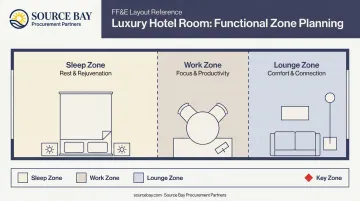
Concealed storage integrated into furniture keeps the space visually clean. Every visible piece should earn its placement — a single oversized canvas, a sculptural lamp, or a premium area rug creates more impact than a room crowded with accessories.
FF&E: The Building Blocks of 5-Star Interiors
FF&E — Furniture, Fixtures, and Equipment — is where design intent becomes physical reality. It's the category that determines what guests actually touch, sit on, sleep on, and look at. Get it wrong, and no amount of inspired architecture salvages the experience.
The global hotel FF&E market was estimated at approximately $63 billion in 2025, reflecting the scale at which this investment occurs across the industry. At the luxury tier, HVS data places median development cost above $1 million per room — with FF&E representing a significant portion of that figure.
Custom Furniture and Bespoke Pieces
Luxury hotels don't source from general commercial catalogs. Handcrafted headboards, bespoke lounge chairs, carved millwork, and sculptural coffee tables are commissioned or specified to ensure no two properties feel alike. Key material categories include:
- Exotic hardwoods (walnut, mahogany): warmth, grain variation, longevity
- Natural stone and marble: visual weight, tactile quality, durability
- Italian leather and premium upholstery: comfort and perceived value
- Hand-forged metals: brass, bronze, and blackened steel for hardware and accents
The specification process moves from concept development through artisan collaboration, material selection, prototyping, and final installation. This requires close coordination between designers, architects, and procurement specialists to protect the design intent and hold the project to schedule.
Source Bay Procurement Partners works with manufacturers including Blue Leaf Hospitality for case goods and upholstered furniture, developing custom pieces tailored to each property's specific design language. Their four-phase delivery model — Discovery, Sourcing, Logistics, and Installation — is structured precisely to manage this complexity from initial specification through final room handoff.
Textiles, Upholstery, and Bedding
Premium textiles are among the most immediate tactile signals a guest encounters. High-thread-count sheets communicate care before the guest even settles in. The Ritz-Carlton specifies 400-thread-count, 100% extra-long staple combed cotton sateen made by Frette. Four Seasons offers 400-thread-count Egyptian Oxford percale. Westin uses a 310-thread-count ring-spun cotton and Tencel Lyocell blend. These choices reflect brand philosophy, not a single universal standard.
Fabric selection for hospitality differs substantially from residential. Contract-grade textiles must meet durability, fire resistance, and cleanability requirements while still achieving the aesthetic richness guests expect. Relevant standards include:
- Cal TB 117-2013: upholstered furniture smolder resistance
- NFPA 701: drapery and window treatment flame propagation
- ACT voluntary guidelines: abrasion, crocking, and lightfastness thresholds
Source Bay sources textiles through partners including Schumacher and Fabricut, both recognized for high-end decorative fabrics suited to commercial hospitality applications. Their sister company, Neuco Furniture & Upholstery, adds custom upholstery capability — an important resource for properties undertaking phased renovations where existing pieces can be restored rather than replaced wholesale.
Fixtures, Finishes, and Procurement
Fixtures are the jewelry of the room: the hardware, fittings, and architectural details that signal attention at every scale. Brushed brass or polished nickel on door handles, light switches, and cabinet pulls should be consistent throughout. In the bathroom, rainfall showers, freestanding soaking tubs, and backlit vanity mirrors communicate occasion and investment before a guest unpacks.
Common fixture specification categories at the luxury tier include:
- Door and cabinet hardware: finish consistency across pulls, hinges, and locks
- Plumbing fixtures: thermostatic controls, hand showers, integrated drain design
- Lighting hardware: sconces, ceiling medallions, dimmer-integrated controls
- Architectural millwork: crown molding, wall paneling, built-in cabinetry details
Sourcing FF&E at luxury scale demands established global manufacturer relationships and the expertise to manage custom lead times, quality control, and delivery sequencing across hundreds of rooms simultaneously. Source Bay's operations team handles comprehensive freight coordination and sequenced warehousing, staging deliveries to match construction milestones rather than overwhelming the site. For large-scale projects, that logistical precision is often what separates an on-time opening from a costly delay.
The Art of Lighting Design in Luxury Hotel Rooms
Three Layers, One Atmosphere
Effective luxury room lighting operates across three distinct layers, each serving a separate function:
- Ambient lighting — ceiling cove lighting, diffused overhead sources — sets overall warmth and mood
- Task lighting — adjustable bedside lamps, desk lamps, backlit bathroom mirrors — serves functional needs without interrupting the ambient feel
- Accent lighting — artwork spotlights, LED strips beneath floating vanities, wall sconces — highlights architectural detail and creates drama
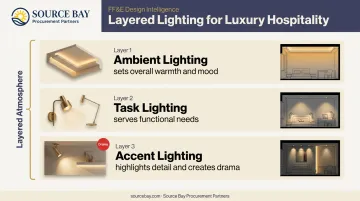
These three layers must function together and independently. A guest reading in bed needs strong task lighting without the room's overall warmth being disrupted. A couple wanting a romantic atmosphere should be able to bring ambient and accent layers forward while dimming task sources.
Statement Fixtures as Design Anchors
Chandeliers, sculptural pendants, and hand-forged wall sconces do more than illuminate — they define the room's design language. A crystal chandelier or a Murano glass pendant signals occasion before a guest touches the bed or opens a drawer. The Ritz-Carlton Mexico City received LIT recognition for its hospitality lighting design, including custom luminaires and room-specific lighting control scenes that demonstrate how fixture design and technical control can work as a single system.
Source Bay's partnership with Remington Lighting gives project teams access to custom fixture solutions specified to each property's design identity — a meaningful distinction when a room's lighting needs to feel intentional rather than catalog-standard. That same specificity extends into how those fixtures are controlled.
Smart Controls and Energy Efficiency
Preset mood scenes — relaxation, reading, romance — controlled via dimmer panels, tablets, or voice commands are now expected across flagship luxury properties. Amadeus research found that 85% of hoteliers believe personalization can deliver more than 5% incremental revenue — and lighting personalization is one of the most immediate and low-friction ways to deliver it. LED-based control systems support this without a significant energy penalty — most properties report 30–50% reductions in lighting-related consumption after switching from legacy fixtures to dimmer-integrated LED systems.
Sustainable and Biophilic Design in Luxury Hotel Rooms
Sustainability is no longer a niche concern. Booking.com's 2024 data shows 83% of global travelers consider sustainable travel important. For luxury properties, this translates directly into FF&E specifications.
Design elements that reduce environmental impact without compromising aesthetics include:
- Reclaimed wood and sustainably sourced hardwoods
- Low-VOC finishes on case goods and millwork
- Recycled glass surfaces and countertops
- Energy-efficient LED lighting systems throughout
- Water-saving bathroom fixtures integrated into premium bathroom design
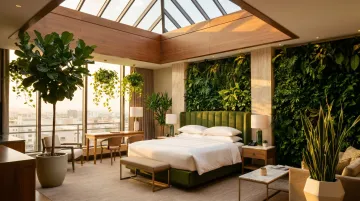
Biophilic design — connecting guests to natural elements — has moved from trend to expectation in premium room categories. A 2025 MDPI hospitality study confirmed that high-quality biophilic design significantly affects guest wellbeing and perceived value. Practical applications include:
- Indoor plants and living walls that improve air quality
- Maximized natural light through large windows or skylights
- Organic materials (stone, bamboo, natural linen) that create sensory grounding
- Circadian lighting systems that shift color temperature throughout the day
Two certification frameworks give properties a structured path to formal sustainability credentials:
- LEED ID+C: Hospitality — addresses FF&E specifications intended for regular operations
- WELL v2 — covers 500+ evidence-based design and operational strategies
Where certifications set the standard, smart environmental controls deliver it in practice. Programmable thermostats, motion-sensor lighting, and water-saving fixtures reduce resource consumption while giving guests precise control over their environment — translating sustainability goals into a measurably better stay.
Luxury Hotel Room Design Trends to Watch
Three directions are shaping new luxury room specifications:
Wellness-first design: Leading properties now integrate in-room yoga mats, aromatherapy systems, air purification, and circadian lighting as standard features in premium categories. The room is being repositioned as a recovery and restoration environment — one where FF&E selections directly support guest wellbeing, from blackout drapery systems to acoustically rated upholstery.
Technology without clutter: Keyless entry, voice-activated controls, smart thermostats, and personalized digital preferences saved from previous stays are being embedded without visible hardware. According to Oracle/Skift's Hospitality in 2025 report, more than 60% of hospitality executives identified contactless technology as a major strategic priority — meaning furniture and millwork specifications must now account for concealed cable management, integrated charging, and flush-mounted control panels.
Cultural authenticity and local storytelling: Generic luxury is losing ground to destination-specific design. Rosewood Amsterdam displays nearly 1,000 artworks and integrates oak paneling, bronze accents, and preserved 19th-century granite columns under its "A Sense of Place" philosophy. Belmond properties specify hand-blown Murano glass, local botanical prints, Mallorcan linen drapery, and regional antiques.
For procurement teams, this shift means locally commissioned artwork, indigenous textiles, and destination-specific color palettes are now entering FF&E specifications at the brief stage — shaping sourcing decisions from the outset rather than being layered in at the end.
Frequently Asked Questions
What is the most luxurious hotel room type?
The presidential or penthouse suite is typically the most expensive and fully appointed room type, featuring the highest levels of custom FF&E, private butler service, dedicated living and dining areas, and premium amenities. Boutique properties may use different names for their top tier, depending on brand identity and scale.
What is the 70/30 rule in interior design?
The 70/30 rule is a design guideline where roughly 70% of the room's visual space — walls, large furniture, flooring — uses a dominant neutral base, while the remaining 30% introduces accent colors, textures, and statement pieces. The split creates balance between cohesion and visual interest without overwhelming the space.
What materials are most commonly used in luxury hotel room interiors?
Natural stone (marble, travertine), exotic hardwoods (walnut, mahogany), high-thread-count textiles (silk, cashmere, percale cotton), and metal finishes (brushed brass, polished nickel) dominate luxury specifications. These materials are chosen for their visual richness, tactile quality, and durability in high-traffic environments.
How does lighting design affect the guest experience?
Lighting influences mood, perceived room size, and comfort level. Layered lighting — warm ambient sources for relaxation, task lighting for functionality, and accent fixtures that highlight design details — creates the adaptable atmosphere guests associate with 5-star hospitality.
How often should luxury hotel rooms be redesigned or refurbished?
Industry practice generally points to a soft goods refresh every 6–7 years and case goods replacement around the 14-year mark. Timelines vary by property tier and condition — high-quality bespoke pieces can extend both cycles and protect the design investment.
What is the role of FF&E procurement in executing a luxury hotel room design?
FF&E procurement bridges design intent and physical execution — sourcing, specifying, and delivering the furniture, fixtures, textiles, and equipment that define the guest experience. A skilled procurement partner manages manufacturer relationships, sequenced logistics, and budget constraints so that design integrity holds from concept through final installation.