Introduction
Picture this: a boutique hotel is three weeks from its soft opening. The lobby furniture arrived on time, the guest rooms are painted, and housekeeping is ready. Then the casegoods manufacturer calls—the custom dresser units are delayed by six weeks. The entire room block sits unoccupied while the clock runs on carrying costs, staff wages, and a reservation list that's already live.
That scenario plays out regularly on projects where FF&E procurement is treated as an afterthought rather than a discipline.
FF&E purchasing in hospitality operates on a completely different timeline than ordering linens or kitchen supplies. Custom-manufactured goods, 16–24+ week lead times, compliance requirements, and multi-vendor coordination demand a structured approach that most project teams underestimate until a delayed opening is already imminent.
This guide covers:
- What FF&E procurement actually involves
- How the process works, step by step
- Where projects most commonly go wrong
- What smarter purchasing looks like in practice
Key Takeaways
- FF&E procurement differs fundamentally from operational purchasing — long lead times and custom manufacturing demand a dedicated process
- The costliest mistakes: underestimating lead times, skipping value engineering, and juggling too many uncoordinated vendors
- A structured, phase-by-phase process keeps design intent, budget, and delivery timelines aligned from day one
- A specialized FF&E procurement firm connects architectural vision with the operational realities of a finished property
What Is FF&E Purchasing in Hospitality?
FF&E—Furniture, Fixtures & Equipment—represents the permanent or semi-permanent physical assets of a hotel: the beds, casegoods, seating, lighting, window treatments, and in-room technology that guests interact with every day.
HVS classifies FF&E as a capital expenditure, separate from pre-opening expenses and operational supplies. That distinction matters. FF&E isn't purchased on a rolling basis—it's procured in concentrated project cycles with high per-unit investment, custom manufacturing, and complex freight logistics.
FF&E vs. OS&E: A Critical Distinction
Two categories that often get confused in hospitality budgets are actually managed through entirely separate procurement tracks:
| Category | What It Covers | Procurement Type |
|---|---|---|
| FF&E | Beds, casegoods, light fixtures, upholstered seating | Capital expenditure, long-lead custom |
| OS&E | Linens, tableware, cleaning equipment, small appliances | Operating expense, shorter cycle |
OS&E items like linens and small equipment are typically expensed in the first operating year, while FF&E sits on the balance sheet as a capital asset—a distinction confirmed by HFTP research on pre-opening expenditures. Running both through the same procurement process creates budget confusion and timeline risk.
FF&E purchasing is far more than placing an order. For a major property, the full lifecycle typically runs 12 months or longer and covers:
- Specification development and vendor sourcing
- Contract negotiation and production tracking
- Freight coordination and sequenced warehousing
- Final installation and project handoff
What Does FF&E Include?
Core Categories by Property Area
The scope of FF&E varies by property type, but most hospitality projects cover:
- Guestroom furniture — casegoods (dressers, nightstands, desks), beds and headboards, upholstered seating
- Public area furnishings — lobby seating, F&B furniture, meeting room tables and chairs
- Lighting and fixtures — pendant lighting, sconces, floor and table lamps
- Window treatments and textiles — drapery, blackout lining, decorative pillows and throws
- In-room technology — televisions, minibars, entertainment systems
A luxury resort might include custom millwork, bespoke fixture programs, and outdoor furniture that carries 20+ week lead times. An extended-stay property will weight casegoods and functional storage heavily.
Custom Manufacturing vs. Off-the-Shelf
Most hotel FF&E is custom-manufactured to meet brand standards, specific finish requirements, and hospitality-grade durability specifications — a distinction that separates this category from general commercial furniture procurement.
Published lead time data shows:
- Domestic casegoods: 12–16 weeks
- Overseas casegoods: 16–18 weeks
- Lighting: approximately 17 weeks
- Backlit mirrors and outdoor furniture: 20+ weeks
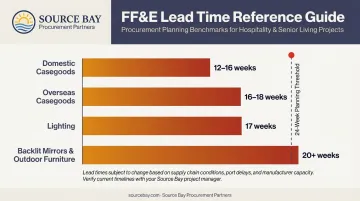
During the 2021 supply chain disruption, CoStar reported that benchmarks that were previously 18–22 weeks stretched to 32–36 weeks. While conditions have normalized, procurement challenges persist and lead times remain vendor-specific and volatile.
Custom items also require prototype approvals, shop drawing reviews, and model room sign-off before full production begins. Each step adds weeks to the schedule that buyers without hospitality experience routinely underestimate.
Key Stakeholders in FF&E Decisions
- Owner/Developer — controls budget, approves specifications, manages risk
- Interior Designer — drives aesthetic vision, generates specifications and finish schedules
- General Contractor — manages construction schedule and site access windows
- FF&E Procurement Specialist — bridges all parties from specification through installation
The FF&E Procurement Process: Step by Step
Step 1 — Specifications and Budget Alignment
The process starts before a single PO is issued. Design intent—expressed through mood boards, finish schedules, and product specifications—must be translated into a realistic procurement budget.
This is where most projects go wrong: procurement is brought in after design is finalized and discovers the specified products are 30% over budget. At that point, value engineering is reactive, disruptive, and expensive.
The smarter approach is involving procurement during or immediately after schematic design, so that real vendor pricing informs specification decisions in real time.
Step 2 — Vendor Sourcing and Qualification
Not every manufacturer can handle hospitality-grade FF&E. Rigorous vendor evaluation looks at:
- Hospitality experience — references from comparable projects, not just general commercial work
- Production capacity — can they handle your project volume without compromising lead times?
- Compliance capability — can they certify against Cal 117, NFPA 701, or brand-specific standards?
- Financial stability — a manufacturer that folds mid-production leaves you with nothing
For flagged properties on a brand-approved vendor list, sourcing is constrained to approved manufacturers. Independent boutique hotels have open-market flexibility, which creates competitive bidding opportunities but requires more extensive qualification work.
Step 3 — Quoting, Value Engineering, and Award
The RFQ process for FF&E goes well beyond unit price. A complete quote comparison evaluates:
- Unit cost across multiple vendors
- Freight terms and estimated landed cost
- Payment schedule structure
- Sample and prototype process timelines
- Lead time commitments and production scheduling
Value engineering at this stage—substituting a finish, material, or manufacturer to hit budget without compromising design intent—is productive and low-cost. Once POs are issued, those same substitutions trigger change orders, reapprovals, and delays that cost multiples of what they would have earlier.
Step 4 — Order Management and Production Tracking
A purchase order marks the start of the most risk-intensive phase, not the conclusion of procurement work.
Active order management means:
- Tracking production milestones (fabric cut, frame completion, finish, QC sign-off)
- Flagging delays before they cascade into schedule problems
- Managing change orders with documented approval chains
- Coordinating prototype reviews and client approvals
The "PO issued = done" assumption is one of the most common and costly mistakes in FF&E procurement. Custom items can be modified, delayed, or produced incorrectly, and catching those issues mid-production is far less expensive than discovering them at delivery.
Step 5 — Freight, Warehousing, and Installation
This is where the most damage—literal and financial—occurs in poorly managed projects.
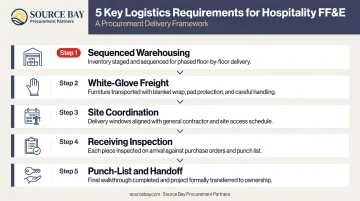
Key logistics requirements for hospitality FF&E:
- Sequenced warehousing — FF&E arrives at a staging facility and is released to the site floor by floor, in alignment with the GC's construction schedule
- White-glove freight — high-value custom items require specialized handling to prevent transit damage
- Site coordination — delivery windows must be negotiated with the general contractor to avoid conflicts with active trades
- Receiving inspection — every shipment should be inspected on arrival, with damage documented for freight claims
- Punch-list and handoff — final installation oversight ensures the delivered environment matches the approved specification
Common FF&E Purchasing Challenges in Hospitality
Four recurring problems derail FF&E projects in hospitality. Understanding them upfront is the first step to avoiding them.
Long Lead Times and Schedule Risk
Custom FF&E doesn't respond to urgency. A casegood program ordered 10 weeks before opening instead of 20 weeks doesn't arrive faster—it arrives late.
Procurement brought in after design is locked often hits this immediately: the specifications call for products with lead times longer than the remaining schedule allows. The options at that point are all bad—expedite fees, specification changes, or a delayed opening.
The fix is straightforward: involve procurement early enough to verify lead times against the project calendar before specifications are finalized.
Budget Creep and Hidden Costs
The HVS Hotel Cost Estimating Guide explicitly excludes attic stock, freight, sales tax, contingency, and installation from its base estimates. That means a budget built on product-only pricing is systematically understating total project cost.
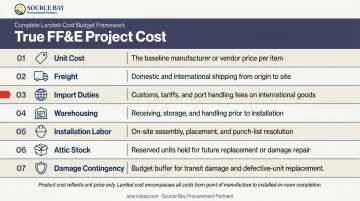
A true landed-cost budget includes:
- Unit cost (product)
- Freight and shipping (domestic and international)
- Import duties on overseas-manufactured goods
- Warehousing and staging fees
- Installation labor
- Attic stock (replacement inventory by category)
- Damage contingency
Procurement teams that skip this framework consistently run over budget—not because specifications were wrong, but because the full cost of delivery was never captured.
Design Intent vs. Budget Reality
This tension shows up on nearly every hospitality project. A designer specifies what the space requires; the owner's budget doesn't accommodate it. When procurement isn't involved during design, this conflict surfaces late—during bidding, when it's expensive and disruptive to resolve.
Early procurement involvement allows budget checks against real vendor pricing as specifications are developed, not after they're locked.
Quality and Compliance Issues at Delivery
Hospitality FF&E must meet specific fire, safety, and durability standards. Key requirements include:
- California TB 117-2013 — smolder resistance for upholstered furniture
- NFPA 701 — flame propagation for textiles
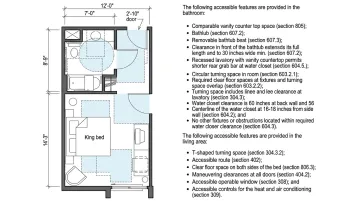
- ADA Section 806 — clear-floor-space requirements around beds in accessible rooms
Without proper specification management and receiving inspection, non-compliant or damaged goods can be installed. The DOJ has pursued federal enforcement actions against hotels for ADA non-compliance, requiring costly remediation. Catching non-compliance at the specification or receiving stage costs a fraction of what post-installation remediation does.
Best Practices for Smarter FF&E Purchasing
Engage Procurement at the Design Phase
The single highest-impact practice in hospitality FF&E is bringing procurement expertise in before specifications are finalized. CoStar's hotel design coverage has consistently documented calls from industry practitioners for earlier coordination between owners, designers, and procurement specialists as lead times, pricing, and availability shift.
Source Bay Procurement Partners structures their Discovery phase specifically around this principle—aligning design intent with operational requirements and real vendor pricing before sourcing begins. The goal is a procurement-ready specification that emerges from design, not a design document that later collides with budget reality.
Build a Landed-Cost Budget
Never budget FF&E on product cost alone. Use this framework as a minimum:
- Unit cost — quoted price per item, per vendor
- Freight — domestic or international, by item weight and volume
- Import duties — applicable on overseas-manufactured goods
- Warehousing — staging facility costs aligned to construction schedule
- Installation labor — supervised setup, not assumed as included
- Attic stock — category-specific replacement inventory (quantities depend on customization level, damage history, and replacement difficulty)
- Damage contingency — buffer for transit damage replacement
Write Performance-Based Specifications
Locking a specification to a single manufacturer eliminates competitive bidding and leaves your budget vulnerable. Writing specifications around design intent and performance criteria—dimensions, finish quality, durability rating, material type—allows qualified alternatives to compete without compromising the design vision.
The Inn at Water's Edge hotel bid, for example, specified that brand names were for identification purposes only and permitted pre-approved products from different manufacturers that equaled or exceeded stated quality and performance. Any specification document can be written the same way—define the performance standard, not the brand.
Consolidate Vendors
Managing 40 individual FF&E vendors independently multiplies coordination overhead and creates accountability gaps. When an item arrives damaged, finger-pointing between manufacturer, freight carrier, and installer becomes the default. Fewer, well-vetted vendors with hospitality experience means clearer accountability and better pricing through volume.
Good vendor consolidation also makes the next phase significantly easier to manage.
Plan Receiving, Inspection, and Attic Stock
Damage claims must be initiated at receiving to be recoverable—which makes inspection a contractual step, not a courtesy. Every shipment should be:
- Inspected on arrival against the PO
- Photographed if damage is present
- Documented for freight claims before installation proceeds
Attic stock quantities vary by category. Base the calculation on:
- Customization level — harder to replace means more stock on hand
- Manufacturer damage history — factor in what you've seen from that supplier before
- Reorder lead time — custom upholstered seating warrants a very different buffer than standard casegoods
Why Work With an FF&E Procurement Partner?
The MPEA's 2024 RFP for the Hyatt guest room renovation—covering 1,258 rooms and approximately $30 million in FF&E—documents the full scope a purchasing agent is expected to manage: budgeting, cost estimating, value engineering, specification coordination, sourcing, bidding, purchase orders, expediting, freight, warehousing, installation contracting, field coordination, punch lists, warranty follow-up, and project closeout. That's not a side function that a design firm or owner's rep absorbs incidentally.
A specialized FF&E procurement firm brings:
- Established manufacturer relationships — access to hospitality-grade vendors with known lead time reliability and compliance capability
- Logistics infrastructure — sequenced warehousing and freight management that aligns delivery with construction, not against it
- Full accountability — one point of contact across the entire procurement lifecycle, not a fragmented handoff between designer, contractor, and owner
- Value engineering expertise — the ability to substitute materials and finishes without losing design intent, done proactively rather than reactively
Source Bay Procurement Partners operates this model across boutique hotels, luxury resorts, and branded hotel portfolios. Their four-phase process (Discovery, Sourcing, Logistics, and Installation) covers the full lifecycle from specification through turnkey handoff. Senior Designer Barbara Church works directly within the procurement process—not alongside it—ensuring design decisions and sourcing choices stay aligned from the first spec sheet to final installation.

That lifecycle focus extends into refurbishment. For properties working through a renovation rather than a ground-up build, Source Bay's partnership with sister company Neuco Furniture & Upholstery adds a meaningful cost lever.
Full refurbishment typically runs 40–60% less than full replacement, and upholstery-specific work yields 50–70% savings compared to purchasing new. When furniture frames are structurally sound, restoring them rather than replacing them extends the asset lifecycle and reduces capital outlay each refurbishment cycle.
Frequently Asked Questions
What is purchasing in hospitality?
Purchasing in hospitality covers all goods needed for daily operations and capital projects—from food and linens to FF&E. FF&E specifically involves custom-manufactured items with longer lead times, requiring specialized vendor management, production tracking, and logistics coordination.
What are the 5 P's of purchasing?
The 5 P's—Product, Price, Place, People, and Process—map directly to FF&E decisions:
- Product: spec compliance and hospitality-grade durability
- Price: landed cost, not unit cost
- Place: freight and delivery coordination
- People: vendor qualification and stakeholder alignment
- Process: structured order management from specification through installation
What are the 4 types of purchasing?
The four types are direct, indirect, capital, and services procurement. FF&E falls under capital procurement—long-term asset purchases that require a different approval structure, budget treatment, and vendor management approach than operational supply purchasing.
What is the difference between FF&E and OS&E in hospitality?
FF&E covers permanent or semi-permanent assets—beds, casegoods, light fixtures. OS&E covers consumable or small operational items—linens, tableware, cleaning equipment. Both are essential, but they're managed on separate procurement tracks with different budget classifications, lead times, and vendor relationships.
How long does the FF&E procurement process typically take?
Custom FF&E can carry 16–24+ week production lead times, meaning procurement should ideally begin 6–12 months before a target opening date. Compressed timelines increase cost, force specification shortcuts, and raise the risk of a delayed opening.
When should a hospitality project bring in an FF&E procurement specialist?
During or immediately after schematic design—before specifications are finalized. Early engagement integrates budget alignment, vendor qualification, and lead time planning into the project schedule from the outset.