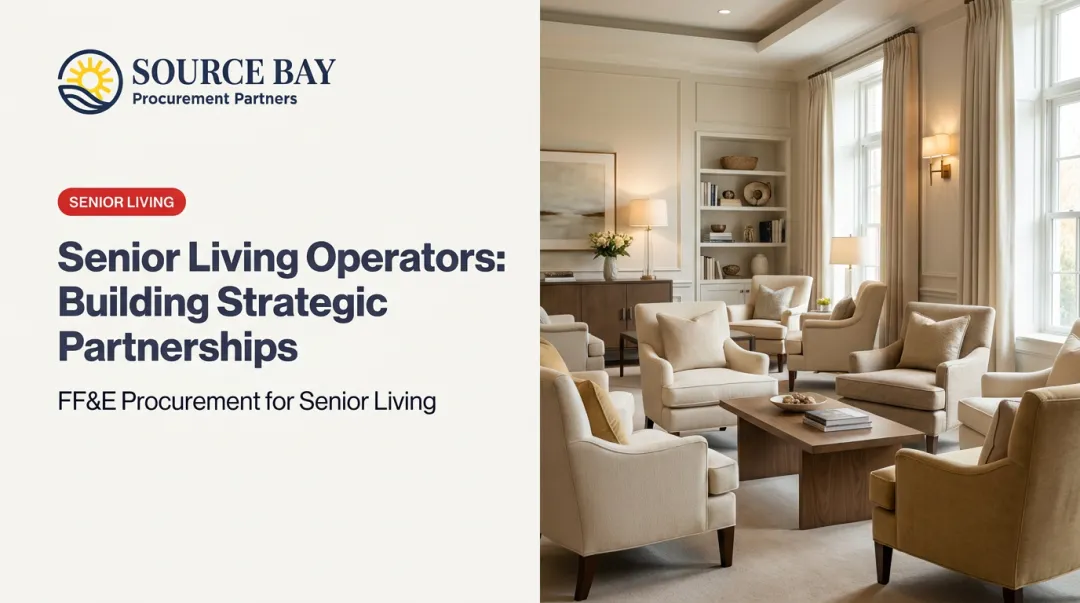
The problem is that FF&E—furniture, fixtures, and equipment—is routinely treated as a final-phase line item rather than a parallel planning track. That sequencing mistake leads to cost overruns, installation delays, and spaces that feel mismatched the moment a prospective resident walks through the door.
This guide gives operators a structured approach to FF&E planning, from specification and budgeting through procurement, compliance, and delivery in occupied communities.
Key Takeaways
- FF&E directly affects occupancy, resident satisfaction, and NOI—plan for it from day one, not after construction starts
- Long lead times (often months for contract-grade items) require orders placed well before installation crews arrive
- Senior living FF&E must meet fire, infection control, and accessibility standards that go well beyond residential or standard commercial spec
- Dining, lobby, and common areas deliver the fastest ROI—prioritize the tour path first
- Reupholstery and refurbishment can extend furniture life at 50–70% savings over full replacement
What Is FF&E in Senior Living and Why It Matters for Operators
Defining the Scope
In a senior living renovation, FF&E covers more ground than most operators initially budget for. The full scope typically includes:
- Resident room furniture — beds, dressers, nightstands, lounge chairs
- Common area seating and tables — dining, lounge, activity, and wellness spaces
- Lighting fixtures — ambient, task, and accent throughout all zones
- Window treatments — privacy, light control, and acoustic function
- Artwork and accessories — finish the space and signal quality to prospects
- Specialty equipment — dining carts, amenity furnishings, bistro equipment
FF&E is distinct from construction finishes (flooring, wall coverings, millwork) even when those items appear on the same renovation budget. More importantly, FF&E has its own procurement lifecycle that must run parallel to—not after—the construction schedule.
Why FF&E Needs Its Own Planning Track
Custom and contract-grade upholstered pieces, dining furniture, and custom lighting often require months from order confirmation to delivery. If an operator waits until drywall is finished to start specifying FF&E, installation will lag behind construction completion by several months: operational disruption, delayed move-ins, and contingency budget burned on temporary solutions.
That schedule risk compounds a second problem. FF&E specification must align with the design intent set at the project's outset — and rushed late-stage selections tend to compromise both aesthetics and compliance.
The Business Case for Investing Here
Ventas's refresh program—which invested $300M across 215 senior housing projects beginning in early 2022—was associated with a 530-basis-point average occupancy increase, 109% more move-ins, and 6.5% RevPOR growth. The program bundled multiple improvements, so FF&E alone cannot claim causation. The pattern is consistent enough to matter: physical environment investment moves occupancy metrics.
J.D. Power's 2025 Senior Living Satisfaction Study reinforces where to focus. Buildings-and-grounds satisfaction rose 21 points among independent living residents, and dining satisfaction rose 11 points among assisted living and memory care family decision-makers. These are the spaces that shape perception—and they're exactly where FF&E decisions land.
Full Replacement vs. Refurbishment
Not every renovation calls for full FF&E replacement. In phased projects or communities with tighter capital budgets, reupholstering structurally sound furniture frames is a proven cost control strategy. Source Bay Partners works with sister company Neuco Furniture & Upholstery to offer commercial reupholstery and refurbishment at 40–60% savings versus full replacement (50–70% for upholstery-only scope). The result is a refreshed aesthetic on existing frames, without the capital outlay or disposal costs of wholesale replacement.
Building Your Senior Living FF&E Specification and Budget
The Specification Document
Before a single item is sourced, operators need an FF&E specification document—a room-by-room itemized list that includes:
- Product category and quantity per space
- Fabric and finish selections with colorways
- Dimensions and clearance requirements
- Applicable compliance requirements (fire rating, ADA, cleanability)
- Manufacturer or approved-equal designations
This document is the foundation of an accurate procurement budget. Without it, quotes are approximate and change orders are inevitable.
Budgeting by Zone
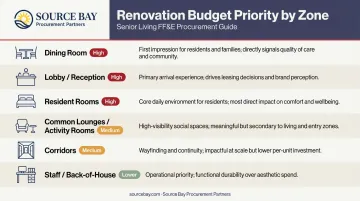
Not all spaces warrant the same investment level. A practical budget framework allocates spend by operational priority:
| Zone | Budget Priority | Rationale |
|---|---|---|
| Dining room | High | Primary quality-of-life driver; heavily weighted in tours |
| Lobby/reception | High | First impression for prospects and families |
| Resident rooms | High | Directly affects resident satisfaction and retention |
| Common lounges/activity rooms | Medium | Tour-path visibility; social environment quality |
| Corridors | Medium | Wayfinding and ambiance; lower per-unit cost |
| Staff/back-of-house areas | Lower | Functional spec; not tour-facing |
Presbyterian Homes and Services has reported renovation budgets ranging from $20,000–$80,000 per unit and $2M–$15M per community depending on scope—covering apartments, common areas, mechanical systems, and envelope work. FF&E is typically scoped as a distinct line item within that range, not a separate budget.
Value Engineering Without Compromising Design
Value engineering in FF&E means making deliberate trade-offs that protect design intent while controlling cost—not simply buying cheaper furniture. Practical approaches include:
- Reserve custom statement pieces for high-visibility tour-path areas; use standard lines in corridors and back-of-house
- Work with procurement firms that hold direct manufacturer relationships (Source Bay Partners accesses commercial pricing unavailable through retail channels)
- Specify contract-grade fabrics with commercial durability ratings to extend asset life and reduce replacement frequency
- Prioritize refurbishment over replacement for structurally sound frames — Neuco's reupholstery program maintains the original design palette at a fraction of new-purchase cost
Setting a Contingency Reserve
Build a contingency reserve into the FF&E budget—most projects set aside 5–10% of total FF&E spend—to absorb freight delays, damage-in-transit replacements, or late design changes.
In occupied communities, delay carries direct operational consequences: construction timelines slip, move-ins pause, and revenue is deferred. A contingency buffer isn't optional in that environment; it's a baseline requirement for keeping the project financially intact.
Prioritizing FF&E Spend for Maximum ROI
The Tour Path Framework
Map the physical journey a prospective resident and family take during a community tour, then prioritize FF&E investment along that path. The sequence typically runs: parking/entry → lobby/reception → dining room → sample resident room → key amenity spaces.
Upgrading FF&E along this path delivers the fastest return because it directly shapes first impressions and purchase decisions. Spaces that prospects never see during a tour can be deferred to a later phase without affecting near-term occupancy.
Highest-Impact Categories
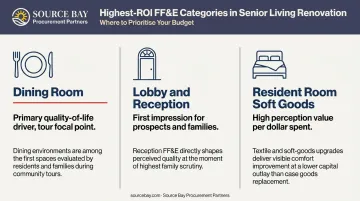
Three categories consistently deliver the strongest return on FF&E investment during renovation:
- Dining room furniture and lighting — Dining is one of the most evaluated aspects of senior living quality. Prospects are often invited to meals during tours, and families rank dining experience as a primary decision factor. J.D. Power's 2025 data showing an 11-point satisfaction gain in assisted living and memory care dining confirms where dollars move the needle.
- Lobby and reception furnishings — Outdated or mismatched furniture signals deferred maintenance to a prospect or family walking in for the first time. Current textiles, updated lighting, and cohesive accessories communicate that the community is well-managed and cared for.
- Resident room soft goods — Bedding, window treatments, and accent lighting are relatively low-cost per unit but have an outsized visual impact on how model rooms photograph and present during tours. Few categories deliver more perception value per dollar spent.
Memory Care Requires a Different Specification
Memory care FF&E cannot simply be sourced from the same product selections used in independent living. Peer-reviewed research supports high-contrast colors, distinct environmental landmarks, and reduced visual ambiguity as effective design principles for residents with dementia. Those principles translate directly into procurement decisions:
- Color palette decisions — high contrast between furniture and floor surfaces aids wayfinding
- Spatial differentiation — distinct furniture arrangements help residents orient within the community
- Seating design — stable, appropriately scaled chairs that support safe transitions
The per-item cost for purpose-designed memory care furniture is typically higher than standard assisted living spec. That premium pays back in reduced maintenance, lower fall-related liability risk, and longer asset life from more durable construction.
FF&E Procurement Sequencing and Lead Times
When to Place Orders
Treating FF&E procurement as a post-construction activity is the sequencing mistake that derails more senior living renovations than any other. Orders for custom and contract-grade items need to be placed months before expected delivery — sometimes before construction wraps.
The practical trigger point: as soon as room dimensions are confirmed and finishes are locked, FF&E specifications should be finalized and orders placed. Waiting for punch-list completion means installation will lag construction by months.
Sequenced Warehousing for Occupied Communities
In an occupied senior living community, FF&E cannot arrive all at once. A phased delivery model — receiving items from multiple manufacturers over different timeframes, warehousing them, then coordinating zone-by-zone delivery matched to the construction schedule — is essential.
Source Bay's operations team manages freight coordination and sequenced warehousing for senior living projects across this full cycle. Items are received, inspected, and staged so delivery to the facility happens on the construction team's schedule — not the manufacturer's shipping window.
Common Sequencing Mistakes
- Placing all orders at once without mapping them to phased construction zones
- Underestimating overseas lead times, which carry customs, freight, and port variability that domestic orders don't
- Skipping warehouse pre-inspection: damage caught at the warehouse is far less disruptive than damage discovered on-site in an occupied community
Compliance and Durability Requirements for Senior Living FF&E
Non-Negotiable Compliance Areas
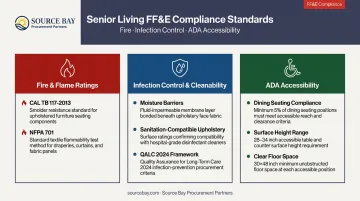
Senior living FF&E compliance is jurisdiction-specific. Verify adopted state and local codes for each property, but the categories operators must address on every project include:
- Fire and flame ratings — CAL TB 117-2013 covers smolder resistance for upholstered furniture components; NFPA 701 (2023 standard) addresses flame propagation for textiles and draperies. These are test standards, not universally self-executing mandates—verify which standards your adopted fire code requires
- Infection control and cleanability — The 2024 QALC assisted living guidelines (developed by LeadingAge, Argentum, ASHA, NCAL, and NARA) provide a voluntary IPC framework. Upholstery should be specified with moisture barriers and cleanability ratings appropriate for frequent sanitation protocols
- ADA accessibility — At least 5% of dining seating must comply with ADA Section 902: surface tops 28–34 inches above the floor, with knee/toe clearance and a 30-by-48-inch clear floor space for forward approach
Contract-Grade vs. Residential-Grade
Consumer furniture from retail sources fails quickly in senior living environments — the use frequency bears no comparison to a private home. ACT (Association for Contract Textiles) rates 30,000 Wyzenbeek double rubs or 40,000 Martindale cycles as the threshold for heavy commercial use. Senior living seating should meet or exceed those numbers, but rub count is only part of the specification. Fabric selection also needs to account for:
- Seam strength under repeated stress
- Moisture-barrier backing compatible with frequent sanitation
- Cleaning chemistry compatibility (bleach-safe vs. solvent-based protocols)
Frame specifications carry equal weight. Commercial-grade casegoods and seating are engineered for repeated daily use across multiple occupants — residential frames are not, and operators who substitute them typically face premature replacement cycles within two to three years rather than the seven to ten a properly specified piece should deliver.
Source Bay specifies contract-grade products across all senior living procurement—working with partners like Kellex Furniture (senior living seating), Blue Leaf Hospitality (casegoods and upholstered furniture), and Schumacher and Fabricut (textiles and wallcoverings) to deliver residential aesthetics on commercial-grade specifications.
Managing FF&E Delivery and Installation in Occupied Communities
Delivering FF&E into a live senior living community is an operational event, not just a logistics task. Risks to manage include:
- Elevator access conflicts between FF&E delivery crews and resident transportation
- Noise during care hours — installation work must be scheduled around medication rounds, meal service, and resident programming
- Temporary displacement of residents from spaces under renovation
- Contractor scheduling defaults that ignore facility rhythms
The Zone-by-Zone Model
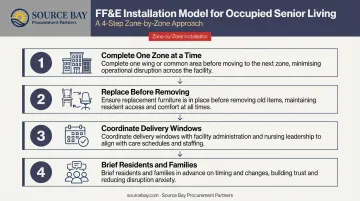
A phased zone-by-zone delivery and installation model is the standard approach for occupied communities:
- Complete one wing or common area before moving crews to the next zone
- Ensure replacement furniture is in place before old items are removed—residents should never lose access to functional spaces during the transition
- Coordinate delivery windows with facility administration and nursing leadership, not just the construction GC's schedule
- Brief residents and families in advance — confirm what's changing, when work begins, and how long each phase lasts
This model requires tight coordination between the FF&E procurement team, the GC, and facility operations. An experienced procurement partner manages these handoffs directly — sequencing deliveries, resolving scheduling conflicts, and keeping crews aligned with the facility's care calendar rather than the construction timeline.
Frequently Asked Questions
What is the correct order for a senior living renovation?
Structural and infrastructure work comes first, followed by interior finishes, then FF&E installation. The important nuance: FF&E orders must be placed early in the process—often before or concurrent with construction start—to account for manufacturer lead times. The installation sequence happens last; the procurement sequence does not.
What is the most expensive part of a senior living renovation?
Structural and mechanical systems, kitchen and dining upgrades, and unit-level apartment renovations typically represent the largest cost drivers. FF&E, though often budgeted separately, can account for a meaningful share of total project cost. Industry planning benchmarks cite renovation ranges of $20,000–$80,000 per unit and $2M–$15M per community depending on scope.
How much does it cost to refurbish an older senior living facility?
FF&E is typically a distinct line item within broad project budgets. For communities with structurally sound existing furniture, refurbishment through reupholstery can substantially reduce the FF&E portion without sacrificing resident experience.
What FF&E items should be prioritized in a senior living renovation?
Dining room furniture and lighting, lobby and reception furnishings, and resident room soft goods (bedding, window treatments, accent lighting) deliver the highest combination of ROI and resident satisfaction impact. These spaces also carry the most weight during prospect tours.
How long does FF&E procurement take for a senior living renovation?
Contract-grade and custom FF&E can require months from order to delivery, with international manufacturers adding freight and customs variability on top. Finalize specifications and place orders well before construction completes—waiting until the building is ready to receive furniture guarantees an installation gap.
How can I modernize an older senior living community for today's residents?
The highest-impact changes are updated dining spaces (hospitality-quality furniture, lighting, and ambiance), refreshed common areas along the prospect tour path, wellness amenity additions, and technology integration. Updated FF&E—particularly furniture, lighting, and textiles—delivers visible, immediate repositioning for a community competing against newer inventory.