
For hotel developers and operators, furnishing a new property — or completing a renovation — is one of the most logistically demanding phases of any project. Tight construction deadlines, brand standards with approved supplier lists, and a global supply chain that doesn't wait for anyone. Get it wrong, and you're paying to store furniture that can't be installed yet, or scrambling to replace pieces that failed quality inspection after arriving from overseas.
This guide breaks down how hotel furniture sourcing actually works: where furniture comes from, how hotels buy it, what the procurement process looks like from specification to installation, and what international logistics involves for projects sourcing from Asia or Europe.
Key Takeaways
- FF&E costs range from $12,000 per room for limited-service hotels to $45,000 per room for luxury properties, per HVS 2025 data
- Vietnam now accounts for 42% of U.S. furniture imports, making Asia-Pacific the dominant manufacturing region for hotel casegoods
- Purchase orders for overseas furniture should be placed 16–26 weeks before the target installation date
- China-origin furniture carries 25% Section 301 tariffs — budget accordingly or plan for Vietnam/India alternatives
- Most hotel developers outsource FF&E sourcing to a specialized procurement firm — few manage global supplier relationships in-house
What Is Hotel FF&E and Why Does Sourcing Matter?
FF&E vs. OS&E: The Basic Distinction
In hospitality procurement, FF&E covers the movable, long-term assets that outfit every guest room and public space — things like:
- Casegoods: dressers, nightstands, desks
- Upholstered seating, beds, and headboards
- Decorative lighting, mirrors, and drapery
- Art and soft furnishings
These are distinct from the building structure itself and from OS&E (Operating Supplies and Equipment), which covers consumable and operational items such as linens, smallwares, and service equipment.
The distinction matters because FF&E and OS&E follow different procurement timelines, budget categories, and sourcing channels. Treating them as a single line item at the planning stage routinely leads to cost overruns when FF&E delivery timelines don't match OS&E replenishment cycles.
Why Sourcing Decisions Carry Real Weight
According to HVS's 2025 U.S. Hotel Development Cost Survey, FF&E costs by hotel tier break down as follows:
| Hotel Tier | FF&E Per Room | Total Development Cost Per Room |
|---|---|---|
| Limited-Service | $12,000 | $167,000 |
| Select-Service | $16,000 | $223,000 |
| Full-Service | $25,000 | $409,000 |
| Luxury | $45,000 | $1,057,000 |
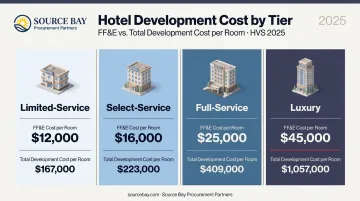
At those numbers, sourcing decisions carry direct financial consequences. A 200-room full-service hotel carries roughly $5 million in FF&E spend. Mismanaged procurement means cost overruns, delays, or furniture that fails durability standards within two years.
Guest satisfaction is also on the line. J.D. Power's 2025 North America Hotel Guest Satisfaction Index, based on 39,219 branded-hotel guests, recorded year-over-year gains in satisfaction with guest-room furnishings and decor. Put simply: guests notice the furniture, and the scores reflect it.
Where Hotels Source Furniture: Key Global Manufacturing Regions
Hotel furniture sourcing is genuinely global. No single country dominates, and most large projects draw from multiple regions simultaneously based on cost tier, lead time, design requirements, and tariff exposure.
Asia-Pacific: The Dominant Manufacturing Hub
China, Vietnam, and Malaysia handle the bulk of hotel casegoods and upholstered seating production. Lower labor costs, high-volume capacity, and established hospitality supplier ecosystems make this region the default starting point for standard room furniture on most U.S. hotel projects.
According to Furniture Today, Vietnam reached 42% of U.S. furniture imports in 2025, with exports to the U.S. totaling $9.5 billion. China fell to 16% of U.S. imports, partly due to tariff pressure. Malaysia remains a significant third source, particularly for mid-range casegoods.
BERMANFALK, a hospitality casegoods and seating manufacturer with production in both Vietnam and China, counts the JW Marriott Las Vegas Resort & Spa among its completed projects — one example of how established manufacturers in this region work directly with major branded hotel accounts.
The tradeoffs with Asia-Pacific sourcing:
- Ocean freight from China or Vietnam to the U.S. East Coast runs 30–45 days in normal conditions, before inland delivery
- China-origin wooden furniture (HTS 9403.60.80) carries 25% Section 301 additional duties, imposed in 2019 — a significant landed cost factor
- Factory-level quality oversight requires either on-site inspections or third-party QC firms
- Minimum order quantities tend to favor large projects over smaller renovations
Europe: Design-Led and Premium Sourcing
Italy, Portugal, and Eastern European countries — particularly Poland and Romania — supply higher-design, luxury, and boutique hotel furniture. Craftsmanship is the draw: solid wood construction, hand-finished textiles, custom upholstery, and design provenance that carries weight with luxury-tier guests.
Salone del Mobile.Milano, described as the global benchmark event for the furnishing and design sector, is where many European hospitality furniture relationships begin — a reflection of how central design culture is to manufacturing in this region.
European sourcing makes sense when design differentiation justifies higher unit costs.
The tradeoffs with European sourcing:
- Higher per-unit freight costs to the U.S. compared to Asia-Pacific
- Longer customs clearance lead times for container shipments
- Import duties and VAT considerations that affect total landed cost
- Smaller manufacturer scale can limit capacity for large full-property rollouts
North America: Domestic and Near-Shore Sourcing
Domestic U.S. manufacturers remain competitive in specific categories — particularly custom upholstery, where brands like Bernhardt Hospitality produce hospitality-grade seating from North Carolina facilities. North American sourcing suits projects with tight timelines, "Made in USA" positioning requirements, or custom textile work that doesn't justify overseas minimum order quantities.
Mexico has grown rapidly as a near-shoring option. Furniture exports from Mexico to the U.S. rose more than 65% over five years through 2024, driven by manufacturers relocating production closer to the U.S. market. For hotel projects where Asia lead times create scheduling risk, Mexico offers faster transit with cost structures below domestic U.S. manufacturing.
When North American sourcing makes sense:
- Projects with aggressive installation timelines where ocean freight risk is unacceptable
- Brands with "Made in USA" flag or marketing requirements
- Custom upholstery and textile work with low minimum order quantities
- Renovations — rather than new builds — where smaller quantities are the norm
The FF&E Procurement Process: From Specification to Installation
Successful hotel FF&E procurement follows a structured sequence. Understanding each phase helps developers avoid the most common — and costly — mistakes.
Step 1: FF&E Specification and Design Intent
The interior design firm produces an FF&E specification document covering every room type and public space. This document details materials, dimensions, finishes, fabric grades, and performance requirements. It becomes the foundation for every purchase order and vendor selection decision that follows. No procurement should begin without a complete spec.
Step 2: Vendor Selection and Purchase Orders
Specifications go to pre-qualified manufacturers — typically through a procurement firm — for pricing and lead time confirmation. Once vendors are selected, purchase orders are issued with delivery milestones tied to the construction schedule.
The critical timing rule: purchase orders for overseas-sourced furniture should be placed 16–26 weeks before the target installation date. Typical lead times break down as follows:
- Overseas casegoods: 16–18 weeks
- Custom lighting: ~17 weeks
- Outdoor furniture: 20+ weeks
- Ocean freight from Asia: add 4–6 weeks for transit and port clearance
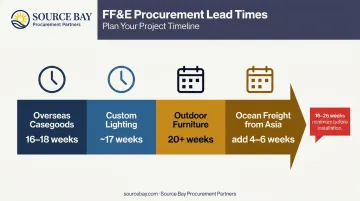
Late purchase orders leave almost no recovery margin if anything slips.
Step 3: Factory Oversight and Quality Control
Reputable procurement processes include factory inspections at three key milestones:
- Pre-production sample approval
- Mid-production check
- Pre-shipment inspection
Skipping inspections is expensive. Manufacturing deviations discovered during installation — wrong finish, incorrect dimensions, fabric substitutions — are far more disruptive and costly to remedy than defects caught at the factory.
Step 4: Freight, Warehousing, and Sequenced Delivery
Once furniture ships, it moves through freight forwarding, customs clearance, and delivery to a dedicated FF&E warehouse. Sequenced warehousing — holding all furniture for a given floor or room block until construction is ready — prevents items from sitting unprotected on a job site or arriving out of installation order.
Construction schedules shift — sometimes significantly. A sequenced warehouse gives project managers a real buffer when a floor isn't ready on the original timeline, protecting both the furniture and the install sequence.
Step 5: Installation and Punch List
Professional FF&E installation teams — not general movers, but crews trained specifically for commercial furniture — unpack, assemble, and place furniture according to room layout plans. A final punch list confirms every item is correctly placed, undamaged, and matches the approved spec before the property opens.
Navigating International Logistics for Hotel Furniture
International logistics is where hotel FF&E projects most commonly encounter unexpected costs and delays. Freight, customs, tariffs, and transit timing must be planned in parallel with procurement — not treated as an afterthought once furniture has shipped.
Key Logistics Considerations
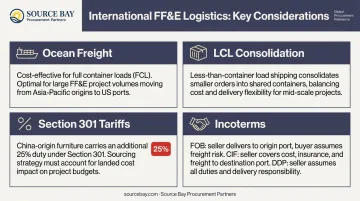
Ocean freight is standard for volume FF&E shipments — far more cost-effective than air for full container loads of casegoods. Air is reserved for small urgent orders or replacement pieces where speed justifies the premium.
LCL consolidation combines smaller orders from multiple vendors into shared containers (Less than Container Load), reducing per-unit freight costs. The tradeoff: more handling points and higher damage risk in transit.
Section 301 tariffs add 25% on top of base HTS rates for China-origin furniture. This has shifted sourcing decisions toward Vietnam and other Southeast Asian countries over the past several years. Importers must verify both the base HTS rate and the applicable Chapter 99 subheading before issuing purchase orders; misclassifications are expensive.
Incoterms (ICC Incoterms 2020) define where supplier responsibility ends and buyer responsibility begins. FOB transfers risk after loading at the origin port; CIF includes seller-arranged freight and insurance to the destination port; DDP places the broadest responsibility (including import duties) on the seller. Knowing which Incoterm governs each PO is essential for accurate landed cost modeling.
Why Sequenced Warehousing Matters More Than Most Developers Realize
Construction delays are almost universal on hotel projects. When furniture arrives before a floor is ready for installation, it either sits exposed on a job site (where damage is likely) or gets stored in a warehouse without a clear delivery sequence. Both outcomes are costly.
Sequenced warehousing solves this directly. By storing FF&E at a nearby facility and releasing it to the site in installation-ready order, project teams avoid the most common and costly logistics failures:
- Prevents job-site damage from premature delivery
- Reduces re-deliveries when floors aren't ready
- Gives project managers a real buffer when construction timelines slip
- Allows last-minute scope changes without disrupting the delivery schedule
For first-time procurement teams in particular, this is one of the highest-leverage operational decisions available.
Working with an FF&E Procurement Partner
For most hotel developers — particularly those without a dedicated in-house procurement team — the complexity of managing global sourcing, quality oversight, freight coordination, and sequenced installation simultaneously is simply too high to handle without specialist support.
What to Look For in a Procurement Partner
- Vetted global manufacturer relationships across multiple sourcing regions, not a single-country vendor roster
- In-house design expertise to bridge architectural specifications and manufacturer capabilities, ensuring value engineering doesn't mean design compromise
- Comprehensive logistics management including freight, warehousing, and customs coordination
- Sequenced delivery and installation oversight — not just sourcing, but full project lifecycle management
- Refurbishment capability for renovation projects where some existing assets can be restored rather than replaced
Source Bay Procurement Partners
Source Bay Procurement Partners operates as a full-lifecycle FF&E specialist for hospitality, senior living, and multi-family projects. Their four-phase model (Discovery, Sourcing, Logistics, and Installation) covers the entire procurement cycle from initial budget alignment through on-site handoff.
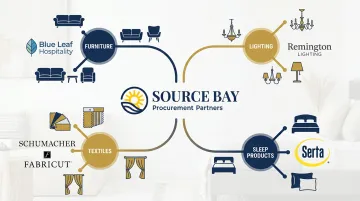
Their manufacturer network spans hundreds of industry partners, including Blue Leaf Hospitality (casegoods and upholstered furniture), Remington Lighting (custom fixtures), Schumacher and Fabricut (textiles and wallcoverings), and Serta (commercial sleep solutions).
Senior Designer Barbara Church bridges the gap between architectural specifications and what global manufacturers can actually produce. This prevents costly specification mismatches from surfacing late in the process, when corrections are most expensive.
Source Bay's partnership with sister company Neuco Furniture & Upholstery adds integrated refurbishment capability for renovation projects where full FF&E replacement isn't budget-feasible. Neuco handles existing assets that can be reupholstered or restored; new procurement fills the gaps. The result is a unified aesthetic without replacing every piece in the building.
For hotel developers, operators, and design teams navigating a new build or renovation, Source Bay can be reached at hello@sourcebay.com or (231) 943-3455.
Frequently Asked Questions
What is FF&E in the hotel industry?
FF&E stands for Furniture, Fixtures, and Equipment: the movable items that outfit hotel guest rooms and public spaces, separate from the building structure itself. FF&E procurement covers sourcing, purchasing, quality control, and on-schedule delivery of those items to a hospitality project.
What countries manufacture most hotel furniture?
China, Vietnam, and Malaysia are the dominant sources for standard hotel casegoods and upholstered furniture, with Vietnam now accounting for 42% of U.S. furniture imports. Italy, Portugal, and Eastern Europe supply higher-design and luxury pieces. North America remains competitive for custom upholstery and time-sensitive domestic projects.
How long does it take to procure furniture for a new hotel?
A full FF&E procurement cycle runs 6 to 18 months from specification finalization to on-site installation. For overseas manufacturing, purchase orders should be placed at least 16–26 weeks before the target installation date to account for production and freight lead times.
What is the difference between FF&E procurement and interior design?
Interior design defines what a hotel should look and feel like, specifying materials, finishes, and furniture pieces. FF&E procurement is the operational discipline that translates that design intent into purchase orders, quality-controlled manufacturing, and on-schedule delivery.
How much does it cost to furnish a hotel room?
Per-room FF&E costs range from approximately $12,000 for limited-service properties to $45,000 for luxury hotels, based on HVS 2025 data. Costs are shaped by hotel tier, design complexity, custom versus standard specifications, sourcing region, and freight.
What does international logistics involve for hotel FF&E?
International logistics covers freight forwarding, customs clearance, import compliance, and delivery coordination across borders. For FF&E sourced from Asia or Europe, this includes ocean freight, tariff payment, container consolidation, warehousing, and sequenced delivery to the installation site.