Commercial FF&E sourcing is not retail buying at scale. It's a precision procurement operation where timing, compliance, logistics, and vendor relationships all have to work in concert. This guide covers what sets commercial FF&E apart, the six factors that drive sourcing decisions, and the step-by-step process that separates on-time openings from costly delays.
Key Takeaways
- Commercial FF&E sourcing requires contract-grade products, not off-the-shelf retail alternatives
- Lead times vary significantly by product category — domestic casegoods run 12–16 weeks; outdoor furniture can exceed 20 weeks
- Six factors shape every sourcing decision — durability, lead times, budget, supplier reliability, freight logistics, and sustainability — and missing any one can derail a project
- A phase-aligned procurement workflow keeps your timeline intact and prevents budget overruns before they start
- Partnering with a specialist like Source Bay Partners consolidates manufacturer sourcing, freight, and installation coordination under one roof
What Is Commercial FF&E Sourcing?
FF&E — Furniture, Fixtures, and Equipment — refers to the movable assets procured for commercial properties that are not permanently attached to the structure. In a hotel, that's everything from guestroom casegoods and lounge seating to lighting fixtures, mattresses, and drapery.
In a senior living community, it spans resident room furnishings, dining chairs, common-area sofas, and custom textiles across every care level.
How Commercial FF&E Differs from Retail Buying
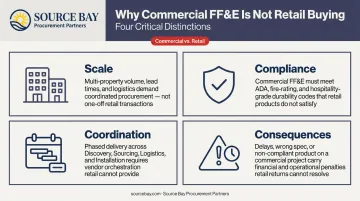
Residential furniture is built for occasional household use. Commercial furniture — often called "contract-grade" — is engineered for high-frequency use in public or semi-public settings, with material specifications, structural standards, and compliance requirements that residential products simply don't meet.
The differences go beyond durability:
- Scale: Quantities span entire buildings or multi-property portfolios, not individual rooms
- Compliance: Every piece must meet applicable durability, fire, and emissions standards
- Coordination: Procurement must synchronize with construction milestones across multiple trades
- Consequences: A wrong order or late delivery doesn't inconvenience one person — it can delay an entire property opening
What FF&E Sourcing Typically Encompasses
A full commercial FF&E package includes:
- Case goods: beds, dressers, desks, nightstands
- Seating: lounge chairs, dining chairs, sofas, ottomans
- Upholstered pieces and custom textiles
- Drapery and window treatments
- Lighting fixtures and lamps
- Mattresses, bedding, and pillows
- Decorative accessories and artwork
Managing this scope through a single procurement workflow — rather than scattered vendor relationships — is where projects either stay on track or begin to unravel. Fragmented sourcing creates gaps in accountability that compound quickly once construction milestones start locking in.
Key Factors to Consider When Sourcing Furniture for Commercial FF&E Projects
Sourcing decisions aren't driven by aesthetics alone. Each factor below directly influences whether a property opens on time, stays within budget, and holds up to years of commercial use.
Contract-Grade Durability and Compliance Standards
Specifying residential-grade pieces on a commercial project is a fast path to rapid wear, liability exposure, and guest dissatisfaction. Contract-grade furniture is defined not by a single label, but by documented test results across several standards:
- Abrasion resistance: The Association for Contract Textiles (ACT) sets a minimum of 30,000 double rubs under the Wyzenbeek/ASTM D4157 method for woven upholstery in high-traffic commercial settings like hotel rooms and dining areas. The Martindale alternative is 40,000 cycles under ASTM D4966.
- Seating standards: BIFMA's ANSI/BIFMA X5.4 covers indoor public and lounge seating — waiting areas, reception, dining, and gathering spaces — making it the relevant standard for most hospitality and senior living applications. X5.1 covers general office and institutional chairs.
- Flammability: TB 133 remains a recognized full-scale flammability test procedure for seating in public occupancies, including hotels and nursing-care facilities, though California repealed its mandatory TB 133 requirements in 2019. Project specifications may still reference it, particularly for certain flag standards or jurisdictions.
- Chemical emissions: GREENGUARD Gold limits emissions of more than 360 VOCs and requires compliance with California's CDPH Standard Method — especially relevant in senior living and healthcare settings where occupant sensitivity is higher.
When vetting vendors, ask for test reports, not just labels.
Lead Times and Project Timeline Alignment
This is where most developers get into trouble. According to published hotel procurement data, lead times vary considerably by product category:
| Product Category | Typical Lead Time |
|---|---|
| Wall vinyl | 4–6 weeks |
| Mattresses | 6–8 weeks |
| Fabric/upholstery | 6–10 weeks (up to 20 for some vendors) |
| Domestic casegoods | 12–16 weeks |
| Imported casegoods | 16–18 weeks + port delays |
| Custom/out-of-stock lighting | ~17 weeks |
| Outdoor furniture | 20+ weeks |
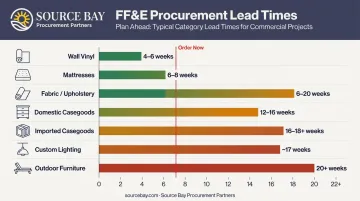
Procurement must begin during or before the design development phase — not after construction milestones. When sourcing starts too late, designers get forced into in-stock alternatives that may not match design intent, arrive out of sequence, or compromise the overall finish. The cascade effect is real and expensive.
Budget Management and Value Engineering
Every commercial FF&E budget has to balance design intent against hard cost-per-key or cost-per-unit targets. CBRE's 2026 senior housing development survey — based on 36 projects — reports average FF&E of $11,900 per revenue unit, representing 3.2% of total development cost.
Value engineering is the discipline of closing the gap between design vision and budget reality without compromising performance. In practice, it looks like:
- Substituting specified fabrics with comparable-performance textiles at better price points
- Consolidating vendor orders to unlock volume pricing
- Evaluating domestic versus international sourcing trade-offs based on lead time and total cost
- Identifying where contract-grade alternatives meet spec at lower cost than the originally specified product
Procurement partners who do this well protect both design intent and contingency reserves — which matters when change orders or supply disruptions hit later in the project.
Supplier Reliability and Manufacturer Network
The depth of a procurement partner's manufacturer relationships determines how problems get solved — not just how orders get placed. When a finish is discontinued mid-project, a production run falls behind, or goods arrive damaged, the question is whether your procurement partner has the relationships and leverage to resolve it quickly.
Look for:
- Established relationships with hospitality-grade manufacturers (not consumer brands)
- References from large-scale commercial projects across multiple sectors
- Demonstrated ability to re-run or substitute items under tight timelines
- Network breadth that provides alternatives when a primary vendor can't deliver
Freight Management, Sequenced Warehousing, and Receiving
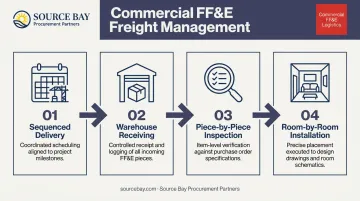
Getting furniture to a job site on time is only half the challenge. Commercial FF&E deliveries must be:
- Sequenced to construction progress — furniture cannot go in until flooring, painting, and millwork are complete
- Received at a staging warehouse, not directly to site where conditions may be unsuitable
- Inspected piece-by-piece against the purchase order before site delivery
- Installed room by room without disrupting active construction crews
Poorly managed freight — damaged pieces found at installation, missing shipments, out-of-sequence deliveries blocking contractors — is one of the most consistent causes of delays and budget overruns in commercial FF&E. A 2026 hotel opening case study from Hospitality Net makes this concrete: a dual-property California hotel project required emergency recovery intervention after order visibility gaps created critical construction misalignments. Both properties ultimately passed inspection, but only through significant unplanned effort.
Sustainability and Certification Requirements
Many commercial property owners, brand flags, and development groups now include sustainability requirements in their FF&E specifications. Key certifications to understand:
- FSC: Chain-of-custody certification for furniture using forest-based materials — verifies responsible sourcing and permits labeled product claims
- GREENGUARD Gold: Limits over 360 VOCs — voluntarily required on many senior living, healthcare, and LEED projects
- LEED: Under LEED BD+C v4.1, at least 75% of furniture by cost must meet the low-emitting materials criteria to earn the Indoor Environmental Quality credit. Certified wood products contribute to the Sourcing of Raw Materials pathway.
Marriott's 2024 ESG report noted that 56% of evaluated FF&E products in the U.S. and Canada reached MindClick's "leader" sustainability level — a benchmark that illustrates how seriously major flags are taking procurement sustainability, and how quickly these standards are moving upstream to procurement specifications.
The Commercial FF&E Procurement Process: Step by Step
Successful FF&E delivery is the result of a phase-aligned workflow that begins during design development and runs through final installation. Here's how a structured process works.
Step 1: Project Scoping and FF&E Specification Development
The process starts with translating architectural drawings, interior design intent, and brand standards into a detailed FF&E specification document, broken out by room type and unit. A complete spec includes product descriptions, quantities, finishes, fabric grades, and code compliance requirements.
An incomplete spec at this stage is the single largest driver of change orders and budget overruns. Getting specs procurement-ready before sourcing begins — not after bids come in over budget — is what separates clean projects from costly ones.
Step 2: Vendor Sourcing, Bid Management, and Selection
Once the spec is complete, the process moves to identifying qualified manufacturers, issuing requests for quotes (RFQs), and evaluating bids against the spec. Selection should weight:
- Compliance track record (not assumed from brand name)
- Lead times relative to the project schedule
- References on comparable commercial projects
- Price — evaluated last, not first
Step 3: Purchase Order Issuance and Production Monitoring
Formal purchase orders specify product codes, quantities, finishes, delivery terms, and payment milestones. Issuing the PO opens the active management phase, not closes it. Waiting passively for shipment notifications leaves too much room for surprises. Regular manufacturer check-ins catch delays, finish substitutions, and production shortfalls early enough to act on them.
Step 4: Freight Coordination, Warehousing, and Damage Inspection
All shipments should be received at a central warehouse facility, not directly to the job site. At the warehouse, every piece is inspected against the purchase order for damage or defect before staging for site delivery.
Items are then released in sequence aligned with construction progress, so they land when the space is ready to receive them.
Step 5: Installation, Punch List, and Final Handoff
On-site installation covers room-by-room setup, final quality checks against the design specification, and punch list management for any damaged or missing items. The project is formally handed off to the property owner or operator only when every space meets the approved design standard and is ready for occupancy or guest arrival.
How Source Bay Partners Can Help
Source Bay Partners is an FF&E procurement firm that manages every phase of a commercial project — from initial specification development through final installation and project handoff — for hospitality, senior living, and multi-family developments globally.
Their four-phase delivery model (Discovery → Sourcing → Logistics → Installation) is designed to remove the coordination burden that would otherwise fall on clients managing dozens of manufacturers, freight carriers, and installation crews simultaneously.
Source Bay's key differentiators:
- Decades of combined experience in FF&E design, procurement, and project management
- An established manufacturer network spanning Kellex, Serta, Schumacher, Fabricut, Blue Leaf Hospitality, and Remington Lighting
- In-house senior design capability through Barbara Church for curating custom textiles and value-engineered specifications
- Comprehensive freight management and sequenced warehousing managed by a dedicated operations team
- Direct oversight of FF&E setup and final project handoff — delivered to a fully operational standard
- Partnership with sister company Neuco Furniture & Upholstery for refurbishment when full replacement isn't warranted — typically at 40–60% of replacement cost

Source Bay handles the procurement complexity so your team stays focused on the project — not the supply chain.
Contact Source Bay Partners at hello@sourcebay.com or (231) 943-3455 to discuss your next commercial FF&E project.
Frequently Asked Questions
What does "sourcing furniture" mean?
Furniture sourcing is the process of identifying, evaluating, and procuring furniture from manufacturers or suppliers. In a commercial context, this includes vetting contract-grade products against durability and compliance standards, negotiating pricing, and managing delivery to align with project timelines — not simply placing orders.
Is it cheaper to buy furniture wholesale for commercial projects?
Direct-from-manufacturer pricing can significantly reduce per-unit cost on large commercial projects. However, true savings depend on lead time management, freight coordination, and avoiding costly mistakes like incorrect orders or non-compliant pieces — areas where a professional procurement partner adds measurable financial value beyond unit cost alone.
What is FF&E in commercial construction?
FF&E (Furniture, Fixtures, and Equipment) refers to the movable assets — beds, chairs, lighting, textiles, case goods — procured and installed in a commercial property that are not permanently attached to the structure. FF&E is budgeted and managed separately from hard construction costs.
How far in advance should FF&E sourcing begin for a commercial project?
Lead times run from 6 weeks for mattresses to 20+ weeks for custom casegoods or outdoor furniture. Starting procurement at or before the design development phase gives projects the buffer needed for production, freight, and sequenced delivery.
What certifications should commercial FF&E furniture meet?
Key certifications to specify: BIFMA X5.4 for indoor public and lounge seating structural integrity, ACT abrasion standards (30,000 double rubs minimum for high-traffic woven upholstery), GREENGUARD Gold for low chemical emissions in sensitive occupancy settings, and FSC certification for wood products where sustainability standards apply.
What is the difference between FF&E procurement and interior design?
Interior design establishes the aesthetic vision and selects specific products. FF&E procurement translates that vision into purchase orders, manages vendor relationships, coordinates logistics, and installs specified pieces on schedule. The strongest commercial outcomes occur when both disciplines are aligned from the specification stage.