
Common areas are where lease decisions get made. They're also where residents decide whether to stay at renewal time.
This article covers the types of common area renovations worth prioritizing, realistic budget considerations, how to think about ROI, and the operational best practices that keep these projects on schedule.
Key Takeaways
- Common areas function as a property's brand; a dated lobby undermines even freshly renovated units
- 70% of renters won't rent without an on-site fitness center; shared workspace interest has grown to 48%
- Commercial-grade FF&E is required for high-traffic shared spaces — consumer-grade products won't hold up
- Budget a 10–15% contingency minimum; 15–20% for pre-1980s buildings
- Phased sequencing and early FF&E procurement are the two biggest drivers of on-time delivery
Why Common Areas Are the Hidden Driver of Multifamily Value
Think of your common areas as the property's brand identity. They establish a quality standard that prospects use to benchmark rent expectations — and that residents use to justify staying when renewal time arrives. A neglected fitness center or an entry corridor that hasn't been touched in a decade can directly undermine everything a renovated unit is trying to communicate.
The financial connection is direct. Properties with well-maintained, appealing amenity spaces tend to attract residents faster and retain them longer — both of which reduce vacancy loss and make-ready costs. According to the 2022 NMHC/Grace Hill Renter Preferences Survey, conducted across 221,559 renter responses:
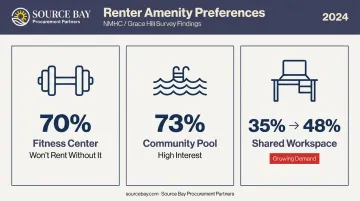
- 70% of renters were interested in or would not rent without an on-site fitness center
- 73% expressed interest in a community pool
- 35% wanted shared community workspace — a number that climbed to 48% in the 2024 survey cycle
These aren't amenity wish lists. They're qualifying criteria for a significant portion of the renter pool.
Deferred maintenance in shared spaces compounds faster than in private units. Higher foot traffic accelerates wear on flooring, hardware, and fixtures, and NAA reported that multifamily repair and maintenance costs rose 11.8% in 2023 alone.
Waiting to address common area deterioration rarely saves money. What starts as a manageable capital project tends to escalate into an emergency repair situation with a much higher price tag.
Types of Multifamily Common Area Renovations Worth Investing In
Common area renovations fall into three broad categories: indoor social and functional spaces, dedicated amenity spaces, and outdoor areas. The right mix depends on your resident demographics and the competitive properties within your submarket.
Indoor Common Areas
Lobbies, hallways, and leasing offices deserve priority for one practical reason — every single prospect and resident passes through them. The impression those spaces create is unavoidable.
High-impact upgrades for entry and corridor spaces:
- Flooring — Commercial-grade LVT or polished concrete holds up to daily foot traffic; residential-grade alternatives show wear within months
- Lighting — Updated fixtures, particularly in entry corridors, have a disproportionate effect on perceived quality
- Paint and wall finishes — Fresh, modern finishes are the lowest cost-per-impact upgrade available
- Package lockers — Smart locker systems have moved from differentiator to baseline expectation; the 2018 NMHC/Kingsley Package Delivery Report found communities were receiving nearly 270 packages per week during peak periods
- Leasing office — A polished, professional leasing environment signals that the property is managed attentively
Furniture and seating in these spaces must meet commercial durability standards — the use cycles, cleaning protocols, and traffic volume in shared residential spaces exceed what residential-grade pieces are built to handle.
Amenity Spaces
Fitness centers and co-working lounges are the two highest-demand amenity investments right now, and the data supports that prioritization.
For fitness centers, the most impactful upgrades are:
- Equipment refresh (cardio, functional training, and a designated yoga or stretching zone)
- Rubber flooring with proper subfloor isolation (to absorb impact noise)
- Mirrors and ventilation improvements
- Access control for 24-hour availability
Co-working and business lounge additions directly address the shift toward hybrid work schedules. Shared workspace interest rising from 35% to 48% between NMHC survey cycles is a clear signal that this space type has moved from novelty to genuine demand driver.
Clubhouse and community room renovations benefit most from flexibility — furniture that can be reconfigured for events, casual gatherings, or quiet work time, paired with integrated AV and refreshed finishes.
Outdoor Common Areas
Outdoor spaces deliver outsized marketing value relative to their renovation cost. Pool surrounds, grilling stations, dog parks, and landscaped green spaces are the most photographed content residents produce — and those images circulate through reviews, social media, and referral conversations.
The most consistently high-ROI outdoor investments:
- Pool area furniture and hardscaping
- BBQ and grilling stations with shade structures
- Dog parks (roughly one-third of renters have pets, and 70% of those pets are dogs, per NMHC data)
- Outdoor lighting and landscaping along primary resident pathways
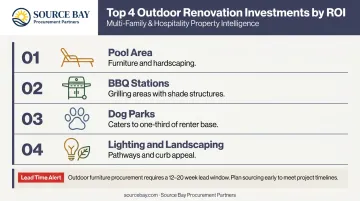
One timing note: lead times for commercial-grade outdoor furniture — weather-resistant frames, UV-stable fabrics, powder-coated finishes — commonly run 12–20 weeks. That's a longer window than most interior pieces require, and failing to account for it is one of the most common causes of delayed outdoor renovation completions.
Breaking Down the Costs of Multifamily Common Area Renovation
How Common Area Budgets Are Structured
Unit renovations are budgeted per unit and tied directly to achievable rent premiums. Common area renovations work differently — they're budgeted per project or per square foot and underwritten against portfolio-wide benefits: occupancy improvement, retention, and asset repositioning.
That structural difference matters for CapEx planning. Common area renovations are typically funded from capital reserves or renovation financing rather than amortized unit-by-unit.
The three main cost categories:
- Hard construction costs — Demolition, structural work, MEP (mechanical, electrical, plumbing), and finish installation
- FF&E costs — Furniture, fixtures, and equipment procurement, freight, and installation
- Soft costs — Design fees, permits, and project management
FF&E is consistently the most underestimated line item in common area budgets. In practice, FF&E can account for 25–40% of total project cost — owners who treat it as a rounding error tend to find scope gaps late in the project, when options narrow and costs spike.
Property Age and Hidden Cost Risk
Older buildings introduce budget risk that newer assets don't carry. Behind walls and under floors, pre-1980s properties often surface:
- Asbestos-containing materials — Federal NESHAP rules require notification and proper abatement procedures before renovation work involving threshold quantities of ACM; the EPA's guidance applies to larger multifamily buildings
- Outdated electrical panels — Common area renovations that add lighting, AV, or HVAC loads frequently trigger panel upgrades
- ADA compliance gaps — Construction permits can trigger accessibility requirements that weren't part of the original scope
AIA construction guidance places standard design-build contingency at 5–10% of construction cost. For common area projects, a practical rule of thumb is to budget 10–15% contingency for standard projects and 15–20% for buildings constructed before 1980. Skipping contingency to hit a headline budget number is one of the more reliable ways to end up over budget.
Budgeting Approach Without Approved Benchmarks
Verified per-square-foot renovation benchmarks specific to multifamily lobbies, fitness centers, and outdoor common areas aren't widely published by primary industry sources. RSMeans' 2026 apartment construction guidance places new apartment construction at $220–$700 per SF depending on height, location, and finish level — a useful order-of-magnitude frame, though renovation costs vary significantly from new construction.
Those ranges make a bottom-up approach the most defensible path. Build your budget using:
- Line-item estimates sourced from local contractors familiar with your market
- RSMeans project models for construction cost validation
- Separate FF&E budgets developed with a procurement partner early in design
- Contingency applied before presenting any number to ownership or investors
ROI and Value-Add: What Property Owners Can Realistically Expect
The Two Financial Levers
Common area renovations improve NOI through two mechanisms:
1. Reduced vacancy costs Lower turnover means fewer make-ready costs, less lost rent during vacancy, and faster lease-up when units do turn. A property that retains residents at renewal because the amenity package is competitive with newer nearby supply captures meaningful NOI that a comparable property with deteriorating common areas does not.
2. Rent premium support Well-executed common area improvements allow owners to justify higher unit rents even when individual units haven't been renovated. The common areas set the quality standard prospects use to calibrate what a unit is worth.
Cap Rate Repositioning
Beyond the NOI improvement, a repositioned property can trade at a more favorable cap rate — meaning the valuation multiple itself improves. Consider a simplified example:
| Metric | Pre-Renovation | Post-Renovation |
|---|---|---|
| Annual NOI | $800,000 | $880,000 |
| Cap Rate | 6.0% | 5.75% |
| Implied Value | $13.3M | $15.3M |
The NOI increase alone would have added roughly $1.3M in value. The cap rate improvement adds another $700K on top. This compounding effect is why common area renovations frequently create more total value than a straight NOI calculation implies.
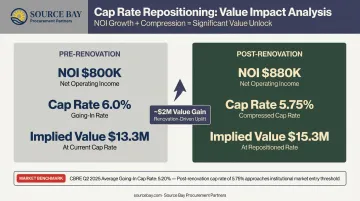
CBRE reported in Q2 2025 that going-in cap rates for value-add multifamily assets averaged 5.20% — a useful benchmark when underwriting exit assumptions. That market context also shapes how the ROI math compares across different renovation strategies.
Common Area ROI vs. Unit Renovation ROI
Unit renovations produce a direct, measurable per-unit rent premium that's easy to underwrite. Common area renovations produce a portfolio-wide lift through occupancy and retention — harder to isolate on a per-space basis, but the occupancy and retention data show up clearly at the asset level.
Avoid over-improving relative to your submarket. Renovation scope should be calibrated to the competitive set within a 2–3 mile radius. A Class A amenity package in a Class B or C submarket will not recover the investment through rents or asset value. Tour comparable properties before finalizing scope.
Best Practices for Planning and Executing Common Area Renovations
Phase the Work to Protect Resident Experience
Renovating common areas in an occupied building requires sequencing that maintains partial resident access throughout. Key principles:
- Never close the lobby and fitness center simultaneously — stagger interior renovations by space
- Schedule outdoor work during off-peak seasons when resident use is lower
- Notify residents at least 30 days before work begins, with regular progress updates throughout
Resident goodwill during renovation directly affects renewal decisions. Properties that communicate proactively retain residents through construction disruptions; those that go quiet tend to lose them. Multifamily Executive noted in 2024 that resident communication now spans email, text, resident apps, and in-person interaction — use multiple channels.
Specify for Durability, Not Just Aesthetics
Common areas are not residential spaces. Furniture, flooring, and fixtures specified for shared residential environments must meet commercial durability standards: higher rub counts on textiles, commercial-grade frame construction, cleaning protocol compatibility, and appropriate warranty coverage.
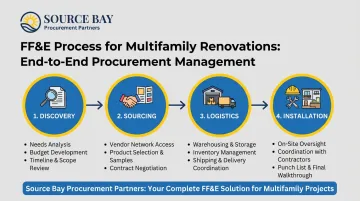
Source Bay Procurement Partners manages FF&E procurement for multifamily common area projects with this specifically in mind. Their services cover:
- Vendor relationships across a global manufacturer network
- Sequenced warehousing aligned to renovation phasing
- Freight logistics and on-site installation oversight
- A four-phase process (Discovery, Sourcing, Logistics, Installation) built to prevent the FF&E delays that most commonly derail renovation timelines
Through their partnership with Neuco Furniture & Upholstery, they can also extend the lifecycle of existing commercial furniture rather than replacing it outright — a practical way to reduce costs for property owners managing renovations across multiple spaces.
Validate Scope Against Market Research Before Committing Capital
Three inputs should drive renovation scope decisions before committing capital:
- Resident survey — Ask current residents what improvements matter most; this prevents investing in amenities residents don't value
- Competitive property tour — Walk the 2–3 nearest comparable properties to identify specific gaps
- Rental comp analysis — Confirm the property has pricing headroom to absorb the renovation cost through improved rents or reduced vacancy
Skipping this step is how over-improvement happens. The renovations that generate ROI are the ones that close a specific competitive gap — not the ones that simply look impressive.
Frequently Asked Questions
How much does it cost to renovate a multifamily common area?
Common area costs are budgeted per project or per square foot — not per unit like individual apartment renovations. Cosmetic refreshes typically run $15–$40 per square foot; full gut renovations can reach $75–$150+ depending on space type, market, and finishes. Build from line-item estimates with local contractors and apply a 10–20% contingency based on building age.
Which common area renovations offer the best ROI in multifamily properties?
Lobbies and entry experiences, fitness centers, and outdoor social spaces (pool surrounds, BBQ areas) consistently rank as the highest-ROI investments. Every prospect walks through these spaces during a leasing tour, and residents use them daily — giving upgrades here the broadest impact on both occupancy and retention.
How do you renovate common areas without disrupting residents?
Phase the work by space so residents always have access to at least partial amenities. Schedule noisy trades during business hours, communicate the full timeline at least 30 days in advance, and maintain alternative access to essentials like mail during construction.
How long does a multifamily common area renovation typically take?
Cosmetic refreshes (paint, lighting, furniture) typically take 2–4 weeks per space; full gut renovations run 6–12 weeks. Outdoor projects generally land in the 4–8 week range, weather permitting. FF&E lead times run separately and should be initiated well before construction begins.
How do common area upgrades affect rent premiums and property value?
Common area upgrades support rent premiums by allowing the property to compete with newer supply, improving retention, and reducing the vacancy loss that erodes NOI. On the valuation side, NOI improvement combined with favorable cap rate repositioning can amplify total value creation well beyond what the rent numbers alone would suggest.