Introduction
A hotel can be structurally complete and still months away from opening. The gap between a finished building and a guest-ready property is filled — or missed — by FF&E procurement: the process of sourcing, specifying, purchasing, and delivering every piece of movable furniture, fixture, and equipment the property needs to operate.
For developers, owners, and project managers, the stakes are concrete. Brand standards, guest experience requirements, hard construction deadlines, and supply chains crossing multiple continents all converge on a single delivery window. A missed lead time or a late spec change doesn't just delay a shipment. It pushes an opening date, triggers penalty clauses, and erodes projected returns.
This guide covers what hotel FF&E includes, why procurement in hospitality is more complex than it appears, how the process works from planning through installation, and which decisions most often determine whether a project opens on time and on budget.
Key Takeaways
- Hotel FF&E covers all movable furnishings, fixtures, window treatments, and guest-facing equipment (nothing permanently attached to the building)
- FF&E procurement spans design coordination, vendor management, freight logistics, and brand compliance — far beyond simple purchasing
- Lead times for custom items range from 12 weeks for domestic casegoods to 20+ weeks for outdoor furniture, making early planning non-negotiable
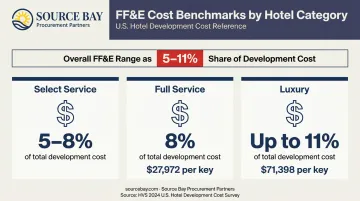
- FF&E typically represents 5–11% of total hotel development cost, with full-service hotels averaging $27,972 per key
- A specialist procurement partner protects budget and timeline by owning the gaps no single internal party covers
What Is Hotel FF&E?
FF&E stands for Furniture, Fixtures, and Equipment — all tangible, movable assets used in hotel operations that are not permanently attached to the building structure.
The Three Categories
Furniture covers the primary functional and aesthetic elements guests interact with daily:
- Guest room beds, nightstands, dressers, desks, and media consoles
- Lobby sofas, armchairs, and coffee tables
- Restaurant and F&B seating and tables
- Case goods throughout guestrooms and suites
Fixtures shape the character of each space and include:
- Lighting: wall sconces, desk lamps, floor lamps, pendant fixtures
- Window treatments and drapery
- Bathroom accessories and mirrors
- Built-in decorative cabinetry (where movable)
Equipment covers the operational technology guests and staff rely on:
- In-room televisions and mounts
- Mini-fridges, safes, and coffee equipment
- Fitness center machines
- Business center and lobby technology
What FF&E Is Not
Two categories trip up even experienced project teams:
- OS&E (Operating Supplies and Equipment) — linens, toiletries, tableware, glassware, and uniforms. The Uniform System of Accounts for the Lodging Industry treats these separately from FF&E; items consumed within 12 months are expensed rather than capitalized.
- Base building elements — structural systems, permanent plumbing, HVAC, carpet and pad, wallcovering, and painted surfaces. These belong in the construction budget, not FF&E.
Misclassifying items across these three buckets is a reliable source of budget overruns. Establishing clear category boundaries at project kickoff prevents costly disputes between owners, contractors, and designers later.
Why Hotel FF&E Procurement Is More Complex Than It Looks
The scale alone separates hotel FF&E procurement from almost any other purchasing category. A single full-service hotel requires furnishings across dozens of distinct product categories — each sourced from different manufacturers with their own lead times, quality standards, and minimums. HVS category data confirms the breadth:
- Furniture, seating, and case goods
- Artwork, mirrors, and accessories
- Lighting and window treatments
- Bedding and textiles
- Electronics and in-room technology
Each category carries separate vendor relationships, delivery schedules, and compliance requirements to manage simultaneously.
Brand Standards Compliance
Franchised properties operating under a flag must source items that meet brand-specified dimensions, materials, and finishes. Any deviation can trigger rejection during brand inspections, requiring rework and creating timeline risk. According to Cayuga Hospitality Consultants, value engineering after a model room is complete requires brand re-approval of replacement selections — and may require new prototypes — directly threatening the renovation schedule.
Brands rarely grant exceptions after the fact. That's the risk of treating compliance as a final-stage review rather than a procurement starting point.
The Design-Procurement Coordination Gap
FF&E procurement must move in lockstep with interior design. Specifications finalized too late — or changed after purchase orders are placed — generate restocking fees, duplicate costs, and project delays. Budget overruns tied to late spec changes are largely preventable — if procurement is engaged before design is finalized, not after.
Financial Exposure
According to HVS's 2024 U.S. Hotel Development Cost Survey, FF&E represents 5–11% of total hotel development cost depending on category. Full-service hotels average 8%, or $27,972 per key. Luxury properties reach $71,398 per key. At that scale, procurement decisions carry direct consequences for asset valuation and investor returns — far beyond the scope of routine purchasing.
Logistics Complexity
Those per-key figures make the operational stakes clear. Executing on them requires infrastructure most hotel development teams don't carry in-house:
- Coordinating deliveries across multiple vendors with different lead times
- Managing warehousing and sequenced release to match construction phases
- Handling damage claims and replacement sourcing mid-project
- Overseeing final installation and punch-list resolution
This is exactly where a dedicated procurement partner earns its fee — managing the complexity so the project team can stay focused on the build.
How Hotel FF&E Procurement Works
Successful hotel FF&E procurement moves through four distinct phases: planning, specification and sourcing, ordering and production oversight, and logistics and installation. Each phase depends on the accuracy of the one before it.
Step 1: Pre-Project Planning and Budget Allocation
The project team defines FF&E scope based on hotel type, number of keys, and brand standards. A detailed budget is established that accounts for:
- Product purchase prices
- Freight (typically 5–10.5% of product cost for guestrooms, per HVS)
- Warehousing (typically 3–6.5%)
- Installation labor
- Professional fees (approximately 10% of overall budget)
- Contingency (10% for a detailed budget; 15% for a quick budget)
For new builds, procurement planning should begin well ahead of opening — the model room process alone takes 4–6 months, according to Cayuga Hospitality Consultants, and it must precede broader purchasing so substitutions can be approved before production begins.
Step 2: Vendor Sourcing and Specification
The procurement team works with the interior designer to develop a detailed specification book, then identifies qualified manufacturers, issues Requests for Quotation, evaluates samples, and finalizes the vendor matrix.
This is also where value engineering delivers its highest return. A skilled procurement team identifies alternative products that meet design intent and brand standards at a lower cost — without sacrificing durability or finish quality.
Source Bay Procurement Partners builds this discipline into the Sourcing phase of every engagement. Its global manufacturer network — including Blue Leaf Hospitality for casegoods, Schumacher and Fabricut for textiles and wallcoverings, and Remington Lighting for custom fixtures — allows the team to present alternatives across multiple price points before a single order is placed.
Step 3: Ordering, Lead Time Management, and Production Oversight
Purchase orders are placed, deposits issued, and the procurement team tracks production milestones for each order. Lead times published by Innvision illustrate the range:
| Category | Typical Lead Time |
|---|---|
| Domestic casegoods | 12–16 weeks |
| Overseas casegoods | 16–18 weeks |
| Custom upholstery | 17 weeks (most vendors) |
| Custom lighting | 16+ weeks, plus port delays |
| Window treatments | 12 weeks |
| Outdoor furniture | 20+ weeks |
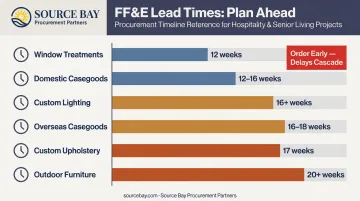
A delay at a single manufacturer can cascade across the entire installation schedule. Experienced procurement managers build lead time buffers and escalation protocols from the outset — treating contingency planning as core process, not crisis response.
Step 4: Logistics, Warehousing, and Installation Handoff
As items arrive, they are received into a sequenced warehousing program that holds product until the construction site is ready. Proper sequencing prevents three of the most common late-stage problems:
- Damage from premature on-site storage
- Theft exposure during extended holding periods
- Costly re-orders that push installation timelines
Final delivery is coordinated by room type and floor to enable efficient installation.
Source Bay's operations team — led by Paul Tomczak and Greg McKinnon — manages freight coordination, sequenced warehousing, and on-site oversight through to final project handoff. Their direct involvement at every delivery stage is what keeps complex, multi-vendor installations on schedule.
Key Factors That Affect Hotel FF&E Procurement Outcomes
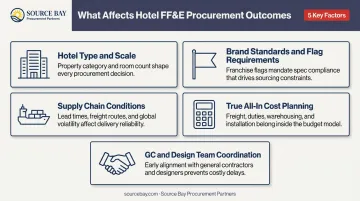
Hotel type and project scale — A 50-key boutique hotel has a fundamentally different procurement scope than a 400-key resort. Boutique projects typically involve a tighter SKU count and a more curated vendor set; resort-scale projects require more concurrent vendor relationships, phased installation logistics, and deeper coordination across the full manufacturer network.
Brand standards and flag requirements — Franchised properties must navigate proprietary approved vendor lists and mandatory product specifications. Independent properties have more design freedom but require greater specification discipline to maintain quality and consistency without brand guardrails.
Supply chain conditions — Innvision's 2023 supply chain update confirmed that lead times improved post-2022, but shipping-container shortages, port labor risk, and freight driver availability remain live variables that require active monitoring throughout production.
True all-in cost planning — FF&E budgets that account only for product prices routinely underestimate total spend. Freight, warehousing, installation labor, professional fees, and contingency can add 25–35% or more — projects that skip this math end up cutting décor or amenities to close the gap.
Coordination with the general contractor and design team — FF&E delivery must align with construction milestones; poor coordination between the procurement team, GC, and interior designer is one of the leading causes of installation delays and finish damage.
Common Mistakes in Hotel FF&E Procurement
Three mistakes account for the majority of blown FF&E budgets, delayed openings, and compromised guest experiences. Recognizing them early is the difference between a controlled procurement program and a reactive one.
Assuming someone else is handling it. Hotel owners often believe the interior designer manages FF&E procurement, or that the general contractor handles delivery and installation. In reality, designers specify FF&E — they don't manage vendor negotiation, purchase orders, freight logistics, or installation coordination. Without a dedicated procurement agent, these responsibilities fall into a gap no party fully owns, resulting in missed orders, cost overruns, and delayed openings.
Underestimating all-in costs. Teams consistently focus on product purchase prices while overlooking the full cost stack:
- Freight: 5–10.5% of product cost
- Warehousing: 3–6.5%
- Installation labor
- Professional procurement fees
The true all-in cost of FF&E delivered to the room runs substantially higher than the purchase price alone. Budgets that ignore this create shortfalls that surface at the worst possible time — during final installation.
Starting too late. FF&E procurement initiated after construction is underway compresses lead times, limits vendor options, and forces reliance on in-stock catalog items instead of custom solutions — driving up expediting costs throughout.
The model room process alone takes 4–6 months and must precede broader purchasing. The most expensive FF&E programs are consistently the ones that started late.
Conclusion
Hotel FF&E procurement shapes every guest interaction and every line of the project budget. Knowing the process is necessary — executing it without delays, cost overruns, or installation failures requires a different level of operational depth.
Most hotel developers and owners benefit from working with a specialized procurement partner who brings established manufacturer relationships, logistics infrastructure, and installation oversight built specifically for commercial hospitality projects. Source Bay Procurement Partners manages the full procurement lifecycle across four phases:
- Discovery — scope definition, budget alignment, and design intent
- Sourcing — vendor selection, specification management, and value engineering
- Logistics — freight coordination, sequenced warehousing, and delivery oversight
- Installation — on-site setup, punch list management, and final project handoff
That end-to-end coverage means fewer handoffs, fewer surprises, and a property that opens on schedule.
Frequently Asked Questions
What is included in hotel FF&E?
Hotel FF&E covers three categories of movable, non-structural assets: furniture (beds, case goods, lobby seating), fixtures (lighting, window treatments, sconces), and equipment (in-room TVs, safes, fitness machines). It does not include permanent building elements like carpet, wallcovering, or HVAC systems.
Where do hotels source their FF&E?
Hotels source FF&E through direct manufacturer relationships, hospitality trade vendors, and specialized procurement firms that manage sourcing, specification, and logistics on behalf of the owner or developer. Firms like Source Bay Procurement Partners coordinate across manufacturer categories — casegoods, textiles, lighting, and commercial sleep solutions — to consolidate sourcing under a single managed program.
What is the difference between FF&E and OS&E in hotels?
FF&E covers movable furnishings and equipment that define the guest environment. OS&E (Operating Supplies and Equipment) covers consumable and operational items like linens, tableware, and toiletries. Misclassifying items between the two categories is a common source of budget error in hotel project accounting.
How much does hotel FF&E procurement typically cost?
FF&E represents 5–11% of total hotel development cost, depending on hotel category. Full-service hotels average $27,972 per key; luxury properties average $71,398 per key. The all-in cost must include freight, warehousing, installation, contingency, and professional fees — not just product purchase prices.
When should hotel FF&E procurement begin?
Procurement planning should begin at least 4–6 months before broader purchasing starts, allowing time to complete the model room process. Vendor selection and specifications must be locked in well before opening — custom categories like overseas casegoods and outdoor furniture carry lead times of 16–20+ weeks.
Do hotels need a dedicated FF&E procurement firm?
For most hotel projects, yes. Interior designers specify FF&E but don't typically manage vendor negotiation, purchase orders, freight logistics, or installation coordination. A dedicated procurement specialist handles the complete program from specification through on-site handoff, ensuring design intent survives the delivery process.