Introduction
Most restaurant operators approach FF&E the same way they approach ordering linens — as a purchasing task. Pick items, place orders, wait for delivery.
The reality is more complicated. That gap between assumption and execution is where openings get delayed, budgets unravel, and spaces that looked great on a rendering fall apart under actual service pressure.
FF&E procurement is a coordinated, multi-phase process. Decisions made in week two — around specifications, lead times, and vendor selection — directly shape what happens on installation day, months later. Get those early decisions wrong and you're not just dealing with a furniture problem. You're looking at a delayed opening, a contractor crew standing idle, and a launch event you've already sold tickets to.
This guide is written for restaurant operators, owners, and project managers who want to understand how FF&E procurement actually works — from scope definition through final installation — so they can make the decisions that keep a project on time and within budget.
Key Takeaways
- FF&E (Furniture, Fixtures & Equipment) covers all movable, non-structural items that make a restaurant functional and guest-ready
- Procurement is a four-phase process: scope and scheduling, specification and sourcing, order management, and delivery with installation
- Lead times, budget alignment, and concept-to-specification accuracy are the three variables that most often derail projects
- Specification and timing errors made early don't stay contained — they escalate into costly delays and rework at installation
- Working with a specialist procurement partner keeps timelines intact and ensures the original design vision survives the ordering and delivery process
What Is Restaurant FF&E Procurement?
Defining FF&E
FF&E refers to all movable, non-permanently attached items that make a restaurant space functional and guest-ready — distinct from structural or built-in elements like plumbing, fixed millwork, or walls.
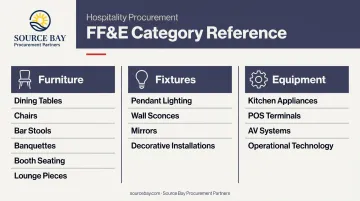
In a restaurant context, FF&E spans three categories:
- Furniture — dining tables, chairs, bar stools, banquettes, booth seating, lounge pieces
- Fixtures — pendant lighting, wall sconces, mirrors, decorative installations
- Equipment — kitchen appliances, POS terminals, AV systems, operational technology
Procurement covers the full coordinated process: specifying every item, sourcing qualified vendors, placing and tracking orders, receiving and inspecting deliveries, managing storage, and overseeing installation. Each phase depends on the one before it.
FF&E vs. OS&E — A Critical Distinction
FF&E items are capital assets designed for multi-year use. OS&E (Operating Supplies & Equipment) covers consumable, frequently replenished items — dinnerware, linens, smallwares, cleaning supplies.
Mixing these up creates two practical problems:
- Capital expenditures and operational expenses get misallocated in the budget
- OS&E and FF&E operate on fundamentally different sourcing timelines, creating scheduling conflicts
An operator who confuses the two often discovers that the FF&E timeline has been compressed while OS&E was prioritized — a sequencing error that leads to delayed openings, rushed installations, or rooms that aren't ready for guests.
Why FF&E Procurement Is Critical for Restaurant Operators
Guest Experience Is Built on FF&E
The physical environment of a restaurant directly shapes how guests perceive quality, comfort, and brand. A 2025 peer-reviewed study of 305 upscale restaurant guests found that physical environment dimensions explained 61.6% of customer satisfaction variance, with facility aesthetics, ambiance, and lighting each carrying independent effects. That same satisfaction explained 60.4% of loyalty variance.
Seating ergonomics matter just as specifically. A 2019 study found that comfortable chairs scored 4.76 versus 3.49 for stools — a statistically significant gap that translated directly into perceived hospitality quality.
Table spacing produces measurable consequences too. Cornell research found that 70% of diners would request reseating at tables only six inches apart, with stress scores climbing as spacing tightened. Floor plan density decisions made during FF&E specification directly affect the guest experience that follows.
Operational Performance Depends on FF&E Choices
Poor FF&E decisions slow operations in ways that compound over time. Common specification errors include:
- Chair heights mismatched to table depths, disrupting guest comfort and turnover pace
- Bar counter clearances that crowd bartenders during peak service
- Aisle widths too narrow to support efficient service flow
Each of these reduces table turnover and revenue per cover — not occasionally, but on every shift.
Lead Times Can Break Your Opening Date
The operational risks above are compounded by another planning reality: lead times. Custom and imported FF&E items carry production windows that routinely stretch 12 to 18+ weeks — validated by manufacturer data from Bernhardt Hospitality (12–14 weeks for custom casegoods and upholstery) and Innvision (12–16 weeks domestic, 16–18 weeks for overseas production). That timeline begins after a purchase order is confirmed, not after you decide you need furniture.
Operators who treat FF&E as something to address after construction begins are, by definition, starting too late for any custom or imported items. The consequence is a delayed opening — which means deferred revenue, missed pre-sold events, and ongoing lease costs accumulating against a venue that isn't yet generating income.
Commercial Grade vs. Residential Grade
Restaurant environments subject furniture to daily heavy use, cleaning chemicals, spills, and high guest turnover. The difference between commercial-grade and residential-grade specifications is substantial:
- Upholstery durability — commercial high-traffic woven fabrics require 30,000 Wyzenbeek double rubs or 40,000 Martindale cycles per ACT standards; residential fabrics rarely approach this threshold
- Frame construction — commercial seating is tested to ANSI/BIFMA X5.4 standards for public-space load and structural performance
- Weight capacity — contract-grade seating often supports 350–500+ lbs versus 200–250 lbs for typical residential products
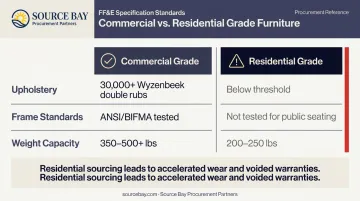
Operators who source from retail suppliers to save money upfront frequently face accelerated wear, voided warranties, and replacement costs that quickly exceed any initial savings.
How the Restaurant FF&E Procurement Process Works
Step 1: Define Scope and Build Your FF&E Schedule
Procurement starts with a comprehensive FF&E schedule — a master document listing every required item organized by zone (dining room, bar, host area, patio, private dining, back-of-house), with quantities, target specifications, and budget brackets.
This schedule is the operational backbone of the entire process. Gaps here don't stay contained — they generate cascading problems downstream, from mis-specified orders to missing items discovered on installation day.
Step 2: Specify, Source, and Approve
The specification phase defines materials, finishes, dimensions, commercial-grade ratings, and aesthetic requirements for each item — before approaching vendors. Three priorities govern this phase:
- All approvals from the design team, ownership, and operators must be locked before orders are placed
- Late-stage spec changes after ordering are among the most reliable sources of cost overruns in restaurant FF&E projects
- Value engineering decisions — blending custom and standard pieces, selecting materials that deliver the aesthetic at a lower cost — are made here, not after
Working with a procurement specialist that maintains direct relationships with manufacturers — Source Bay partners with Blue Leaf Hospitality, Kellex Furniture, Remington Lighting, and 100+ others — gives operators better pricing, faster lead times, and more finish options than independent sourcing typically delivers.
Step 3: Manage Purchase Orders, Lead Times, and Receiving
Purchase orders must be tracked against confirmed lead times with buffer built in for production delays — especially on custom pieces. Every delivery must be inspected against the FF&E schedule and purchase order for:
- Quantity accuracy
- Specification compliance (finish, dimensions, grade)
- Transit damage
Items arriving before the site is ready require coordinated, climate-controlled warehousing. Inadequate storage causes finish damage, upholstery compression, and structural issues that generate expensive replacement orders right before installation, at the worst possible moment in the project timeline.
The solution is sequenced warehousing — holding items until the construction phase is ready to receive them, then aligning freight delivery with site milestones. Source Bay's logistics model is built around this approach, releasing items in coordinated waves rather than all at once.
Step 4: Coordinate Delivery, Installation, and Final Handoff
Delivery must be sequenced to align with construction milestones. Items delivered too early create staging conflicts on an active site; items delivered late stall installation crews and push opening dates.
Professional FF&E installation involves:
- Assembly per manufacturer specifications
- Precise placement per approved design drawings
- Integration with electrical or AV infrastructure where required
- Debris removal and site clearing
- Final walkthrough verifying every item against the original FF&E schedule
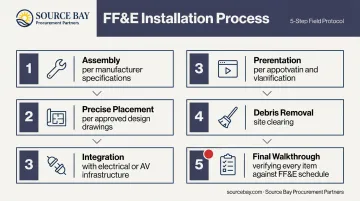
The final walkthrough isn't a formality. It's where specification compliance is confirmed and the project is formally handed off to the operator — a structured close, not a casual check.
Common Mistakes Operators Make in Restaurant FF&E Procurement
Starting Too Late
The most frequent and costly mistake. Many operators treat FF&E as a task that begins after the lease is signed and construction is underway. For any custom or imported items, that timing is already too late.
Procurement — particularly the specification and sourcing phases — must begin concurrently with design development. When it doesn't, the choice becomes unavoidable: delay the opening or accept substitutions that compromise the design.
Confusing Residential-Grade with Commercial-Grade
Sourcing furniture from retail or residential suppliers rather than commercial hospitality vendors is a false economy. Key differences operators miss:
- Frame construction — commercial frames are tested to ANSI/BIFMA public-seating standards; residential frames are not
- Upholstery ratings — commercial high-traffic fabric requires 30,000+ Wyzenbeek double rubs; most retail upholstery falls well short
- Warranty coverage — commercial warranties are voided when products are used outside their intended application, which residential furniture in a restaurant environment typically triggers immediately
Accelerated wear and premature replacement erase any upfront savings — often within the first year of service.
Treating FF&E as a One-Time Purchase
FF&E is a capital asset with a defined lifecycle — one that requires active management across multiple replacement cycles. Operators who skip procurement records and asset tracking end up facing unplanned capital expenditure instead of predictable, budgeted refresh schedules.
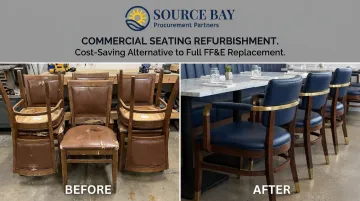
The practical alternative: maintain complete procurement documentation, track asset condition over time, and plan periodic refurbishment — particularly for upholstery and high-contact surfaces.
Source Bay's partnership with Neuco Furniture & Upholstery makes this straightforward. Commercial reupholstery and frame restoration bring seating back to hospitality-grade finish at 40–70% savings versus full replacement — a meaningful lever for operators managing tight margins across multiple locations.
Frequently Asked Questions
What is FF&E in a restaurant?
FF&E covers all movable, non-structural items that make a restaurant functional and guest-ready: furniture (tables, chairs, seating), fixtures (lighting, mirrors, décor), and equipment (appliances, POS systems). None of these are permanently built into the structure, which is what distinguishes them from construction elements.
What is the difference between OS&E and FF&E?
FF&E items are long-life capital assets (furniture, fixtures, equipment) replaced every several years. OS&E (Operating Supplies & Equipment) covers consumable and frequently replenished operational items like dinnerware, linens, and smallwares — each requiring different procurement timelines and budget categories.
How is FF&E different from furniture?
Furniture is one category within FF&E. The broader term also encompasses fixtures (lighting, mirrors, decorative elements) and equipment (appliances, technology, operational machinery), all of which must be specified and procured as part of a restaurant project.
How long does restaurant FF&E procurement take?
Budget at least 4 to 6 months for the full procurement cycle. Custom or imported pieces can carry individual production windows of 12 to 18+ weeks, so procurement must start concurrently with design development, not after construction begins.
How much should a restaurant budget for FF&E?
FF&E budgets vary significantly by concept type, scale, and the proportion of custom items. No universal percentage applies across QSR, full-service, and fine dining. Build a scoped FF&E schedule for your specific project — one that accounts for quantities, specifications, freight, installation, and contingency from the start.
Can restaurant operators manage FF&E procurement without a specialist?
Smaller projects with standard, off-the-shelf items can sometimes be self-managed. Projects involving custom specs, multiple vendors, or tight timelines carry real risk without specialist coordination. Lead time mismanagement, freight sequencing errors, and installation missteps compound fast as opening day approaches.