Introduction
Commercial interior designers don't just pick furniture—they manage supply chains. Across a single hospitality or senior living project, a designer might coordinate dozens of vendors, track hundreds of line items, navigate 12–16 week lead times for custom pieces, and still hit a hard opening date.
Knowing where to find a great sofa is easy. The harder work is building the vendor ecosystem, documentation practices, and logistics infrastructure to deliver 200 rooms on schedule.
This guide covers the sourcing channels commercial designers rely on, why trade access matters beyond the discount, how to structure the FF&E procurement process, and when handing off to a specialist partner makes more sense than managing it yourself.
Key Takeaways
- Trade-only showrooms, direct manufacturer accounts, and design markets unlock products, pricing, and compliance documentation retail can't provide
- Commercial FF&E specs must address durability ratings, fire standards, and finish codes—not just aesthetics
- Custom contract-grade furniture can carry lead times of 12–16 weeks domestic and longer for overseas orders—start early
- Procurement software (Studio Designer, Specsources, Programa) tracks POs, lead times, and budgets across complex projects
- A dedicated procurement partner protects your timeline and margins when project scale outgrows in-house capacity
Where Commercial Designers Source Furniture: A Channel-by-Channel Breakdown
Professional designers work from a curated sourcing ecosystem—not a single vendor catalog. For commercial projects in hospitality, senior living, or multi-family, that ecosystem leans heavily toward trade-only and contract-grade channels.
Trade-Only Showrooms and Design Centers
Trade showrooms housed inside major U.S. design centers offer product lines unavailable to the public, dedicated sales reps, material samples, and custom ordering capabilities. They're also where you verify commercial durability ratings and fire compliance before specifying anything.
Key design centers across the country include:
- DCOTA – 1855 Griffin Road, Dania Beach, FL
- Pacific Design Center – 8687 Melrose Avenue, West Hollywood, CA
- THE MART – 222 Merchandise Mart Plaza, Chicago, IL
- ADAC – 351 Peachtree Hills Avenue NE, Atlanta, GA
- New York Design Center (NYDC) – 200 Lexington Avenue, New York, NY
- San Francisco Design Center – Two Henry Adams Street, San Francisco, CA
Access isn't automatic. Las Vegas Market requires registration limited to verified trade professionals, and vendors like Kravet request Federal Tax ID, D&B numbers, trade references, and resale documentation before opening an account.
Direct Manufacturer Accounts
Going direct with manufacturers unlocks advantages a showroom can't match:
- Custom dimensions tailored to project specs
- COM (customer's own material) options for full upholstery control
- Bulk pricing and structured lead time agreements
- Direct claims resolution without a middleman
For large commercial orders, those manufacturer relationships also translate to faster turnarounds when schedules tighten.
COM—fabric selected by the designer from outside the manufacturer's standard line—requires its own approval workflow. ACT notes that COM may need additional testing and special handling, so build that into your schedule and spec documentation.
Design Markets and Trade Fairs
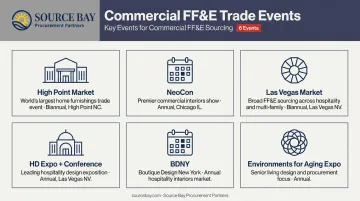
Industry events are where you discover new vendors, compare quality in person, and negotiate show pricing before product reaches the broader market. For commercial-focused designers, these events matter:
- High Point Market – 11.5 million sq. ft. of showroom space, ~75,000 attendees per market, held twice annually
- NeoCon – The leading commercial interior design event since 1969, held at THE MART in Chicago
- Las Vegas Market – Biannual, serving residential, commercial, and hospitality designers year-round
- HD Expo + Conference – Hospitality-focused, held in Las Vegas
- BDNY – Boutique and lifestyle hospitality design, annual
- Environments for Aging Conference + Expo – Senior living and long-term care design
Custom Fabrication and Artisan Networks
Some projects outgrow what off-the-shelf lines can deliver—unusual dimensions, proprietary upholstery specs, or contract-grade requirements that standard product simply won't meet. Custom fabrication fills that gap.
Custom commercial upholstery typically runs 6–10 weeks depending on project size. Hospitality case goods can stretch to 12–16 weeks domestic or 16–18 weeks overseas. Loop in fabricators early—these lead times don't compress once a construction timeline is locked.
Trade vs. Retail: Why Commercial Designers Go Trade-Only
For commercial projects, retail sourcing creates risks that scale badly. With a single residential install, an inconsistent freight experience is annoying. Across 200 hotel rooms, it's a project-threatening problem.
The core issues with retail channels for commercial work:
- No commercial-grade documentation – Retail products rarely carry BIFMA performance data, ACT textile ratings, or fire compliance certifications
- No customization path – Standard retail dimensions, finishes, and fabrics don't accommodate COM workflows or spec-driven modifications
- No freight control – Retail shipping isn't designed for consolidated commercial deliveries or sequenced installation schedules
- No claims infrastructure – When something arrives damaged on order 47 of 200, you need a direct manufacturer contact, not a consumer returns process
The stronger argument for trade isn't the pricing—it's the documentation. BIFMA frames commercial furniture standards around comfort, safety, sustainability, and durability. For upholstery, ACT's performance guidelines specify 30,000 double rubs Wyzenbeek (or 40,000 Martindale cycles) for high-traffic/public spaces. Without those certifications on file, specs fail at review—and substitutions get forced at the worst possible point in the schedule.
Documentation is only part of the equation. Trade accounts also deliver the service infrastructure that keeps projects moving: dedicated CSR contacts, manufacturer rep access, established warranty processes, and the ability to expedite or track shipments when construction timelines compress.
The Commercial FF&E Sourcing Process: From Specs to Installation
Residential sourcing is relatively forgiving. Commercial FF&E—especially for hospitality or senior living—demands a document-driven, structured process. Here's how it actually flows.
Develop Detailed Product Specifications
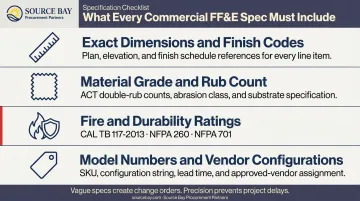
Vague specs are expensive. Commercial specifications must include:
- Exact dimensions and finish codes
- Material grade and upholstery rub counts
- Fire and durability ratings (CAL TB 117-2013 for smolder resistance, NFPA 260 for cigarette ignition, NFPA 701 for textile flame propagation where required)
- Model numbers and vendor confirmation of available configurations
One poorly written spec creates change orders, reorder delays, and installation rework. On a 150-room project, that cost multiplies fast.
Issue and Track Purchase Orders
A well-structured commercial PO includes:
- Item description and quantity
- Unit price and vendor confirmation number
- Lead time and delivery address
- Any custom fabrication or finish notes
Tracking POs against vendor confirmations prevents billing discrepancies and catches delivery errors before they reach the job site.
Coordinate Freight and Receiving
Commercial freight is operationally complex. Key decisions include:
- Consolidate shipments to reduce freight costs, but plan for warehouse staging time
- Stage receiving before the installation window opens — furniture sitting on an active construction site gets damaged
- Schedule white-glove delivery for high-end or fragile pieces going directly into finished spaces
Source Bay Procurement Partners handles freight coordination and sequenced warehousing as part of their full-service procurement model, managing carrier relationships so designers aren't juggling logistics alongside spec work.
Inspect, Install, and Hand Off
Final-mile execution matters more than most designers anticipate. Inspect all units for damage upon delivery, coordinate installation against the design plan, and walk the space before handoff. On commercial projects, damaged or incorrect items must be identified and resolved before the property opens — not discovered during a client walk-through.
Essential Tools and Resources for Procurement Management
Tracking PO status, vendor contacts, lead times, and budget allocations across a commercial project requires more than a shared spreadsheet.
Widely used platforms in commercial FF&E include:
- Studio Designer – Product sourcing, project management, ordering, invoicing, and a catalog of 300K+ products
- Specsources – FF&E spec software supporting product selections, finish details, vendor notes, purchase orders, vendor bids, approvals, and budget reports
- Programa – Specifications, product library, procurement, orders, shipping, delivery, installation tracking, and invoicing in one platform
- Mydoma – Project management, product sourcing, proposals, POs, and payments, used by 20,000+ designers
Two physical assets also pay dividends across projects:
- Vendor library – A documented database of vetted suppliers with notes on quality, lead times, specialty categories, and preferred contacts. Each project you complete strengthens it for the next one.
- Sample and specification library – Physical swatches, finish samples, and spec sheets on hand speed up client approvals and cut the back-and-forth that stalls procurement on large installs.
Best Practices for Building a Reliable Sourcing Toolkit
These four practices consistently separate commercial projects that stay on schedule from those that spiral into delays and disputes.
Start procurement before you think you need to. Custom contract-grade lead times of 12–16 weeks are common. Late sourcing decisions create cascading delays—installation windows pushed past construction completion, rushed freight decisions, and storage costs that weren't in the budget.
Vet vendors before a project requires them. A vendor who performs well on a residential job may not have the capacity or infrastructure for a 200-room hotel installation. Before the project starts, evaluate each vendor against four criteria:
- Quality consistency across large production runs
- Claims handling process and responsiveness
- Commercial certifications relevant to your project type
- Financial stability to sustain a multi-month contract
Get everything in writing. Client sign-offs on finishes, vendor confirmations of specs, documented change orders when anything shifts—undocumented changes are the fastest path to budget overruns and client disputes on commercial projects.
Consolidate orders where possible. Multiple items from the same vendor reduce freight costs, simplify receiving coordination, and often unlock better pricing. Volume consolidation also builds leverage as a repeat buyer with key vendors.
When to Work With an FF&E Procurement Partner
At a certain project scale, managing procurement in-house stops being efficient and starts consuming design hours that belong in creative direction.
The scenarios where in-house management becomes a liability:
- Projects with hundreds of FF&E line items across dozens of vendors
- Tight construction timelines with no buffer for sourcing delays
- Multi-property or international sourcing requirements
- No dedicated procurement staff on the design team
A dedicated FF&E procurement firm becomes the single point of accountability between the design team and the supply chain. That means taking on:
- Vendor relationship management and PO issuance and tracking
- Freight coordination and sequenced warehousing
- Delivery oversight and installation management
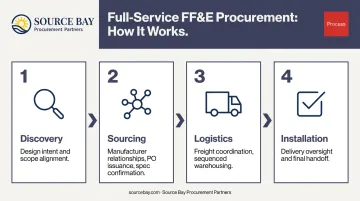
Source Bay Procurement Partners provides this full-service model for commercial projects, backed by a global manufacturer network that includes Blue Leaf Hospitality (case goods and upholstered furniture), Kellex Furniture (senior living seating), Schumacher and Fabricut (textiles and wallcoverings), and Remington Lighting (custom fixtures). Their four-phase process—Discovery, Sourcing, Logistics, Installation—lets designers hand off execution after locking in design intent, staying informed without managing the details.
When evaluating procurement partners, look for:
- Depth of direct manufacturer relationships
- Demonstrated experience in your specific project type (hospitality, senior living, multi-family)
- Logistics capabilities including sequenced warehousing
- Clear process for handling claims and timeline exceptions
Frequently Asked Questions
How do interior designers source furniture?
Professional designers use trade-only showrooms, direct manufacturer accounts, design markets, and custom fabrication networks rather than retail channels. This unlocks exclusive product lines, commercial-grade specifications, and professional pricing unavailable through standard retail.
How much do interior designers charge for sourcing?
Sourcing fees vary by model: flat procurement fee, product markup above trade pricing, or hourly billing for sourcing time. Project scale, scope complexity, and who manages execution typically drive which model makes the most sense.
What is the difference between furniture sourcing and FF&E procurement?
Sourcing refers to finding and selecting appropriate products. FF&E procurement covers the full process: specification development, vendor negotiation, purchase order issuance, delivery coordination, and final installation.
What are trade-only showrooms and how do designers get access?
Trade-only showrooms are exclusive to credentialed design professionals, typically requiring proof of business licensure, Federal Tax ID, and professional status. They offer deeper product lines, custom ordering, and professional pricing not available to the public.
How do interior designers manage procurement for large commercial projects?
Large commercial projects require structured PO tracking, detailed specifications, coordinated freight staging, and either dedicated procurement software or a specialist procurement partner to keep timelines and budgets on track.
What should designers look for when vetting a new furniture vendor?
Assess quality consistency, commercial certifications (BIFMA, ACT ratings, applicable fire codes), lead time reliability, and claims handling. Verify the vendor has handled projects of similar scale and type before committing to a large engagement.