Introduction
Hotel developers, senior living operators, and hospitality designers face a consistent challenge: specifying furniture that survives years of punishing daily use, satisfies commercial safety codes, and still looks like it belongs in a thoughtfully designed space. Get the fabrication wrong and you're replacing chairs in year three of a fifteen-year asset cycle.
That gap — between furniture that looks right and furniture that performs right — is where contract-grade fabrication matters. The term "contract" comes from the formal agreements drawn between commercial operators and specialized manufacturers. The category has always carried a specific meaning: furniture built to commercial standards, not residential ones.
This guide covers what separates contract-grade pieces from their residential counterparts, the construction methods and materials that define quality, and the certifications procurement teams need to understand. It ends with a practical framework for choosing the right fabrication path for your project.
Key Takeaways
- Contract-grade furniture uses heavier-gauge materials, stronger joinery, and higher weight capacities than residential furniture — by design, not coincidence
- Fabrication choices — frame construction, foam density, abrasion ratings, finish process — directly determine lifespan in high-traffic environments
- BIFMA, CAL 117, CAL 133, and NFPA 701 certifications are non-negotiable for hospitality, healthcare, and senior living projects
- Custom, semi-custom, and catalog fabrication each offer different trade-offs between cost, lead time, and design flexibility
- Lead time management and freight sequencing matter as much as product selection for large commercial openings
What Makes Furniture "Contract-Grade"?
Contract-grade furniture is manufactured specifically for commercial environments — hotels, restaurants, offices, senior living facilities — where pieces face far greater frequency, load, and cleaning intensity than anything residential furniture encounters.
A typical residential chair is designed for light household use. A contract-grade equivalent must withstand dozens of sit-cycles daily, commercial cleaning chemicals, and users across a wide range of body types and weights — often for a decade or more without structural failure.
Residential vs. Contract-Grade: The Core Differences
The performance gap shows up clearly in the specs:
| Factor | Residential | Contract-Grade |
|---|---|---|
| Weight capacity | ~243–250 lbs | 350–600+ lbs (BIFMA X5.41) |
| Steel frame gauge | 20–22 gauge | 16–18 gauge |
| Warranty (upholstery) | 1 year (Ashley Furniture) | 5–10+ years; some lifetime coverage |
| Cleaning tolerance | Light household use | Commercial chemicals, bleach-cleanable surfaces |
| Fire certifications | Typically none | CAL 117, CAL 133, NFPA 701 |
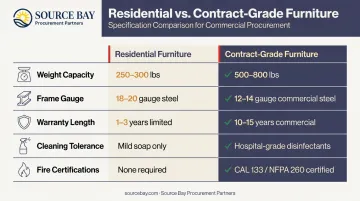
In healthcare and senior living settings, cleaning protocols are particularly aggressive — bleach-based disinfectants applied daily will degrade standard residential upholstery within six to twelve months. Contract-grade textiles and finishes are engineered specifically to survive that cycle without cracking, fading, or delaminating.
What Items Qualify as Contract-Grade?
The product range is broader than most buyers expect. For hospitality, senior living, and multi-family projects, commonly specified categories include:
- Lobby and lounge seating
- Guestroom casegoods, beds, and bedroom furniture
- Banquet chairs and event tables
- Restaurant and bar seating
- Outdoor resort and pool furniture
- Senior living seating with accessibility features (raised seat heights, sturdy armrests, removable cushions)
- Healthcare-specific pieces with antimicrobial finishes and bariatric capacity
Worth noting: contract-grade covers a spectrum of performance tiers, not a single universal standard. Furniture that meets restaurant requirements may fall short of the fire, antimicrobial, or accessibility thresholds required in a senior living dining room. Matching the specification to the environment — not just the category label — is where procurement decisions get consequential.
Contract-Grade Fabrication: Materials, Construction & Finishing Techniques
Understanding what happens during fabrication helps procurement professionals evaluate manufacturer quality and make better sourcing decisions. These are the technical factors that separate contract-grade pieces from residential alternatives.
Frame Construction and Joinery
Commercial furniture metal frames use 16–18 gauge steel, compared to the 20–22 gauge steel common in residential pieces. Heavier gauge steel resists flex and fatigue under repeated loading — a critical distinction in high-turnover settings like hotel lobbies or dining rooms. Joints should be fully welded, not bolted or glued, which eliminates the connection points most likely to fail under heavy use.
Wood frames for contract applications use hardwoods — typically oak, maple, or European beech — kiln-dried to 6–8% moisture content. Kiln-drying stabilizes the wood and prevents the warping and joint separation that occurs when moisture content fluctuates in high-humidity environments like hotel pools or restaurant kitchens.
European beech is a preferred commercial species for this reason: BFM Seating cites its strength, durability, and machining characteristics as key advantages over softer domestic alternatives.
Reinforcement at stress points — corner blocks, dowels, and metal brackets — adds structural integrity at the joints most prone to failure over years of repeated loading.
Upholstery and Foam Specification
Foam density is the primary indicator of how long cushioning will maintain its shape under repeated compression. Commercial-grade foam typically runs 1.8 lb/ft³ or higher; lower-density foam compresses and flattens significantly faster in high-use settings. Contract fabrication also incorporates flame-retardant foam cores and fire barrier layers to meet CAL 133 and similar fire codes.
Fabric selection for contract upholstery centers on abrasion resistance, measured in double rubs using the Wyzenbeek method. According to the Association for Contract Textiles, the thresholds are:
- 15,000 double rubs — low-traffic or private spaces
- 30,000 double rubs — high-traffic/public spaces (woven fabrics)
- 50,000 double rubs — high-traffic/public spaces (coated fabrics)
Beyond abrasion, contract fabrics for healthcare and senior living applications require antimicrobial finishes and moisture barriers. When clients specify COM (Customer's Own Material), the fabric must be validated against these same benchmarks before fabrication proceeds.
Finishing Processes for Durability
Wood finishing for contract furniture is a multi-stage process — MityLite's commercial workflow runs nine steps, from initial sanding through catalyzed sealer application with intermediate sanding between coats. The result is a thicker finish layer that resists scratching, moisture penetration, and the wear caused by daily housekeeping in hotel environments.
Powder coating for metal frames works through electrostatic spray deposition — charged powder particles are applied to grounded metal parts, then cured in an oven where heat triggers a chemical reaction that creates a dense, cross-linked molecular structure. The result is significantly more chip-resistant than standard paint, which matters for chair legs, table bases, and outdoor frames that take consistent physical impact.
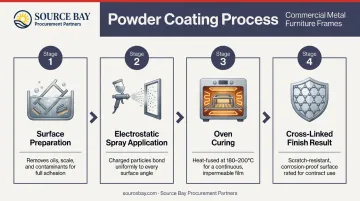
Outdoor contract furniture adds UV-resistant and rust-inhibiting treatments. Commercial outdoor pieces — like those used in resort pool areas — commonly specify powder-coated aluminum frames paired with UV-stabilized fabrics from manufacturers like Sunbrella or Dickson.
Quality Standards and Compliance Certifications
Compliance certifications provide documented proof that a product has been independently tested against minimum safety, durability, and fire standards. Non-compliant furniture creates direct liability for commercial operators — exposing them to risk with insurance carriers, licensing bodies, and building code authorities.
Key Certifications to Know
BIFMA (Business and Institutional Furniture Manufacturers Association) sets the benchmark for structural performance in North American commercial furniture. BIFMA standards cover multiple categories:
- ANSI/BIFMA X5.1 — General-purpose office and institutional seating
- ANSI/BIFMA X5.4 — Public and lounge seating (reception areas, restaurants)
- ANSI/BIFMA X5.11 — Large-occupant seating (400 lb weight basis)
- ANSI/BIFMA X5.41 — Large-occupant public/lounge seating (400 lb and 600 lb categories)
BIFMA testing also addresses cleanability through BIFMA HCF 8.1-2017, which covers healthcare furniture design guidelines — directly relevant to senior living and medical settings.
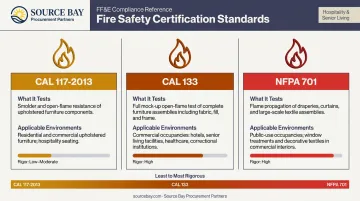
Fire safety certifications vary by environment:
- CAL 117-2013 — California's smolder-resistance standard for upholstered furniture materials (foam, fabric, barrier layers). Widely required across commercial settings.
- CAL 133 — Full-scale seating furniture flammability test for public occupancies. More rigorous than CAL 117 and commonly required in healthcare and senior living.
- NFPA 701 — Tests flame propagation of textiles and films. Applicability depends on the adopted code and authority having jurisdiction (AHJ).
ADA design considerations apply directly to senior living and healthcare seating. Per ADA Section 903, accessible benches require seat heights of 17–19 inches above finished floor and must withstand 250 lbs of vertical or horizontal force applied at any point on the seat or supporting structure.
Manufacturer Testing Protocols
Third-party certification is the floor, not the ceiling. Reputable contract manufacturers conduct in-house testing that goes well beyond what certifications require. When evaluating suppliers, request documentation for each of the following:
- In-house load testing — Verifies structural integrity under real-world weight conditions
- Cycle testing — Simulates thousands of sit/rise repetitions to assess long-term durability
- Finish durability testing — Confirms surfaces hold up to commercial cleaning protocols
- Certificates of conformance — Written documentation tied to specific test results, not just a general compliance claim
A supplier who can't produce these documents on request is a procurement risk — regardless of what their product literature says.
Industries That Rely on Contract-Grade Furniture Fabrication
Hospitality and Hotels
Hotel furniture faces a specific combination of demands: daily housekeeping cleaning, luggage impact on casegoods, and hundreds of thousands of sit-cycles across guestrooms and public areas over a ten-to-fourteen-year replacement cycle.
According to Grand View Research, the global hotel FF&E market was estimated at $63.09 billion in 2025, projected to reach $107.97 billion by 2033. That growth reflects both new development and the renovation cycles that continuously drive FF&E replacement.
Soft goods (upholstery, textiles) typically refresh on a 6–7 year cycle; full casegood renovations run 12–14 years. Every fabrication decision made at procurement affects where in that cycle a property faces its first replacement expense.
Outdoor resort and pool furniture adds weather resistance requirements: UV-stable finishes, marine-grade aluminum or stainless steel frames, and solution-dyed fabrics that won't fade under prolonged sun exposure.
Senior Living and Healthcare
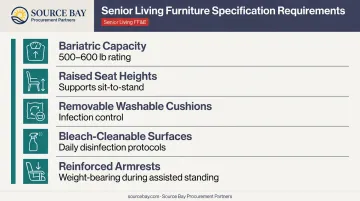
Senior living demands more specification rigor than standard hospitality. The fabrication requirements layer on top of each other:
- Bariatric capacity — KI's Affina Bariatric Chair is rated at 600 lbs; Wieland Healthcare lists a dedicated bariatric category at 500+ lbs
- Raised seat heights — Research from PMC found that residents and caregivers preferred chairs above standard recommended height to support sit-to-stand ability
- Removable and washable cushion systems for infection control
- Bleach-cleanable surfaces to withstand commercial disinfection protocols
- Sturdy armrests designed to bear weight during assisted standing, not just provide comfort
CAL 133 full-scale testing is commonly required in these environments, rather than the CAL 117 component testing that may suffice for restaurant or office settings.
Multi-Family and Commercial Spaces
Common areas, amenity spaces, and co-working zones in multi-family developments need contract-grade durability without an institutional look. Modular and reconfigurable furniture is growing in demand here for a specific reason:
- Spaces shift between resident lounge, event, and co-working functions without new procurement
- Reconfigurable pieces reduce long-term replacement costs by extending usable life
- Contract-grade construction ensures pieces hold up across varied, high-traffic use cases
Custom, Semi-Custom, and Catalog: Choosing the Right Fabrication Path
Three fabrication models serve different project needs. The right choice depends on budget, timeline, and how much design differentiation the space actually requires.
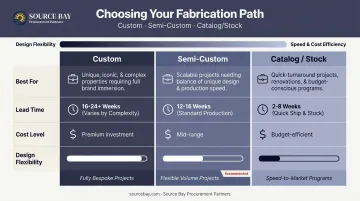
Custom fabrication builds entirely to specification — custom dimensions, materials, finishes, and COM upholstery. It offers maximum alignment with architectural intent but carries the longest lead times and highest per-unit costs. Best suited for flagship properties, luxury hotels, and branded senior living communities where design differentiation justifies the investment.
Staying within budget on custom work requires an experienced FF&E procurement partner with established manufacturer relationships. Source Bay Procurement Partners maintains those relationships through its global network, including partners like Blue Leaf Hospitality and Kellex Furniture.
Semi-custom fabrication uses a manufacturer's standard frame and construction with client-specified finishes, fabrics, and dimensional modifications. This is the most common approach for large-scale hospitality and senior living projects, balancing design flexibility with manageable lead times and cost control.
Source Bay's partnership with Neuco Furniture & Upholstery extends this further, enabling custom upholstery builds or reupholstery of existing frames as a cost-effective alternative to full replacement.
Catalog/stock pieces are off-the-shelf contract furniture with no modifications. Fastest lead times (2–6 weeks for domestic stock) and lowest cost. Useful for phased openings, supplemental seating, or spaces where design differentiation isn't the priority.
Use this as a decision framework:
| Path | Best For | Lead Time | Cost |
|---|---|---|---|
| Custom | Flagship hotels, luxury brands, senior living communities | 12–24+ weeks | Highest |
| Semi-custom | Large-scale hospitality and senior living | 8–16 weeks | Mid-range |
| Catalog/stock | Phased openings, supplemental needs | 2–6 weeks | Lowest |
Procurement and Lead Time Considerations
Lead time management is consistently underestimated in contract furniture procurement. According to ProCurist's lead time data, typical ranges break down as follows:
- Stock items: 2–6 weeks
- Domestic custom furniture: 8–16 weeks
- European imports: 12–24+ weeks
- Custom upholstery: 8–16 weeks, plus 2–4 additional weeks for COM approval
On a project with a firm opening date, the longest-lead item defines the critical path — and that item needs to be ordered first.
Sequenced warehousing matters as much as lead time management. Furniture from multiple manufacturers arrives on different schedules. Without a coordinated staging and inspection process, pieces arrive out of order, get damaged in temporary storage, or hold up installation crews waiting on a single missing item.
Source Bay's operations team — led by Paul Tomczak and Greg McKinnon — manages this end-to-end, from purchase order issuance through final installation and project closeout, providing a single accountable point of contact across a multi-manufacturer project.
Value engineering is a procurement tool most project teams don't use early enough. An experienced partner reviews specifications and identifies equivalent or superior products from alternative manufacturers that meet design intent at lower cost or with shorter lead times.
Source Bay's approach, led by Senior Designer Barbara Church, treats value engineering as a design exercise — not purely a cost exercise. Substitutions must preserve the visual and functional standards established in the Discovery phase, or they don't make the final specification.
Frequently Asked Questions
What is contract grade for furniture?
Contract-grade furniture is manufactured specifically for commercial use in high-traffic environments — hotels, restaurants, senior living facilities, and offices. It meets stricter durability, safety, and performance standards than residential furniture, using heavier-gauge materials and certified construction methods.
Is contract grade furniture good quality?
Yes. Heavier-gauge frames, certified fire ratings, and rigorously tested construction make contract-grade furniture significantly more durable than retail alternatives — built to hold up under constant daily use, not occasional residential wear.
Who makes contract grade furniture?
Contract-grade furniture is produced by specialized commercial manufacturers, not retail furniture brands. It's typically sourced through FF&E procurement firms or trade-only dealers — such as Source Bay Procurement Partners — that maintain established relationships with those manufacturers and can validate product compliance.
What is the difference between contract-grade and residential furniture?
The key differences are material gauge, construction quality, weight capacity, fire and safety certifications, finish durability, and warranty length. Residential furniture isn't engineered for commercial-frequency use — a contract-grade dining chair, for example, may carry a 500-lb weight rating and a 10-year structural warranty where a retail equivalent carries neither.
How long does contract-grade furniture last?
Warranty terms provide the clearest benchmark: Grand Rapids Chair offers 10-year structural coverage for steel seating; Global Furniture Group's commercial seating carries a lifetime warranty for standard 8-hour use and 12 years for 24/7 environments.
What certifications should contract-grade furniture have?
The most important certifications are BIFMA for structural performance, CAL 117 or CAL 133 for fire safety (CAL 133 required for higher-risk environments like healthcare and senior living), and NFPA 701 for textiles. Required certifications vary by industry and jurisdiction — always confirm requirements with the authority having jurisdiction for your specific project.