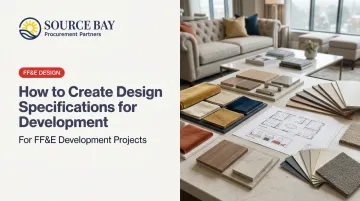
Construction quality deviations — including rework, redesign, and replacement — average 12.4% of total installed project cost, according to the Construction Industry Institute. A significant share of that figure traces back to specification failures, not field execution.
This guide covers exactly how to create FF&E design specifications for development projects: what to include, how to structure them, what determines their quality, and the mistakes that derail even well-planned projects.
Key Takeaways
- Design specifications translate design intent into precise, actionable instructions for procurement teams, contractors, and installers
- A complete spec covers functional requirements, materials, dimensions, compliance standards, and coordination notes — beyond aesthetics alone
- Specs belong at Design Development completion for budgeting and at Construction Documents for procurement
- Vague language, missing measurements, and specs written without procurement input are the most common failure points
- Engaging an FF&E procurement partner during the specification phase reduces substitutions, delays, and scope creep
What Are Design Specifications in an FF&E Development Context?
Design specifications in physical development are documented descriptions of every fixture, finish, furnishing, and equipment item to be procured and installed. They define what each item is, how it must perform, what it must look like, and how it fits into the broader project environment.
Unlike digital UX specs, FF&E specs govern tangible environments — a hotel guestroom, a senior living dining area, a multi-family amenity lounge.
Two Levels of Specifications
Commercial development projects typically use two tiers:
- Preliminary specifications — issued during Design Development to guide budgeting and procurement sourcing. Per AIA's definition of basic services, DD deliverables include outline material specifications and are used for trade-breakdown cost estimates and owner approval.
- Final construction specifications — issued at Construction Documents as the binding procurement and build-to document. AIA describes CD specs as containing comprehensive specifications and all information a contractor needs to price and build the project.
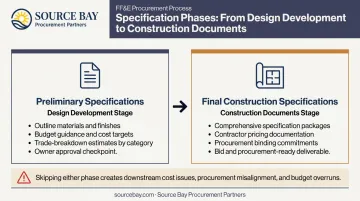
Skipping either phase creates downstream cost and coordination problems that are difficult to recover from mid-project.
Who Uses These Documents
Interior designers and architects author FF&E specs, but the audience is broader:
- FF&E procurement managers source products against them
- General contractors coordinate rough-ins and sequencing from them
- Project managers track budget and schedule against them
- Installation crews execute from them on-site
Each of these stakeholders reads the same document for a different purpose — which is why clarity, completeness, and consistent formatting matter as much as the technical content itself.
How to Create Design Specifications for Development
Step 1: Establish the Project Brief and Design Intent
Before writing a single spec entry, confirm the foundational documents exist: the design concept narrative, space-by-space programming, brand standards if applicable, and the overall project budget envelope.
Specs written without a clear brief drift in scope and miss critical constraints. The brief is the foundation every specification entry builds on — skip it, and every decision downstream becomes a guess.
Create a master list of all FF&E categories to be specified organized by space:
- Hospitality: guestrooms, corridors, lobby, dining, bar, fitness, meeting spaces
- Senior living: resident rooms, common areas, dining, memory care, outdoor
- Multi-family: lobby, amenity lounge, fitness, corridors, model unit
This master list prevents items from falling through the cracks during the specification process.
Step 2: Define Functional and Performance Requirements
For each item category, document what the product must do, not just what it must look like.
A lobby seating spec, for example, should include:
- Weight capacity
- Cleanability requirements and chemical compatibility
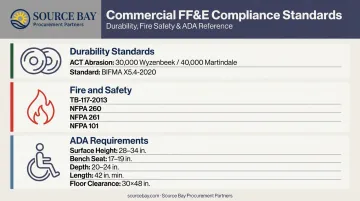
- Commercial-grade durability: ACT guidelines specify 30,000 double rubs (Wyzenbeek) or 40,000 cycles (Martindale) for high-traffic commercial spaces, with lower thresholds for private or low-traffic areas
- Public and lounge seating compliance per ANSI/BIFMA X5.4-2020(R2025)
- Stacking or mobility requirements if applicable
Fire and safety compliance must be documented before design decisions lock in:
- California TB-117-2013 and the federal SOFFA standard for upholstered furniture smolder resistance
- NFPA 260 and 261 for cigarette ignition resistance in applicable occupancies
- NFPA 101 for life safety, reviewed against the adopted code and local authority having jurisdiction
ADA requirements for senior living and applicable hospitality spaces include:
- Accessible dining/work surface tops at 28 in. minimum to 34 in. maximum above finish floor (ADA Section 226/902)
- ADA bench seat height 17–19 in., depth 20–24 in., length 42 in. minimum (Section 903)
- Clear floor space 30 in. × 48 in. minimum (Section 305)
Step 3: Specify Materials, Finishes, Products, and Dimensions
Every material and finish choice needs enough precision to allow accurate procurement without follow-up calls to the design team:
- Fabric names, colorways, vendor, and item numbers
- Finish codes for metal and wood components
- Paint colors with manufacturer name and formula reference
- Tile selections with ANSI A137.1:2022 variation class (V0–V4) noted where shade variation matters
- Stone selections with slab and dye lot notes
- Dimensions: height, width, depth, seat height, and clearances for all furniture and fixtures
For every named product, include an approved-equal clause. CSI Form 1.5C establishes that substitutions must be demonstrated as equal or superior across physical characteristics, in-service performance, expected durability, visual effect, and sustainable design features.
Be explicit about what is non-negotiable (silhouette, color family, fire rating) versus what can flex (specific manufacturer, hardware finish detail).
Step 4: Document Coordination, Installation, and Procurement Notes
Coordination notes are the step most commonly missing from specs — and the one that causes the most expensive surprises on-site.
Include:
- Electrical rough-in specs for all hardwired lighting fixtures
- Blocking requirements in walls for grab bars, hardware, and mounted case goods
- Floor load ratings for heavy case goods or equipment
- Sequencing notes for items that must be installed before others are placed
Flag long-lead items explicitly in the spec. Based on hospitality procurement data, custom lighting typically runs approximately 17 weeks, domestic casegoods 12–16 weeks, and overseas/imported casegoods 16–18 weeks.
Custom upholstery and commercial textiles require direct confirmation with the mill or manufacturer — particularly as import tariff conditions continue to affect FF&E pricing and lead times.
What to Include in a Design Specification Document
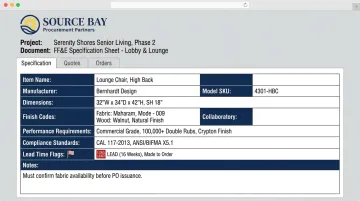
A complete FF&E spec document is organized by space or item category. Every entry should follow a standardized format.
Required Fields for Each Spec Entry
| Field | What to Document |
|---|---|
| Item name and category | e.g., "Guestroom Lounge Chair – Soft Seating" |
| Design intent description | Functional and aesthetic purpose in the space |
| Manufacturer / vendor | Primary selection with approved-equal criteria |
| Model or SKU | Specific reference number |
| Finish / colorway | With vendor codes, not descriptive language |
| Dimensions | H × W × D, seat height, clearances |
| Quantity per space | Unit count and total |
| Performance requirements | Rub count, weight capacity, BIFMA standard |
| Compliance standards | ADA section, TB-117, NFPA rating |
| Installation notes | Electrical, blocking, sequencing |
| Lead time flag | Custom vs. stock; estimated weeks |
Visual and Material References
Attach annotated finish schedules and mood boards as supporting documents. They clarify intent, but they do not replace the written spec. A procurement team working from a mood board alone will interpret color, texture, and material differently than the design team intended — and those gaps show up on installation day.
Version Control
Every spec document must include:
- Version number and issue date
- Change log tracking what was revised and when
- Distribution record noting who received which version
Verbal design updates that never enter the written spec are a leading source of procurement errors — the kind that surface when 40 guestroom chairs arrive in the wrong finish because a finish change was communicated by email but never formally documented. When a design decision changes, update the spec, issue a new version, and confirm receipt with the procurement team.
Key Factors That Affect the Quality of Design Specifications
Specificity and Measurability
The single most important quality of a spec is that every requirement can be objectively verified. Avoid language like "high-quality," "durable," or "appropriate finish." Name the standard, the measurement, or the test method.
If a requirement can't be verified during QA, it won't hold up when disputes arise — and it won't protect the project.
Early Procurement Involvement
Specs written in isolation by design teams, without input from procurement partners, often include items that are discontinued, carry prohibitive lead times, or push beyond the project budget.
Source Bay Procurement Partners' Discovery phase addresses this directly: aligning design intent with operational requirements and budget feasibility before sourcing begins. Engaging procurement early means every selection gets validated for availability, compliance, and deliverability before the design is locked.
Timing Within the Development Schedule
- Too early: Specs issued before design is resolved require costly revisions
- Too late: Specs issued after procurement should have started compress the sourcing window and increase substitution risk
The AIA framework is a reliable guide: preliminary specs at Design Development completion, final specs at Construction Documents. The window between these two phases should be used to validate long-lead selections, confirm budget alignment, and resolve any compliance gaps.
Common Mistakes When Creating Design Specifications
Writing Vague or Unmeasurable Requirements
"Comfortable seating" and "neutral palette" are not specifications. They are design aspirations. Every requirement must be specific enough that a contractor, manufacturer, or installer can verify compliance without calling the design team for clarification. If a requirement can't be measured or verified on-site, it isn't a specification — it's a wish.
Failing to Update Specs After Design Changes
Design evolves throughout a development project. Spec documents often don't evolve with it. When the design file diverges from the issued spec, procurement teams work from outdated information — and the discrepancy typically surfaces at installation, not before.
A formal change management process prevents this. When any design revision affects a procured item:
- Issue a spec revision with a version number and date
- Update all affected line items in the procurement schedule
- Notify relevant stakeholders before sourcing continues
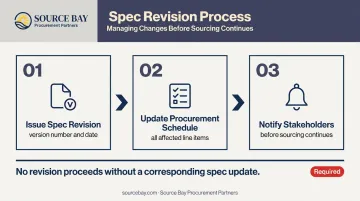
No revision should proceed without a corresponding spec update.
Ignoring Lead Times During Specification
Specifying a custom fixture with a 17-week lead time on a project with a 12-week procurement window is a spec failure — not a procurement failure. Realistic lead time planning belongs in the specification phase, not the sourcing phase.
On compressed schedules, the spec should proactively identify stock or near-stock alternatives for high-lead-time items. Source Bay works directly with manufacturers like Remington Lighting, Kellex Furniture, and Blue Leaf Hospitality to find those alternatives early — before procurement timelines are already broken.
Frequently Asked Questions
What is an example of a design specification?
A hotel guestroom lounge chair spec might read: "Manufacturer: [Brand], Model: [SKU], seat height 18 in., Grade B COM upholstery in [Fabric Name, Colorway], TB-117-2013 compliant, BIFMA X5.4 compliant, approved equals must match silhouette and seat height." That is a specification. "A comfortable chair in a warm tone" is not.
What are the four types of specifications?
CSI defines four specifying methods: descriptive (physical characteristics, no brand named), performance (outcomes the item must achieve), reference standard (a published standard it must meet), and proprietary (a named manufacturer or product, with or without substitution allowances).
What should be included in an FF&E design specification?
Every entry should cover:
- Item name, manufacturer, and model reference
- Dimensions and quantity per space
- Materials, finishes, and vendor codes
- Performance requirements and compliance standards
- Installation or procurement coordination notes
Who is responsible for writing design specifications on a development project?
The interior designer or architect authors the specifications. The FF&E procurement manager or procurement partner reviews them for sourcing feasibility and lead time viability. The project manager confirms alignment with the construction schedule and approved budget.
How detailed should design specifications be?
Detailed enough that any qualified contractor or procurement professional can source, procure, or install the item without further clarification from the design team. Every dimension, material code, finish reference, and performance requirement should be explicitly stated.
When should design specifications be finalized?
Preliminary specs should be complete at Design Development, supporting budget validation and early sourcing conversations. Final specs are due at Construction Documents to initiate procurement. Use any gap between phases to confirm lead times, availability, and compliance.